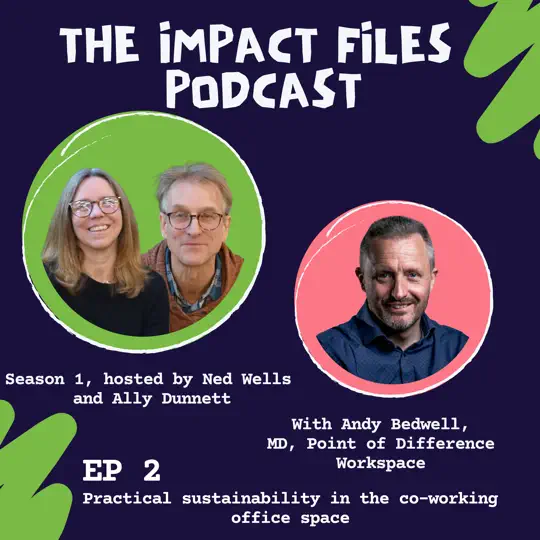
Series 1 Episode 2, Practical sustainability in the co-working office space, with Andy Bedwell.
Ned: Welcome to another episode of The Impact Files podcast. In this episode, I’m delighted to be joined by Andy Bedwell, owner and Managing Director of Point of Difference Workspace. Andy, let’s start with an introduction to yourself, to Point of Difference, and the work that you do.
Andy: Great, thank you, Ned. I’m delighted to be joining you. So we have been established as Point of Difference Workspace since 2018. We run serviced offices and co-working in Oxfordshire, Buckinghamshire, and Northamptonshire. We’ve got a base in Bicester, which is our main home, and we really specialise in providing boutique, niche, fully refurbished workspaces to small and medium-sized companies – although increasingly, post-COVID, what we’re finding is bigger companies are coming down and taking smaller spaces. So really across the business spectrum, it’s office space and co-working in Bicester, Banbury, Aylesbury, and Towcester – our main patches.
Ally: Am I right in thinking you have one more residential space that you manage too, Andy?
Andy: We have, yeah. I basically run two businesses. One is Point of Difference Workspace, which is the office and commercial base, and we also have Point of Difference Properties, which is high-quality shared housing – Bicester-based, 10 properties, around 60 tenants. It’s rooms in shared houses, fully serviced, fully refurbished – we pay all the bills and look after them, and try to create a sense of community around the people who live there. So it’s two businesses. The main focus of our conversation today has been around the office business, but there are both sides.
Ned: And if you were to give an example of a typical workspace and a typical client, what would we be looking at?
Andy: Typically we’d have a building somewhere between 5,000 and 13,000 square feet, and within that we’d divide a bigger building into smaller units – anything from an office for one person up to about 12. We have some adjoining offices where bigger teams are situated across two or three offices, but our sweet spot is around 5 to 10 people. In the bigger sites we provide reception services, and across all the sites we manage all the consumables – tea, coffee, the basics – plus heat, light, internet, maintenance, telecoms. All of that is provided as a wrap-around. And our typical building is one where we spend time and effort putting quite a nice design style around it. My corporate background was very much in offices that were soulless and horrible – you didn’t really want to be there from the moment you walked in the door. So I changed that. We try to create nice, vibrant, funky spaces – not hipster funky, just really pleasant places that a wide range of people would be happy to call home.
Ned: And to give our listeners a sense of scale – how large are you?
Andy: We turn over over a million, we’ve got 10 sites, and we’ve grown from a standing start in 2018. We’ve got 9 employees – decent, established, growing, not huge, but with a solid base.
Ned: You’ve got a really interesting history of how you came to own and manage Point of Difference. Could you give us a potted history?
Andy: Yes, sure. The overriding thing that started the journey was about me personally not trading time for money. I grew up – a long way back – on Diageo Guinness’s graduate training programme, then did a variety of logistics, supply chain, consultancy, leadership development, and change management. I ran my own consultancy business, and I always knew I wanted to run my own business at some stage. I think fairly quickly after you start down that journey, you become relatively unemployable, because you realise you can’t really work for anybody else.
I loved consultancy – it taught me a lot in terms of business growth and setup – but I reached a point where if I wasn’t working, I didn’t earn money. I needed to move into a world where I wanted to run a proper business. Property worked in that it gave me more time freedom, and other people can work in the business and manage things – which is obviously different from consultancy, where I personally needed to be involved.
The turning point was the very first buy-to-let property we had in York. I was still doing consultancy, and I rocked up with an IKEA van and an empty flat, and left a week later with a fully set-up property ready to go and rent. I liked the tangibility of property. You can touch it and feel it. That really set the direction.
Ned: And I wanted to come on to the relationship between purpose and profit for you – how has that evolved and changed over the years?
Andy: I’ve always had quite a clear sense of purpose. Even back in the consulting days, one of the first pieces of work I was offered was for a tobacco company, and I turned it down. I don’t make any judgement about people who do work for tobacco companies – I started my career with a drinks business, so you could accuse me of being hypocritical. But I think purpose is something you have to form your own view of, and what you’re prepared to live with. I’ve always been quite clear in my own head about what’s right and wrong for me, and let other people make their own judgements.
In our current world, with the office business, it’s about how we treat people – clients, the community, the environment around us. I always say to our clients: we treat people like people, not like contracts. That extends to how we make purchasing decisions – we’ll pay more for the right type of supplier rather than just going cheap. That has a profit impact, because sometimes you don’t make as much profit as you could. But I believe in the long term there’s a sustained profit impact – our client retention is pretty good, our staff retention is pretty good, we do a lot of repeat work with established contractors. It pays back in the long term on the profit angle, even though in the short term you might say we could have got more out of that client or chipped that contractor down further.
Ally: Do you see a near-term impact on revenues from your sustainability work? It sounds like you’re in it for the long haul.
Andy: Yes, that’s fair. The ROI on sustainability is a challenge – make no doubt about it. We did a lot of analysis about 18 months ago, and there’s not a lot of low-hanging fruit, and what there was wasn’t hugely impactful either on profit or on sustainability. The big stuff – solar panels, EV installations – they’re expensive, and quite often the payback would be longer than the remaining lease we have on some of our buildings. So there’s no payback in financial terms if you look at it on a cold, hard level. You have to take a decision on a different basis.
As a business, you’re always taking decisions about where to spend and where to improve. You can’t do everything at once, so every year we have a budget and we take a view on how we’re going to allocate it across various programmes – some directly sustainability, some indirectly, and some not at all.
Ally: Waste management must be a significant piece, given you’re working in the built environment?
Andy: Yes, waste on a number of levels. Right from the start we’ve tried to go zero to landfill and chose suppliers that worked that way. We do the usual things around separating out recycling. When we did our sustainability programme, we did a lot more in terms of splitting out recycling on-site, educating clients, putting up signage, and some soft – and occasionally harder – education about sorting it properly so it carries all the way through.
The challenging end has been on refurbs, where more waste is generated. We did a project where I had my son working for me, and we got the old carpet tiles completely recycled – sent them away to a supplier for recycling. That whole process was really involved: it took one person two days, an old Volvo, two loads, palletisation, partnering with a local logistics company to get it shipped. And we had to pay to do it. All we can do on a day-to-day basis is, if we’re able to make those choices, we make them. If we can’t, we try to choose the best available option.
My favourite mantra, which most of our business would know, is: do it well, do it once. Don’t buy cheap things that get thrown away. We’ll spend the extra money on proper kit. Carpet’s a good example – the lifetime of what we’re putting down will be at least 20 to 30 years, in terms of both visual appeal and wear and tear.
Ally: Have you ever seen clients come to you specifically because of what you’re doing on sustainability?
Andy: Solely for that reason – no. I can’t think of anybody who’s come to us because of that specifically. I can definitely think of clients who’ve asked us questions about what we’re doing, and who’ve chosen to work with someone that’s more ethically minded – that’s one of the criteria they use. Other criteria would sit above it in their list. But three years ago, it wasn’t even on the list. Now it’s on the list – not for every client, but for some it is. It’s getting there. I wouldn’t say it’s the primary criteria anywhere yet for us, although I think for other providers in different locations it might be more of a factor.
Ned: Am I right that you also operate the Perch workspace?
Andy: It’s worth clarifying, actually. Perch as a brand entity is owned by Cherwell District Council, who set up two sites – Perch Co-working in the centre of Bicester, and Perch Eco Centre on the outskirts. We’re the operator of the town centre site. The eco site has always had a pure eco focus, and the companies for whom that’s 100% their priority have tended to head there. We run the other Perch site along the same lines, but the building wasn’t set up from the outset to be carbon zero and BREEAM-certified in the way that site is.
Our Point of Difference brand ethos is to run by site rather than by building – you wouldn’t see Point of Difference above the door in the same way other operators might. We tend to go by site name: the Perch site, Bicester Innovation Centre, the Old Courthouse, St Edburg’s Hall. I think that’s quite important. There are different ways of doing it – you can operate as a company where your brand stands for everything across your entire estate. What we’ve chosen to do is make it important for our clients to have their own presence and their own brand within the building. What sits underneath that is the way we run the building, and if somebody asks them about sustainability initiatives, we can answer that question for them, pull the data together, and run the programmes that are impactful. I’m quite happy for them to claim those programmes as their own, because it’s in the building they’re in. I don’t need the credit for it.
Ned: Do you have people within the team whose job descriptions include sustainability?
Andy: It falls as part of my brief – I lead on the overall initiatives. It also sits in the job descriptions of probably three of our team of nine, particularly around site management, utilities, consumables management, and the way we approach clients on-site and education. It runs as a red thread through the job descriptions of those people.
About 18 months to two years ago, we had a full-time sustainability consultant with us for about six months to analyse the estate and the data around waste, utilities, consumables, suppliers, and carbon footprint. We did the base analysis, got quite a detailed plan of where we are and what the opportunities are, and from that we collectively took some decisions as a company.
Ned: What are the sustainability successes you’re most proud of?
Andy: I think for me, there isn’t one huge one. I’d love to sit here and say we did this one thing and wow, what a difference. I just don’t think that exists in our world without spending a lot of money.
We’ve done lots of smaller things. We’ve upgraded LEDs across the entire estate – partly because it’s the right thing to do, and partly because it aligns with our client experience. I don’t want our clients walking into flickering halogen sites. So the LEDs are a good decision for us for two reasons: environmental and client experience. Where you can find an environmental decision that also aligns with your corporate purpose, you’ve got two reasons to spend the money rather than one.
We’ve optimised temperatures in server rooms to avoid overcooling – that saves quite a lot of energy. We’ve done things around secondary insulation, heat protection in rooms, heat control, waste and recycling both day-to-day and on big refurb projects. We’ve chosen more recyclable and renewable materials. We’ve moved to renewable tariffs on utilities.
And some of the nicer stuff – our facilities and operations manager is a beekeeper, and he’s set up beehives outside one of our sites. We’ve got bat boxes, hedgehog boxes, bee-friendly planting, and areas left to grow. Some clients actually come across from other sites to engage with the bees.
We also work with Mr Green, a local charity – there are a number of dimensions to it, where they train people to build skills and produce bird and bat boxes, and it puts money into a local charity. So there were multiple reasons to take that decision: environmental, community, and giving back.
Ally: Any examples where something didn’t go as planned?
Andy: One we chose not to do rather than one that failed – EV charging. We surveyed clients on one of our biggest sites, the Bicester Innovation Centre. The costs weren’t huge but weren’t inconsiderable either, and we could have got grants to cover a good chunk of it. Clients said no. Out of around 70 on-site, only one originally said they’d use it. We’ve installed one dedicated charger for a specific client who wanted one, but beyond that we haven’t made that decision. You could say that’s a bit backward, but there is a carbon cost to installing EV chargers too, and based on the ones I see around Bicester that are universally empty, and what our clients told us – I’m not sure we’d have recouped the carbon cost of installation from the actual charging that would have taken place.
Instead, what we’ve done is sweep through the estate and change all the lights to LEDs, which is a similar overall cost, but has an immediate impact that will last 20 years without needing to be upgraded.
Ned: And on the grant system – I know you mentioned that’s been a frustration.
Andy: Incredibly frustrating. In 10 years, we’ve received £5,000 in grants. Literally, that’s it. We’ve replaced every LED across the estate. We’ve done things that would be eligible for half a million pounds of grants, but because we either didn’t receive them, weren’t in the right timescale, or needed to crack on before clients would wait – we’ve done most of it off our own bat. The grant system hasn’t worked for us. We’ve often been slightly ahead of the curve: we’ve planned a refurb, and then the grants come – but we can only apply if we get three quotes and wait months for approval, and in a client-driven business I can’t always say “just wait nine months while we sort this.”
Ned: And on marketing – how do you tell the sustainability story without greenwashing?
Andy: We’ve tended to use case studies and stories, talking about the journey and the purpose of what we’re on. My instinct is always to talk about it as a journey, something we’re working on. I’ve been hugely sensitive to greenwashing. If you look back at my LinkedIn posts from a couple of years ago, you’ll see I was probably talking about this a lot more than I do today. There was a momentum around it then – these initiatives we’ve described, we were doing a lot of them, and it was really clear what the next steps on that journey were.
Over time, I’ve become more conscious of not just saying, “Look at us, we’re doing this.” Because some of these initiatives are quite small in their own right – I didn’t want to be seen as that person saying, “Look, I’ve put one beehive here, aren’t I great?” In the grand scheme of things, that isn’t a huge impact on its own, even if it has to be part of the story.
We’re much more now in the space of: just tell people what we’re doing, as we’re doing it. For all the reasons I’ve talked about, it’s challenging for us to suddenly say “here’s our grand vision to 2035,” because that’s a very hard journey to plot out and then deliver on. What I don’t want to do is set a strong marketing commitment and then fail to deliver. It’s more powerful for us to be clear about what we’re going to do, do it, and then show people what we’ve done.
Ned: There’s a balance between greenwashing on one hand and green hushing on the other – and I’d challenge you slightly, because you are actually doing an awful lot.
Andy: I think that’s right. And I think we’re probably at the green hushing end of it more than anything. We could do more on that front.
Ally: Do you have any sustainability accreditation – ISO, B Corp?
Andy: We’ve looked hard at it. The consultant we had was very passionate about pushing us down the B Corp route. We did go through the B Corp assessment process offline ourselves, and it does throw out a lot of really good questions and activity that we’ve followed up on. As processes, they’re excellent – really good things for companies to work through.
But they’re not without a great deal of work and cost. I’ve taken a decision that if I’ve got that amount of effort to put into something, I’m just going to do it anyway. I don’t think people choose us or don’t choose us because we are or aren’t a B Corp. If you talk to us, if you meet our team, if you come to our sites – I think it comes through that we work pretty consistently with that ethos, as much as we can. For me, that’s good enough. I don’t want to dedicate the people or financial resource to getting the badge at this stage of our development. That’s not in any way a criticism of those things or the companies that have worked hard to achieve them – it’s just where we are right now.
Ally: What’s next for the business?
Andy: We’ve grown, and will continue to grow, at a consistent rate since we started. The next one, two, five-year plan will follow that route. We’re very building-led – we don’t just do any building. That means I can’t sit here and say we’ll have three new sites by this time next year, because if the right sites aren’t there, we just won’t do them.
A good example is the Old Courthouse on Sheep Street in Bicester – it’s a beautiful, iconic, historic building. I love it. We could have done another building in Bicester nine months ago that we didn’t feel as passionate about, and if we’d done that, we wouldn’t have done the Courthouse. If you put the two side by side, you do the Courthouse every time.
We’re trying to grow sustainably financially – we’re not heavily indebted, we have no third-party borrowings, we own and operate the business, and we’ve funded it ourselves. That means it’s difficult to suddenly triple in size in a year, unless somebody came along and waved a large cheque at us. So we’ll carry on with steady growth, building up the sites and the client base. I enjoy it – I don’t have grand ambitions to dominate the world. At the level we’re at, times two, three, or four, remains interesting and exciting.
Ned: Where do you hope your sector will be in 10 years?
Andy: I think there’s a difference between where I’d hope it’d be and where I think it might be. I would hope it develops a strong cohort of local, powerful operators who are passionate about what they do. If you look at the brewing industry – coming almost full circle from my early days – you’ve got lots of good quality regional brewers who did an interesting twist on things and captured the local flavour, supported the local environment, and spoke to local companies. I’d like to think the office world does that: strong regional operators, connected with their communities, connected with the people in their buildings, using businesses and suppliers that are local.
In reality, I think it’s at risk – like everywhere else – of being mopped up by bigger corporate entities, standardised, and cost driven out of it, as tends to happen. But I’d hope there’s still space for some strong regional operators with local connections.
Ned: One piece of advice for businesses pursuing both sustainability and financial objectives?
Andy: Really simple. Make a plan, get on with it. Work out your landscape – work out everything you could do – form a plan, don’t just randomly do stuff. Pick some things and do them. When you’ve done that, do the next thing. It’s not much more complicated than that, and you get stuff done.
Ned: Fantastic. How can people find out more about you and the business, Andy?
Andy: Connect with me on LinkedIn – Andy Bedwell. Our website is pointofdifference.co.uk, where you’ll see all our sites. You can email me at andy@pointofdifference.co.uk. And if you want to come in person, Perch Co-Working in the centre of Bicester – just underneath the library in Sainsbury’s Car Park – you’ll find some of our people there. Whatever works for you.
Ned: That was such an interesting conversation, Andy. Thank you so much.
Andy: Thank you for having me. I’ve really enjoyed it.
Ally: Thank you – I always feel like there are so many other interesting angles we could go off on. Maybe that’s for over a pint sometime.
Andy: Absolutely. And I’ve just realised I called Ned “Nick” earlier, which is very bad – so thanks, Ned and Ally. I really appreciate it.