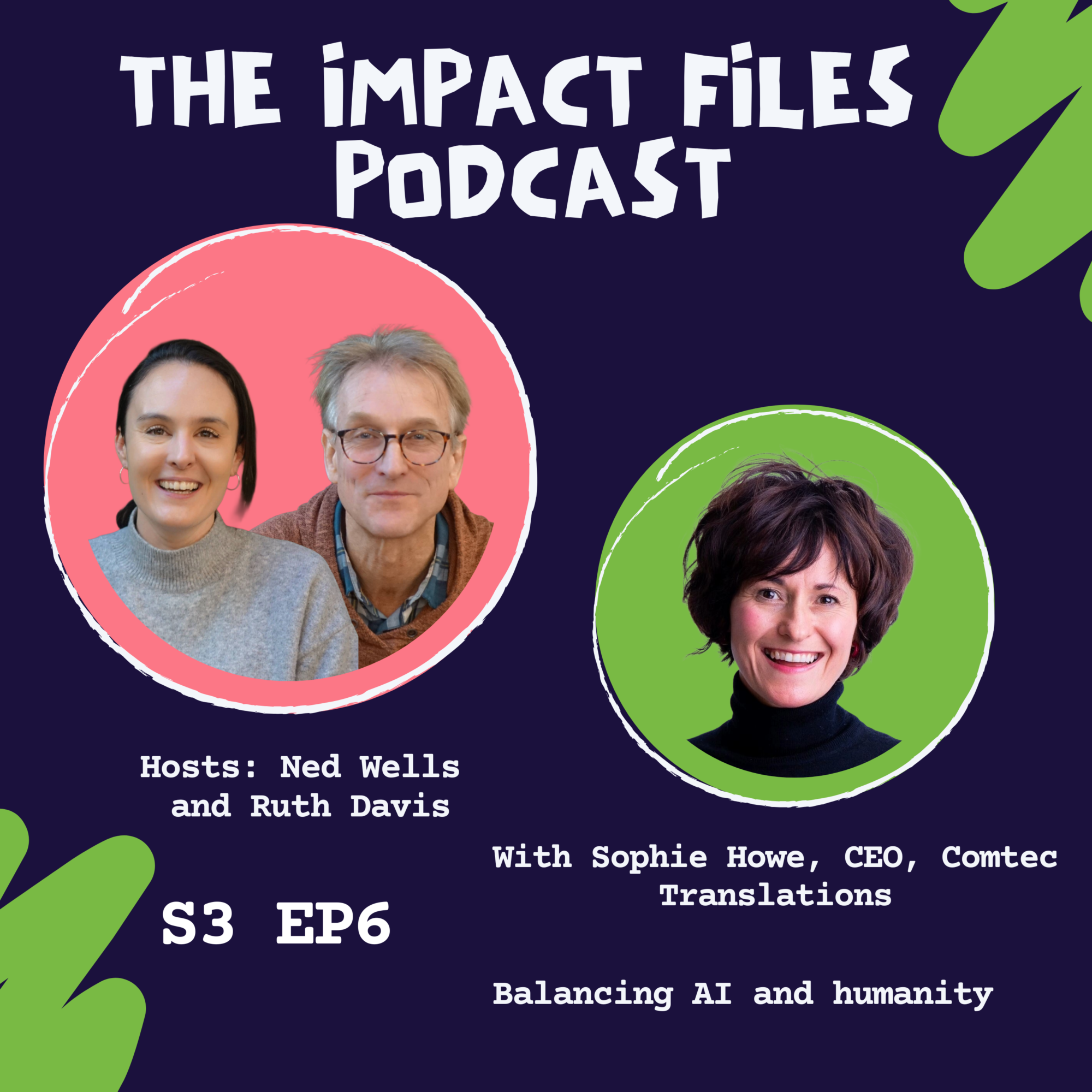
The Impact Files Podcast – Sophie Howe, CEO, Comtec Translations
Ned Wells: Welcome to the Impact Files Podcast. This week, Ruth and I are really pleased to be joined by Sophie Howe, CEO at Comtec Translations.
Ruth Davis: Welcome to the podcast, Sophie. Really great to have you.
Sophie Howe: Thank you very much. It’s great to be on the podcast.
Ned Wells: I’d love to start with an introduction to yourself, to Comtec Translations and the work that you do.
Sophie Howe: Okay. At Comtec Translations we provide localisation and translation services. We cover over 200 languages and work with a global network of linguists based all over the world. We localise a whole range of content, from marketing and learning through to much more technical and financial content. We work with clients across a range of industries, covering both B2B and B2C. We also partner and work very closely with agencies, both marketing and creative agencies and learning agencies.
Ned Wells: Could you describe what you mean by localisation, for any listeners who aren’t sure what that is?
Sophie Howe: Localisation is about the true experience. It takes things further than just translating the content into another language. It’s about providing an experience that really resonates and connects with the audience, so it means thinking beyond just the words and taking the cultural context into consideration. It’s a much broader definition that brings that cultural consideration into the picture.
Ned Wells: Interesting. That’s very helpful, thank you. When we talked off air a week or two ago, you were telling me that Comtec is a family business. Is that right?
Sophie Howe: Yes, it’s a family-founded business. Comtec started in 1981, founded by my mum, Dr Isabella Moore. She subsequently sold the business, and then my husband and I bought it back. We have been running the business since 2007, so it is definitely still a family affair, but my husband and I run the business.
Ned Wells: What sort of scale is the business?
Sophie Howe: As I said, we have our worldwide network of linguists, a truly global network. Then we have our team of project managers and localisation engineers. We work with clients in the UK and overseas, and our client base is very broad.
Ned Wells: Can you give us a sense of the scale in terms of numbers of employees or revenues, or anything that you’re happy to share?
Sophie Howe: Yes, of course. Our internal team has 16 project managers, and then, as I said, we have about 4,000 linguists working worldwide, and we’re constantly expanding that network.
Ned Wells: Four thousand linguists, that’s a huge number.
Sophie Howe: Yes. We have that number of linguists in our network because of the range of languages we work in and also the range of subject areas. Where we really focus is on selecting the right team of linguists for each of our clients. Those linguists translate only into their mother tongue, and they specialise in specific industries and areas. They have an in-depth understanding of the technical terminology for that particular industry and are fully immersed in the client’s brand. That’s part of what creates that fully localised experience.
Ned Wells: I see. That’s fascinating. Ruth, over to you.
Ruth Davis: Thanks, Ned. Thanks, Sophie, for that overview. Coming from an agency background, it’s really interesting to hear how you approach it. Could you tell us a little about your business case for sustainability? Obviously, a lot of people might think, “Translation, that’s not exactly super linked to sustainability.” So it would be really interesting to hear about your approach and your business case, and how you work with your team, things like your team’s contributions and skills, fair wages, and the long-term view you have on being kind to people and…
Sophie Howe: We were the first translation company to be B Corp certified. It must be almost five years since we started our certification. I had actually looked at it a while before then, because I felt it really resonated with how we work and our approach to doing business. As I said, our linguist community is huge and it is core to what we do. They bring such amazing skills and linguistic expertise, but also that invaluable cultural understanding, which really creates the quality that we produce. We’ve always invested hugely in that network.
So when you talk about the business case, B Corp gave us a brilliant framework for focusing on developing that community and those relationships, but also very much our internal team. We have always had a very strong culture and very strong values, and we’ve invested heavily in the development of the team, giving them the opportunity to learn and grow. And when it comes to our customers, we have had some of them for over 20 years, or longer actually. For us, the customer is core. We are there to understand their needs and to make sure that we are delivering the best possible service.
The B Corp framework brought all that together in a brilliant way. For us, it is all about sustainability: creating a business model that can grow and evolve and support all the key stakeholders within it, the linguists, the team internally and our customers. As I said, it was something that had always been core, but the B Corp values and framework fitted so nicely into what we were doing.
Ruth Davis: It’s so nice to hear that it was such an organic journey for you, and being the first B Corp translation company is an amazing achievement. Just following up on that quickly, you mentioned that your clients are central and your team is central. Do you have any insight into how the B Corp certification has helped you in winning clients, retaining your team and attracting that network of freelancers? Do you feel that having that B logo on everything you do has helped in any way?
Sophie Howe: Yes, it definitely has helped. We have won business through the B Corp community. But I wouldn’t say the accreditation is enough. We have it, but we’ve always lived it. We talk about what we do. With our linguist community, we have talked about the B Corp certification and they’re very much aware that we have it, but it’s what we’re doing with them and how we’re developing that community that matters. The accreditation isn’t what’s driving it.
With our customers, I think there’s a lot more awareness of the B Corp accreditation. With our linguists, it’s more that they know who we are and they see what we’re doing. We have told them that we are a B Corp. And I think the environmental aspect, which I’m sure we’ll come on to later, plays into that too. For example, when we’ve talked with our linguists about our use of AI, we have framed it in the context of our B Corp accreditation, which has helped to add weight and meaning to what we’re doing.
Ruth Davis: That’s great. Certainly, when my agency was looking for a translation company, we knew that we would prefer to work with another B Corp. So I can imagine that’s the case for quite a few.
Sophie Howe: Yes, definitely. We actively do that too. We’re very keen to work with partners and fellow B Corp agencies as well.
Ned Wells: The thought occurs to me, Sophie, that with your enormous network of translators, who I’m going to guess are located all around the world, B Corp certification isn’t necessarily hugely well known in all of those locations. I know there are lots in England, so translators in England may be aware of it. But it’s interesting that you say your B Corp values are intrinsic to what you’re doing, and that’s what the translators will see, more than the B Corp logo necessarily having any meaning for them.
Sophie Howe: Yes. The B Corp movement is growing, and it’s brilliant to see how much it has grown since we first received the accreditation. But I wouldn’t say it’s massively well known within the linguist community. We have taken every opportunity to raise that awareness and make sure our linguists do know about it, but I wouldn’t say the awareness is that high across that community.
Ned Wells: To come on to some more tangible examples of what you’re doing: as a commercial organisation, there’s the need to generate near-term revenues, for all the reasons that we know about, but also an eye on long-term sustainability in terms of social and environmental factors. It would be lovely to hear any examples of processes, procedures, skills, or even people you’ve put in place to drive the balance between those two things.
Sophie Howe: In our industry, when we’re talking about AI and technology, we have developed a number of key services. One we call AI-led machine translation with automated post-editing, which leverages AI to automate the post-editing process. Then we have machine translation with post-editing completed by the linguist. And then we have workflows that are completely linguist-led, with very minimal or no input from machine translation or AI.
The approach we’ve used to develop those services is very much about working with the linguists. For example, with machine translation with automated post-editing, we work very closely with our linguists to introduce very comprehensive glossaries and style guides, and to develop comprehensive prompts that run that automated post-editing. But the linguist is very much core to that service, as they are with linguist post-editing of machine translation and with the fully linguist-led workflows.
The technology is there and we’re developing it, but we are developing it with human linguistic input in everything we do, and training and supporting our linguists to be able to work with us and to be a core part of what we do. In all the developments we’ve made, particularly in the last 18 months, we have from the start been very mindful about how we work with our linguists, so that they are on the journey with us.
Ned Wells: Could you explain to our listeners what the post-editing process is? That would be helpful.
Sophie Howe: Automated post-editing is where we automate that process using AI. We use a combination of neural machine translation and LLM-led machine translation, and then we leverage the style guides, glossaries and prompts to automate the post-editing of that content. For example, we will work with a client who has specific glossaries and style guides. We train the engines to post-edit their content in line with those style guides and glossaries. This is how we bring together the linguistic expertise with the technology, so that the content is fully customised to the client, but done through an automated process.
Ned Wells: I think I’ve got that. I’m perhaps not quite clear enough on what post-editing is, rather than how you’re automating it. What is the actual process?
Sophie Howe: Post-editing is editing the content in line with the specific glossaries and style guides that we’ve created. If you’re localising website content, for example, or a database of products, we can use machine translation with automated post-editing to localise that content into another language. We can feed that with the client’s glossaries and style guides so that the AI then post-edits the content in line with those specific style guides and glossaries.
Ned Wells: I can see that there are all sorts of interesting things that come out of that. I imagine there are organisations in your sector that are going fully into AI without involving their translators and localisation experts as much, which I guess will compromise on quality but will certainly be less expensive.
Sophie Howe: Yes, exactly. There is a spectrum. That’s something we’ve focused on, because AI has opened up huge opportunities to localise at scale. There’s no doubt about that. We want to take advantage of those opportunities for our clients, to support them to localise as cost-effectively and as fast as they possibly can.
What we’ve looked at with clients is understanding the profile of the content and then matching the approach to fit that profile. Some content is lower risk, lower profile and more repetitive, and that’s where you can lean into more AI-led approaches, such as automated post-editing. Then there may be content that is much higher profile, much more emotive, much more creative, and has much more significance for brand building and brand positioning. There we would advise working more closely with our linguists, who are more involved in crafting that content. So it’s about being able to offer different types of service, ranging from the more AI-led to those with more linguist input, depending on the profile of your content.
Ned Wells: You must have been through an absolutely extraordinary journey in the last 18 months or two years, where AI has completely dominated your industry. There’s the complexity of how to stay loyal to your huge community of freelancers and pay them a fair wage, whilst taking advantage of all the benefits that AI gives you. That must have been quite a journey.
Sophie Howe: Yes. And I think we have developed solutions at an amazing speed, which is testament to the team here. We have a very hard-working tech team, led by my husband, Dan Howe, and then we have Mark Jones and Dan Jacob, who all work very closely together and have worked very hard to develop these solutions. It has been a journey. We have always believed very strongly in bringing the two together. We’ve always been very tech-focused as a company, and we always leverage the translation technology available, maximise it and develop our own solutions as well. But we’ve always believed in that marriage between the technology and the linguistic, and in keeping our linguists in the process.
Ned Wells: That’s the social side of your sustainability efforts. In terms of the environmental side, the environmental cost of AI, is that a journey you’ve started on?
Sophie Howe: Yes, it is. We have completed detailed audits of the tools and technology that we use, and we’re working with an external consultant to understand what steps we can take to manage that impact in more detail. But our focus has very much been on working closely with our linguist community. Going forward, we are looking to do more and to consider more of the environmental impact. But for the last 18 months we have very much focused on how we can support our linguist community. We understand the changes that they’ve been through and the impact it has had on them, and our focus is on understanding how we can support them and bring them on this journey.
Ned Wells: It feels to me like that has been the commercial imperative for you for the last year and a half.
Sophie Howe: It has, yes. The reality is that we are a small business working in an industry that has gone through an incredible amount of change. We have an amazingly loyal team and a fantastic community of linguists. Our focus has been on how we navigate this, how we respond, how we evolve and how we move into this new phase. So it’s been very much about working with our key stakeholders, our linguists, our team internally and our customers, to understand how to respond to the changes we’ve been going through.
Ned Wells: And to navigate this extraordinary new situation you find yourself in.
Sophie Howe: Yes, exactly.
Ned Wells: Ruth, over to you.
Ruth Davis: You mentioned some initiatives, Sophie, and some of the challenges you’ve overcome. Could you share any other learnings, perhaps things that didn’t go so well when you tried to implement them in the business, when it comes to the balance of purpose and profit?
Sophie Howe: Well, for example, we developed a tool called Pronto, which is our self-service machine translation tool. I talked earlier about machine translation with automated post-editing, and Pronto allows our customers to access that service on a self-service basis. They log into Pronto and upload their content, which is fully customised to them with style guides and glossaries and so on, and then they process the content. They then have the option to upgrade for more linguist input.
We developed that at quite lightning speed. There wasn’t much time for reflection. The market had changed dramatically and we knew we were able to develop this tool and that it had huge potential. The challenge has been having the time to take stock and think about how it impacts all the different stakeholders in our business. I do think the B Corp framework really helped there, because we had done the work to understand who our key stakeholders are and how to manage that. So in launching Pronto, it gave us the framework to be able to reflect.
With hindsight, it would have been nice to have a bit more time, but I think that’s very rarely the case. You have to jump on it and respond quickly. We did a lot of work with our linguists. We ran webinars. We did a survey with our whole linguist community to understand how they were feeling and to collect their feedback, and we generated a comprehensive report. We spoke at various linguist community events. But I think there’s more that we can be doing and more that we want to do.
Ruth Davis: That’s so interesting. It sounds to me like you almost have an extra role, a sort of consultancy role, as the key point between your clients and your network of translators, helping them understand what’s going on in the wider world, especially when it comes to AI. I had another question on that. You mentioned you’ve done that stakeholder exercise with your freelancers, but when it comes to the market and your clients, do they have much awareness? I can imagine they come to you and say, “Can you do this with AI, and can you do it now?” Do they have much understanding of the ethical and sustainability implications of AI, or is that not something you’ve come across yet?
Sophie Howe: No, I think they do. I think there is an understanding, and a real keenness to have linguist input in this process. This idea of looking at your different types of content and understanding the profile seems to have really resonated with clients. There is an appreciation that there’s linguist input in all the services we offer, and that gives them reassurance. There’s also an appreciation that this is a human process alongside the use of AI, with human input throughout. So yes, I think there is an ethical understanding as well.
Ruth Davis: Great to hear.
Ned Wells: You mentioned when we spoke a couple of weeks ago the launch of a tool called Clara. What was your experience with that?
Sophie Howe: We have Pronto, which is a self-service machine translation tool, and then we also have Clara, which is designed to support clients to generate content from a brief. It works very well for short-form content. Pronto is a self-service tool for translating content that has already been written, whereas Clara helps to create content from a brief. It would work very well for product descriptions, for example, or social media content. Some of our clients have local teams: we may work with the central marketing team, and they may have local sales and marketing teams. Because we train Clara with all the style guides and glossaries for our clients, they can have the reassurance that the local teams are using approved terminology and approved style guides when they generate content in the target language.
Ned Wells: Okay, fantastic. I think there was an anecdote about the launch of Clara.
Sophie Howe: Well, we launched that product before Pronto. I think that was probably an example where time was of the essence, and where perhaps a bit more thought was needed around how it would fit, and also around the role of our linguists in that process.
Ned Wells: I think the overwhelming impression you’re giving is of an industry that’s been turned upside down by AI. Navigating that with the values that you hold so dearly has obviously been incredibly hard.
Sophie Howe: Yes, it has. When AI first emerged, it brought huge opportunities, and companies and brands were obviously keen to maximise them when it comes to localisation. But what we’re seeing now is an understanding that AI is brilliant and has huge potential, and allows you to create content at huge scale, but that it is crucial to marry it with cultural and linguistic understanding, to use it very strategically and to think carefully about where it fits. That’s the offering we have been able to develop and evolve over the last 12 to 18 months. It aligns very well with what we believe and what’s core to our business. What has made us exist for so long and kept our clients for so long is our linguists and the service we provide to our customers.
Ned Wells: Excellent. I think the next section, about media and marketing, we’ve really covered most of already, unless there’s anything in particular you wanted to draw out. Then I was going to ask Ruth to go on to what’s happening in the next year or so.
Sophie Howe: The only thing I was going to say is that transparency is very important to us. We are transparent about how we do things. We’re open about the tools we’re using, how we work with our linguists and how we work with the tech. One of the key things we do for our clients is show them what the content looks like with the different types of approach, so you can see what a more AI-led approach looks like versus a fully human-led workflow. That level of transparency is very important to us.
Ned Wells: That’s really interesting, Sophie, because when you started talking about transparency, my first thought was how that can feel risky, because you might be transparent about things that people couldn’t understand. But what you’re describing is transparency in terms of giving clients or potential clients options and showing them what A, B or C could look like. That’s transparent, but it’s also a very authentic and nice way of showing them what they could do next.
Sophie Howe: Yes, and that’s key. It’s about explaining that there are types of content that work really well with automated post-editing, where you can get to a decent standard. But there is still a lot of difference between languages. Some languages work very well with AI, and some just don’t work at all. The amount of rework means there’s just no point in trying to use AI. So we offer that knowledge and experience to our clients as well.
Ned Wells: Fascinating. What would be an example of a language that works less well?
Sophie Howe: It’s the languages with fewer resources. The major Western European languages work very well, but when you get to languages that are less widely spoken, where there are fewer resources available, that’s where the quality starts to drop off. But the list of languages that work well with machine translation is growing. When we first launched Pronto, 12 to 18 months ago, we were talking about 20 languages. Now we’re talking about 30 to 35 languages that work well. The speed at which things are developing is really quite amazing.
Ruth Davis: Sorry, Ned, I was going to say, on that note, the speed of developments, providing there are no massive shockwaves, which I guess there could be over the next 12 months, what are your plans for Comtec? Do you have anything exciting coming up? You mentioned that you’ve been a B Corp for about five years. Am I right in thinking you might have a recertification coming up at some point as well?
Sophie Howe: We have actually just gone through another recertification, so it must be longer than five years. We went through a recertification last year, and we now have our certification for three years. I think we did three and two, so we’ve got our longer certification now.
In terms of plans for the year ahead, it’s about continually improving our offering. We’re seeing a lot more interest in, and appreciation of, the importance of cultural understanding. We have developed, for example, playbooks to help companies moving into a new market think about the cultural aspects that may affect the brand in that market. So we are continually developing our solutions, leveraging all the technology and making sure we stay on top of it, and broadening our language offerings, for example around Pronto. And then we’ll continue to offer our consultancy services around technology, and also around the cultural aspects of moving into and operating in a new market.
Ruth Davis: That’s great. It certainly sounds like you’re much more of a trusted partner to your clients than anything transactional. That comes across so clearly. Great to hear.
Sophie Howe: Yes, very much. We want to support and advise. We understand that our clients trust us, because they don’t speak all those languages. They trust us to give them that expertise, and we work with all our brilliant linguists to be able to do that.
Ned Wells: I was interested to hear you say there’s renewed interest in the cultural understanding side of the work you’re doing. Has there been a trigger for that? Not being in your sector, I would assume that’s something that’s continually in the background, but it sounds as though there has been renewed interest. I’m wondering if that’s been sparked by something.
Sophie Howe: Like you said, it’s constant. There’s always that interest in getting the balance between global and local. The question is how we leverage all this amazing technology to do it at scale, while staying very local and locally relevant. So it’s a combination of localising existing content and producing content directly for that market, which is something we also do. We do a lot of copywriting and content creation for specific markets. That balance between global and local is always there, but it comes and goes, and at the moment it’s very, very pertinent.
Ned Wells: I wanted to start to wrap up by asking where you think your sector will be in the longer term, maybe 10 years from now.
Sophie Howe: Particularly in the last six months, you can see that the tech is there, but it’s the cultural and linguistic understanding that matters, and I don’t think that’s going to go away. You’ll see further advancements in the technology, but the role of the linguist, the role of the expert in that process, will continue to be very important, though it will be refined. We’re not going away. We’re very much here. We add a huge amount of value, and the feedback we get continually from our clients is that this understanding and knowledge needs to work alongside the AI. It’s not a replacement.
Ned Wells: So a vote for AI, but it has to have the human element in there.
Sophie Howe: To make it effective.
Ned Wells: And then finally, what one piece of advice would you give to businesses that are pursuing sustainability and financial objectives alongside each other?
Sophie Howe: I would say dialogue is really important. Understand who your key stakeholders are and speak with them. For us, it’s the dialogue we have with our linguists, understanding where they were, especially when we ran the survey 12 months ago to find out how they were feeling, what they were afraid of and what they wanted to see. And it’s having that with our customers too, understanding what was important to them, and then bringing those together. It’s about really talking to all the key stakeholders in your business and understanding what’s important to them. From that, you can drive a strategy and an approach which is sustainable.
Ned Wells: How are you communicating with your translators? You’ve got 4,000 of them. Are there particular ways you’re doing that?
Sophie Howe: With all the linguists we have all over the world, we have that huge network, but they’re not live all the time. We need that network to cover the sheer number of languages. But we have linguist lunches, we have webinars, and we have a linguist board that meets every three months. So we are constantly communicating with them and checking in to understand what’s changing and what’s important to them. We use lots of different tools, and our team are working with them every day, so there’s a constant dialogue. The way we place our projects is in conversation with our linguists. It’s very much about understanding whether this is a good fit and whether it matches their experience. Then once we get going with the project, we’re constantly working with them to deliver for the client.
Ned Wells: Sure. Fascinating. That was wonderful, so interesting. Thank you so much, Sophie. The final thing is, how can people find out more about you and about Comtec Translations?
Sophie Howe: Go to our website, www.comtectranslations.co.uk. On the website we’ve also launched a tool called the Localisation Scorecard. We’ve talked so much about content categorisation and picking the right approach, and the scorecard helps you work out how to profile your content and what approach would work well for it. It also tells you whether the languages you need it for work well with machine translation.
Ned Wells: That sounds fascinating. We shall certainly include a link to that in the show notes. Sophie, thanks so much. Lovely to chat with you.
Sophie Howe: Brilliant. Thank you very much, Ned. Thank you very much, Ruth.
Ruth Davis: Thank you.
Sophie Howe: Brilliant.