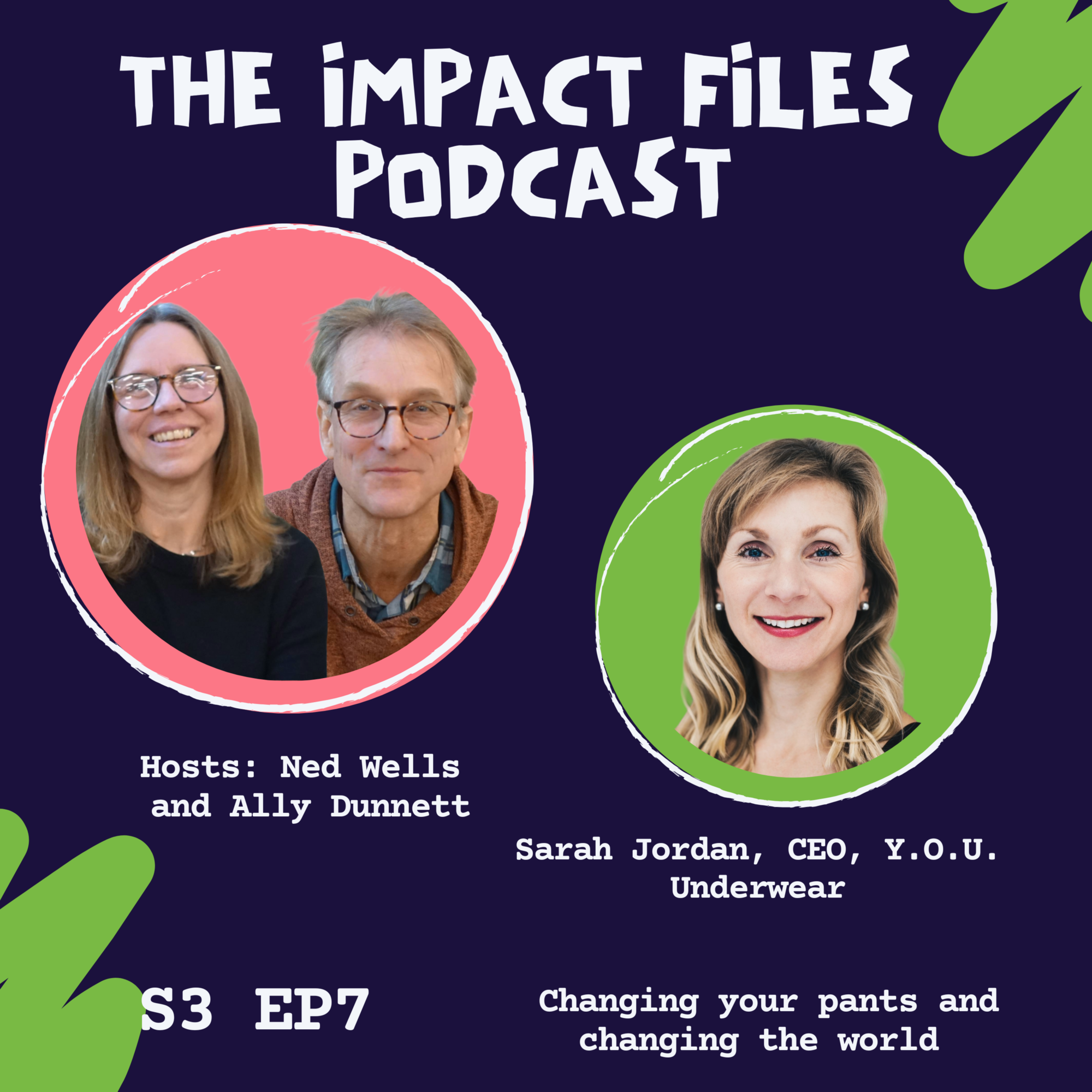
The Impact Files Podcast – Sarah Jordan, Founder and CEO, Y.O.U. Underwear
Ned Wells: Welcome to the Impact Files podcast. This week Ally and I are joined by Sarah Jordan, founder and CEO of You Underwear.
Ally Dunnett: Welcome, Sarah, great to have you here.
Sarah Jordan: Thank you very much, you both. Lovely to be here.
Ned Wells: Sarah, it’s so nice to see you. I wonder if we could start with an introduction to you, your business and the work that you do.
Sarah Jordan: No problem at all. As you said, I run You Underwear. We are what I describe as an ethical underwear business. Our mission is to change the world, basically one pair of pants at a time. Our way of changing the world is by getting people to change their underwear. Our focus is primarily period poverty, because I discovered the impact of not having a pair of pants, effectively, when I was working in Uganda in 2016, so ten years ago. And it’s not just the health and hygiene impact. It was the ability of women and girls to go to school. That was the biggest thing that really struck me, because they were missing up to 25% of their education: a week every month when they had their periods, they didn’t have a pair of pants and couldn’t go to school.
The knock-on impact of that is so phenomenal at every level, socially and economically, and I just wanted to do something about it. I know how important education is to girls. And it got to me that something we take for granted, literally the first thing we put on in the morning, has such an impact if you don’t have it. So that’s the story. It’s not my background. I don’t know anything about fashion or manufacturing or any of the things that I’m doing now.
But, having discovered that, I looked into how we could provide underwear and how you manufacture it, and I discovered all of the problems of the fashion industry, which is one of the most destructive on the planet. I didn’t want to help on one side and contribute to all of those problems on the other. So that’s embedded in the way we work: trying to do something very different to traditional models of fashion business and supply chain, or fast fashion, and any of that side of it. The whole principle is that we work in a very different way to try to tackle all of that.
Ned Wells: What was it that took you to Uganda in the first place?
Sarah Jordan: I was there with a programme called the Uganda International Marathon. We were running a marathon. It was about bringing the community together through sport and supporting different local groups or local programmes that you were interested in. It was self-funded; I went out there and volunteered with different communities. I was working with a group of female business owners, trying to support them in getting their businesses off the ground. One was making reusable period products and nappies, and was struggling as a business. It turned out that you couldn’t use the product if you didn’t have the underwear to put it in. That was the issue with the business, but when I took it back to a personal level, a family and community level, I saw the women and girls who didn’t have underwear and what impact that was having. So it went from supporting one side to something very different.
Ned Wells: So talk me through the story. You flew home from Uganda with this shocking realisation and this determination to do something about it. What happened next? What did the early years look like for you?
Sarah Jordan: Well, I actually broke my leg really badly while running the marathon in Uganda. The plus side of that was having the opportunity not to be able to do what I was doing. I was commuting to London, working for the MS Society and other charities. I couldn’t do that, but I could spend a lot of time researching underwear, basically. As you said, I couldn’t get that problem out of my head. I’d previously worked for Oxfam and others in the international development space, but underwear was never on our radar as something that impacts access to education and poverty. You’ve got all the traditional impacts, and underwear just wasn’t something I’d ever come across as such a fundamental issue. So I wanted to do something about it.
Then, as I said, I discovered how you make it, and all of the challenges with the fashion industry in terms of the chemicals, the pesticides, the pollution, and the impact on people, particularly women, through the supply chain. I didn’t want to set up something that could make a difference but cause more inadvertent problems by contributing to that. And, from my background in the charity sector, I wanted it to be sustainable long term, financially, which is why I set it up as a business, not a charity. I didn’t want to be reliant on fundraising or grants to make us last. I didn’t think this problem was, sadly, going to go away in the short term, so I wanted it to have a long-term life and a long-term impact, and not be continually in that cycle of fundraising. That’s why we’re a business, but we’re a business for good, purpose-driven, however you want to call it.
We’re set up as a social enterprise, with all of those elements embedded from the start in terms of how we work, because I’m very, I was going to say stubborn, very values-driven. It’s really important to me that we’re trying to do the best that we can and leave everything in a better place. So it was really important that we were effectively a good business, and that’s led to everything.
Ned Wells: Give me a brief picture of that time. You’re at home, you can’t commute to London, you’re researching underwear. I’m thinking you’re going to have to raise finance, find suppliers, and convince your nearest and dearest that this mad idea is a good one. What did that look like for you?
Sarah Jordan: It was quite a process. I didn’t initially come back with the idea of starting a business. I just had this nagging thing in the back of my mind. It actually took 18 months to a couple of years to go from that seed of an idea to something more, partly because I was on crutches for so long and partly because it took a certain amount of time to decide whether this was more than just me being frustrated. Is there really a business there?
Very early on I did a kind of pre-business accelerator, almost, to test some of those theories. I started thinking of it as something that could go beyond just me helping, so I wanted to bottom out some of the product side: how do we do this, and how do we test it with customers? We did customer research, all the classic pieces, because I don’t come from a business background either. I didn’t know any of that side of it from a start-up perspective.
I met somebody very early on who introduced me to our first manufacturer. He was running an ethical clothing business in Goa, in India, and that’s how I learned about some of the problems of the cotton farmers there: the immense pollution and the challenges they face. They have a suicide rate equivalent to one every 30 minutes because of the pressures of the cotton industry, the toxins and the chemicals, and there are 200,000 pesticide deaths a year. It’s horrific. Once I’d learned that side of it, we had to do something different. So he introduced me to a supplier that was organic, Fairtrade certified and Sedex-registered, that cared about doing something different, and that worked with small-scale farmers. So we had that connection directly through to the supply chain.
Then it was about going through the prototyping. I only knew about underwear as a customer, so I had to learn a lot about all the different styles, the sizing, the cuts and the colours, from a customer side as well as from the manufacturing side. That meant understanding order quantities and the whole process from getting cotton to it being carded, spun, knitted, cut and finished.
It took a couple of years to get that off the ground and get our first production run. We crowdfunded it. It was a small Kickstarter project to raise £20,000 to get the first production run in. In reality, you don’t get a fraction of that by the time you’ve put the costs of developing the product through, but it did help us get started. It helped us raise awareness, and it helped us to go to friends and family and say, “This is what we’re doing. Can you support it?” And it got us started at the beginning of 2018. That’s it. Sorry.
Ned Wells: That’s a huge amount of effort. My mind’s racing. Were you mainly funding this yourself? Did you have a day job alongside this at the same time?
Sarah Jordan: Yes, I’ve had a day job pretty much since day one. I’ve had a full-time day job, I’ve had a part-time day job, I’ve gone full-time and then I’ve gone back out of it as well, to support the business. Since that first bit, which gave us a small cash injection, we’ve self-funded everything. We’re completely bootstrapped while I work, basically. I work to fund the business. That’s very much because I wanted to grow it sustainably, in the broader sense. I wanted us to be confident as a business that we weren’t taking on debt and that we were in control, particularly because of the values. It was really important to me that we sourced it properly, made the products properly and paid people properly, and that gets challenged if you’re in a more commercial setting. So it was really important that we set it up like that, and we’ve carried on like that.
I was paid for the first time last year, 2025, five or six years in. Not every month, and definitely not a living wage, but I’m the only one who doesn’t get paid properly. That’s what we’re hoping for as we scale: that we can support ourselves. At the moment everything is going back into the business to help it grow.
Ned Wells: When you say you’re working alongside it, does that mean you’ve got a job that’s not related to the business that you’re working at to fund yourself? Wow.
Sarah Jordan: Yes, I did that all the way through. I was effectively freelance, contracting and consulting in marketing and, in the nicest possible way, anything I could get that would allow me to do this alongside it. Because this was always there in the back of my mind, growing, and a priority. So I had to balance those. I did that with an amazing company in Woking for several years, who actually matched our donations for a while as well. They were incredibly supportive of helping me to work alongside this. I went full-time on the business in 2025, last year, and this year I’ve gone back out to do a bit of work to support us as we grow. So it’s a flexible model, but I’m still doing something else to keep us going.
Ned Wells: Would it be appropriate to name-check the company in Woking? It sounds like they’ve been brilliant.
Sarah Jordan: They’d be very happy. They’ve been amazing. As I said, they matched our donations, allowing us to do buy one, give two for three years, but they also just let me do this, recognising that while I’m working for them part-time, I’m doing something else on the side. So yes, very happy to thank them.
Ned Wells: What a brilliant-sounding company. That’s amazing. And what sort of scale has You Underwear reached now?
Sarah Jordan: We are now…
Sorry, go ahead.
Ned Wells: Numbers of units or revenues, whatever you feel happy to share.
Sarah Jordan: Yes. Our turnover last year was about £350,000 to £370,000; we haven’t got our official accounts audited yet. I’ve just done our impact report, so I know that 10,217 pairs of pants were shipped. We have very rigorous reporting as part of our Fairtrade commitments, so we know exactly what products, sizes and colours we have shipped to all the different countries. That’s how I know so specifically what we’re selling.
It’s a small team. There are four of us in the business, all part-time, all doing other things as well. And there are four in the shop in Oxford, also all part-time and all doing other things. We’re now online as well as in the shop. We opened the shop as a pop-up in 2021 in the Covered Market in Oxford, which is run by Oxford City Council. There were lots of empty units at the time, and they prioritised purpose-driven businesses locally to help bring the market back to life. It’s been incredibly successful for us at getting us out there, because it’s a lot easier to get in front of people in Oxford now that visitors have come back post-Covid. We’re now in a more permanent and central space in the market.
It’s so good for increasing awareness, starting conversations about what we’re doing and what we’re trying to tackle, and showcasing other small businesses. Online you’re competing with the big high-street brands, M&S as well as the fast-fashion brands, and it’s a competitive landscape. So having a physical presence has been really good, and it has given us credibility and trust as well. We’re a real business: now we have a shop, and people really see that. They want to see it, they want to feel it, and it gives them confidence. It’s lovely, as well, to meet customers.
Ally Dunnett: I wonder if I could just chip in, Sarah, for listeners who are hearing all about your underwear business for the first time. Could you summarise for us how the purchase model converts into underwear for the girls and women who wouldn’t otherwise have it, to solve the initial problem you were trying to tackle, period poverty? How does the retail enable that?
Sarah Jordan: Sure. We have a buy one, give one model, basically. For every pair bought from us, we donate a pair to a charity called Smalls for All. They are based just outside Edinburgh, in Livingston in Scotland, and they distribute the underwear. They work with local organisations on the ground in the UK and across Africa to identify vulnerable communities: women and girls in refugee camps and IDP camps, people experiencing homelessness, and people in women’s refuges here. Underwear is something that is very rarely donated, in terms of homelessness and that kind of thing. It’s just not thought of. And for school banks, food banks, refugees and people coming to the UK, it’s not something that’s regularly provided. So we support through that. It can be our underwear, or, if it’s across Africa and rural communities, we buy and support locally. So we’re not just shipping our stuff in; we’re supporting local markets and makers.
So it works like that. If you buy a pack of three from us, we actually, I’ve got one of our cards here, detail the donations. We basically say, “Thank you, this is what you’ve bought, this is where it’s going.” The core collection supports the charity Smalls for All, so that would be three pairs to them. They have a wear, wash, dry model as well: each person who’s supported is given three pairs, because you need to wear one, wash one and dry one. It’s not just one pair that’s going to make a difference, so it’s at least that.
And then the other products: the bright colours, like the red ones you can see behind me, are inspired by Maasai beadwork, and they support communities in Kenya and Tanzania. Our light pink supports breast cancer charities, which is something close to my heart. So it’s a very tangible model, so that customers know the difference they’re making, and we can make it real. I didn’t want to do it on a percentage of profits, because you can hide your profits if you want to, and that doesn’t mean anything. Even a percentage of turnover… I wanted it to be really, really clear, the direct impact that people were having by supporting us.
Ally Dunnett: That’s so interesting. Yes, I think there’s huge value in that. As you were saying, the business seems more real for having a physical presence in your shops, and your cards are another piece of that: as you say, people know what’s happening when they buy your product. Super interesting, and a really complex ecosystem. It was interesting hearing about the charities, the third parties, the different directions and the different distribution channels. There’s a lot.
Sarah Jordan: It’s complicated. There is a lot there. I wanted to make the buy one, give one model really clear to customers, so that they know their impact and it’s really transparent. But as you say, there’s so much more behind it. It then goes to Smalls for All, and then to local organisations. When we started working with them it was solely across Africa, including Uganda, which is where the inspiration came from. But now it’s more than 50% in the UK, which is shocking in its own right: we have the same period poverty access problems here.
It’s a whole network, basically, because, from my charity background, I wanted to work with the experts. It’s not me in that case. I wanted to work with charities that could identify where the need and the impact was greatest, and working with small organisations on the ground makes it much more impactful. They know what they’re doing, I trust them, and we support them to do what they’re doing.
Ned Wells: I’m intrigued by the business model. I’m just thinking about how you can afford to do this, because you sell a pair of pants for what, seventeen, twenty quid. It’s a hugely competitive market. You need to make something to pay your rent and staff, and then you’ve got the suppliers and stock and all the rest of it, and ideally something for you at the end of the day, Sarah. I guess part of it is that, by not necessarily donating your own underwear, that potentially takes out some of the cost of donating another pair. Is that right?
Sarah Jordan: It varies. Our underwear goes from £12 a pair through to, yes, £20, for some of the different products, so the proportion varies. It’s something we embedded from the start. It’s factored into our costs. It’s one of the line items to get us to the end point. It’s not an option. It’s a big chunk, but in reality the biggest chunk is our Fairtrade commitment. Providing another pair of underwear on the end of that is a chunk, but actually being Fairtrade certified and paying fairly right the way through the supply chain, from the cotton farmers, through the workers in the factories who make it, to our team here, is the biggest uplift, and that’s what has the biggest impact on our end costs. For me that’s a deal-breaker. It’s paying people.
Fairtrade cotton is 75% more expensive than conventional cotton, but all that means is that you are paying people to grow it, manufacture it and so on. I think that’s the biggest shock I learned in all of this: how much difference it makes to pay people properly. Which sounds terrible, because it shouldn’t be something that’s even an option, in my mind. But that’s the biggest uplift. We often get questions about this in the shop. Our stuff is a bit more expensive, but it’s not expensive compared to a lot of the high-street brands and certainly a lot of the designer names you would know. But when you break down where that’s going, we are not making more. In fact, the example I always give is that Primark sells a pack of five pairs of pants for £5. It costs us more than that to buy one of ours. So they are making more on a considerably lower-priced item. Now, you can’t make it fairly at that rate. There’s a hidden cost somewhere, and it’s predominantly the people who aren’t getting paid for what they’re doing. So it’s not a level playing field. It’s not fully transparent. None of those market prices include the true cost, I suppose, of production.
So it’s a challenge, but as I said, it’s baked in. We don’t have a business case for being sustainable; that’s how we work, and then we have to work out how to make it work. It significantly impacts our profits. It means we will grow much more slowly and we will never be as profitable or as large as a lot of the high-street or fast-fashion brands, because we’re trying to do something different. That’s why I’m still working, effectively, and why we’re doing it more carefully, more consciously. We’re never going to hit that size, because I don’t want to. I want to be able to sleep at night and know that I’m doing a fair job for the people who are producing our clothes, because it’s so remote, often. I don’t think we think of it as people. I don’t know how we think our clothing gets made, but I think we just don’t have that awareness and push it to the back of our minds.
Ally Dunnett: It’s interesting that you mention size. I was going to say competitors, or other retailers, let’s say, because I don’t see you and Primark as being in the same space at all. But when you talk about size, do you think there’s a possibility, a likelihood, that if you’re able to scale up in volume terms there are some economies of scale? Again, they’re not going to close that gap far, but is that something you anticipate? I’m thinking about the manufacturing process: a lot of the costs of manufacturing are in the start-up process, aren’t they, whatever the nature of your manufacturing is. Once the machines are running, to put it simply, there are economies of scale.
Sarah Jordan: Yes, I think some of it, and we’ve found that already. We’ve gone from sampling prices to production prices because we’re now producing at a greater scale. That’s one of the challenges, I suppose, because across fashion and textiles there are minimum order quantities. For anything, you have to make a minimum to hit their levels, to make it worth it from their side as well. That’s everything from buying the cotton to the dyes, the elastics and the trims; every step has a minimum. What we’re discovering is that they’re high at every step. It’s not just that we place an order of a thousand pieces or 10,000 pieces: you then need at least 200 kilos in every colour to be dyed, and at least a thousand metres of elastic, and trims for everything. They’re all different. Our different underwear styles have 5mm, 10mm and 15mm trims. So at every point you hit another barrier where you have to jump up.
And to buy the Fairtrade cotton, you have to commit upfront, and it has to go to a purchase order. The example I gave at the start was that we sold 10,000 pieces last year; we need to order a minimum of 25,000 to have the Fairtrade-certified cotton and commit to it. We pay upfront for at least 50% of that all the way through, because that’s a fair way of doing it. But that means massive cashflow issues from our side. And we’ve always got excess stock, because we’re always having to order a bigger range than we actually need, initially, just to be able to afford it, effectively. So there’s that big investment. It does change, but not in a linear way. There are always big steps at every level.
It’s always a challenge, basically, because of the intricacies. Underwear is incredibly complicated in terms of the sizes, the styles and the details of it. Had I known, I might have done something a bit simpler. So the more you unpick it, the more complicated it becomes. It’s not simply that, as we go bigger, we get the economies of scale on the manufacturing side. At some level we do, and we do for things like packaging, where we know we can just buy across. And you learn a huge amount as well. As we go, we know which sizes sell better, which colours and which styles, and we can get packaging that sits across all of it. We can reduce the cost and reduce the footprint of everything we’re doing. So there is some scale advantage, but it’s not as simple.
And there are big lead times as well: about six to nine months, sometimes twelve months, to get an order in. Slow fashion is really slow. Compare that to the six weeks of fast-fashion brands, who are producing a massive volume and bringing it to customers incredibly frequently. We have a much slower approach, and there’s no seasonality. So we plan in a very different way as well.
Ned Wells: It’s absolutely miraculous that you’ve survived and managed to fund it yourself. That’s extraordinary.
Sarah Jordan: One of the measures every year is that our accountant says, “Well, you’re still here,” which is not to be taken lightly. It’s a massive challenge. It’s something I’m very proud of, that we are still going and that we have funded it ourselves, because it does give us control over how we work. But we’re still thinking about it in terms of the fact that we need constant cash input into the business. We’re expanding; we’re looking at a second location for a shop, which is another huge investment. Most of the investment so far has gone into product. Basically all our money goes into buying pants. My thinking at the start was that the worst case was that I’d have underwear for the rest of my life, as would all my friends and family.
But we’re now at a stage where we’re asking how we can invest in the business. How do we invest in our team, grow the team, and do some actual marketing rather than just doing bits ourselves? How do we develop more products and more ranges, within quite a tight constraint, because we want to keep managing and working in the same way? How do we do that and keep the business going without any external investment? It’s a bit of a question, and that’s why I’ve gone back to work this year, actually, to try to get some more money in.
Ned Wells: I think that’s a segue into your section, really, Ally, on the balance of how you stick to your values and survive financially.
Ally Dunnett: Exactly that. You’ve described very clearly, Sarah, that the sustainability criteria are non-negotiable. So you don’t have a point where you say, “We could do this piece more cheaply, or we could source this piece more cheaply, if we sacrifice…” and it’s usually something to do with, as you say, a fair wage, or other aspects of sustainability and environmental impact. Having said that those pieces are non-negotiable, how do you, first of all, measure that you’re being as sustainable as you want to be across all those pieces, and then still make the profit to enable the investment that you need?
Sarah Jordan: I don’t even think it’s a balance of profit and sustainability, because that implies they’re on a scale and they balance each other out, which I don’t think they do. I think you have to prioritise one or the other, because otherwise something is sacrificed. We have definitely chosen sustainability. It has come at the cost of profitability. But we are still here. So it’s about trying to do that slowly and carefully, recognising it, and not comparing ourselves. We are going to grow more slowly than a traditional business. If you go to any business event, it’s, “How are you doing? What’s your growth rate? What’s the percentage increase?” You’re under that real pressure to continually grow, to get bigger and faster and better all the time. Then you focus on the financial side and the profit, and the sustainability has to take a hit, because it’s not possible to do both. We haven’t even done it the other way; we just set it up differently.
We align all our work to the UN SDGs. We’re a B Corp. We had the five pillars, and now there are 12 pillars under the new standards, and it’s all about our social and environmental impact. We share it monthly with the team, so as well as turnover and sales in the shop, it’s: What have we donated? What are we doing socially? What are we doing environmentally? How are we improving things? What are the challenges? We have quarterly updates that we share. Externally, we have a full-year impact report that we publish on our site and everywhere else, which is fully transparent about all the numbers. Mostly, apart from financial, we just report on the social and environmental side when we’re going externally, because that is the number one measure.
We actually track our progress based on underwear donations. We’ve got a target of 100,000 pairs by the end of next year. We’ve always had some target, and that’s our big measure of business growth. So it’s aligned in that sense: the measures and the business reporting are aligned very much to our impact goals, through the different structures like B Corp and the SDGs, and then we share that.
Ally Dunnett: Through those frameworks, yes. And it strikes me, tell me if I’m right or wrong on this, that you mentioned that most of your investment goes into the product and then into the people and the growth you need. But it sounds to me as if you must have made some investment in robust reporting and tracking systems. Your data has got to be something you can rely on, and it’s got to be robust.
Sarah Jordan: Yes. We do a lot of reporting to the different certifications we have for each vertical pillar, like Fairtrade. All of that data goes back in and informs a lot of the reporting, because it’s very much product-based. We know the weight: the kilos of cotton we’re buying and the kilos we’re producing. We’ve got a take-back programme, so we know how much we’re collecting, and what’s going for recycling, and that kind of thing. So we’ve got all of that. Then it’s how you communicate it. How do you communicate it to a specialist audience, such as the awarding bodies themselves? And how do you communicate it to the public as well, who don’t necessarily want to know the intricacies of it? Some do, some don’t. But showing that we’re doing something different also differentiates us, because there’s so much greenwashing in the fashion industry. We’re very transparent and very based on our numbers, the data and the impact, because we want to show that it’s solid.
Ally Dunnett: Yes, that’s interesting. Greenwashing, and its twin greenhushing, come up a lot in the conversations that the co-hosts have with people. As you say, if your data is there, it’s transparent, it can be interrogated and it can be proved out. And because it’s hung on those frameworks, that’s your secret sauce.
Sarah Jordan: Yes. We do the Speak Volumes work too. We do a lot around what we’re doing and a lot around the broader industry context, because I think that’s important. We are, at one level, definitely not trying to compete, but we are in that space alongside some of the more well-known brands. So where do we sit? What are the volumes, and all the issues around the fashion industry, consumption, production and the macro pieces? We’re trying to put ourselves in that space as well, so people see where we are size-wise, and the broader considerations. So yes, we’re reporting on a lot. There’s a lot of data if you’re a sustainable business. Definitely.
Ally Dunnett: I wanted to ask about people, because you were telling us you’re a pretty small operation, and a lot of your staff are part-time. What sort of skills do you recruit for, and what sort of people do you hire? What do they need to be able to demonstrate?
Sarah Jordan: Mainly passion. We’re a very small business, so you’ve got to want to work in a space like that, where you get involved in everything. You see across the board. We’re very transparent, so we do share everything. There’s a definite advantage in that, because you can see everything you’re doing and where it has an impact on the business and on the people and causes and issues we’re supporting. But there’s a lot of juggling. You need a passion for doing something different, for sustainability, for fashion, to, I was going to say change the world, but yes, basically. It’s harder. We’re in a difficult space in terms of what we’re trying to do, because we’re fundamentally trying to work in a different way and change things. That’s complicated. So we’re really looking for people who are interested in that, who want to get involved and get stuck in. It’s more aptitude and attitude rather than skill set.
We pay well, in terms of above living wages, but we can’t offer competitive salaries compared with what I or any of the other members of the team might earn in a different sector, for example. So we’re trying to attract people who are inspired by what we’re doing, by the difference we’re trying to make, and who want to be part of that. We’ve been really fortunate that being a B Corp helps with attracting and retaining staff, along with the mission that we’ve got. We’ve ended up with brilliant teams. We’ve always had very passionate people who are keen to work with us, whether in the shop or in the business, who want to make a difference. So it’s very much about that, and about wanting to support customers, do a really good job for them, do something different and be involved.
The flexibility we have is a big pulling point as well. We will very much work around people’s commitments and lives, because I know that happens. We try to accommodate that and work flexibly around everybody. That’s why we’ve got a smaller team of part-time people whose schedules we’re always shuffling and juggling, because it’s more important that they can balance things and have a good time, and that they enjoy it.
Ally Dunnett: Yes, that sounds like it comes back to the point you were making much earlier, in a slightly different context, that you don’t want to solve one problem and create another. Wouldn’t it be dreadful if you were doing this wonderful work globally and managing to adhere to your very challenging sustainability targets, but had a miserable, oppressed workforce? It sounds like that’s not the case.
Sarah Jordan: And there are some B Corp examples, one well-known brand, that did exactly that. We want to be a good business all round. We want to be a nice place to work. We want people to want to work for us and to stay with us, because we need that as well. We need people who are passionate and committed and enjoy it, and we spend a lot of time together. One of our team said last year, when we did a survey, that it’s like a little family. That’s something I’m incredibly proud of, because we’re trying to create that. We can’t be nasty behind the scenes. That’s not our values. It just doesn’t work. So, as you say, it’s about trying to do that inherently, I suppose.
Ally Dunnett: Yes. Okay, great. Well, moving us along slightly: you’ve told us so much about the journey, how you started out, how you got to where you are now and what’s in your sights. Can you give us some examples of things on that journey which went particularly well, successes, and, almost more importantly, because I think people love to learn from these things, things which maybe didn’t go so well, and how you dealt with them and perhaps used them as learning points?
Sarah Jordan: Blimey. Successes. Well, as I said, we’re still here. That’s good. We’re growing slowly. I think opening the shop has been one of our biggest surprise successes. It was never on my plan to go into physical retail, but it has been brilliant at getting us out and in front of people, particularly in the tourist and visitor market in Oxford. It’s given us surprising credibility. I always thought, with a background online, that we were real, but when you go into bricks and mortar, people really do think that you’re a real business. It’s driven a lot to online as well, so it’s really strengthened that, which has been great.
Becoming a B Corp is, again, one of the things I’m most proud of. We certified in 2021 and we recertified last year, and we got an incredibly high score, which I’m very proud of. It just shows that you can do something different. That was always on my mind as something we wanted to achieve, because it’s the pinnacle of a holistic look at your impact and your commitment to people, planet and everything else. Certifying as a small business and as a fashion business really showed that you can if you want to, because there’s so much around it. It’s difficult, it’s complicated, it’s expensive. And it’s, “Yes, it is, but you can, if you care. You really can.” That’s been very powerful. And being part of that community, adding our voice to other businesses trying to do something good, has been really positive, because it showcases a different way of doing business. There’s a nicer, kinder way that you can also be profitable and be a good business in every sense. And the donations hitting 70,000 last year was a big one.
Challenges: blimey, there are a lot of those as well. Brexit, all the classics. Brexit hit us. About 20 to 25% of our customers were in Europe, and we lost those. I would say overnight, but it wasn’t; it was very slow and painful, because of the uncertainty and lack of clarity around it. It had a huge impact, and we’ve really tried to build it up again over the last few years. Now we’re being hit by the small parcel issue and delivery into Europe, where legislation is coming in to try to tackle companies like Temu, who send small parcels directly to customers rather than importing and paying all the costs around import duties. It means they’re putting a levy on parcels delivered to end customers, per item, and that’s having a massive impact. It’s just killed the European market that we had built back up. US tariffs are having a similar impact. It surprises me, though it shouldn’t, how bigger things out in the world and the economy can impact you on such a tangible level. It’s not the big companies that get hit, because they can get around it; it’s the small businesses that are trying to reach individual customers. That’s been a really interesting learning curve and challenge: how do we tackle some of those issues?
I think our biggest challenge at the moment is the recycling programme. A few years ago we introduced a take-back programme, because end-of-life textile waste is another one of the big problems of the fashion industry. Something like a rubbish truck load is dumped or burnt every second, and I didn’t want our stuff to be part of that. So we introduced the take-back programme. We got so many questions about whether you’d take anything, and we said yes. Now we’ve got a backlog of nearly a tonne of second-hand underwear in my shed that we’re looking for a solution for. We can recycle some of it, but a lot of the partners we were working with to recycle that waste disappeared; they couldn’t afford it, it wasn’t viable. It’s not cost-effective to do it. Until some legislation comes in to tackle that, there’s a gap generally in the market. That’s one of the big challenges, because I really want to keep offering it to customers.
We’ve restricted it back to just our underwear, or items with a high cotton percentage, because that can be shredded and processed into roll mats, for example, for people experiencing homelessness. But the synthetics will never go anywhere. They need to be processed and dealt with, and there isn’t really a viable solution. We’re continually looking for affordable solutions, because it was costing us about £10 a kilo to deal with that, and with 900 kilos, that’s a lot. We’re not a recycling business, so it’s an added cost. I’m hoping that things like that… it’s not something we’ve necessarily been able to overcome ourselves, but we’re working on it and trying to find different partners who can help improve that.
So a lot of the challenges are bigger, I suppose, in terms of behavioural changes and sector-wide pieces that we’re trying to tackle, as well as all the usual day-to-day stuff of how we just keep going as a business and fulfil orders. We still do it all ourselves. Our fulfilment, our warehousing, our global distribution centre is basically here at home, which is really nice, because it gives a personal connection with customers. I write the cards for each order that goes out, which is really nice for me, and people feel really connected to it. But how do you scale that? There are a lot of questions around each piece as we grow: how do we manage it ourselves until we can’t, and then how do we develop an affordable, sustainable solution that helps us get there? I don’t know whether that’s answered your question about the challenges.
Ally Dunnett: So interesting, and there’s tons we could follow up on there, but I’m going to hand back to Ned at that point.
Ned Wells: So interesting. Sarah, I wanted to move us on to something you hinted at earlier, which I think is going to be very exciting: perhaps in the next year or so, opening your second branch, down in Brighton. How are things developing there?
Sarah Jordan: Well, it’s still a work in progress. It’s a big piece of work, with lawyers and estate agents and all sorts involved, but we’ve been looking for coming up to a year to find a suitable place that has a nice shop floor plus the storage. We have a lot of underwear, and we need to store it somewhere dry. We signed the lease on a property in Brighton yesterday and we’re hoping that all goes through. It still needs to be finalised with the lawyers, but we’re hoping that happens in the next few days or weeks and that we can open in the next couple of months.
That will be another very exciting, huge step for us, because it feels like a proper shop. Having one locally in Oxford feels a bit closer to home, and this is now branching out, literally. But yes, that’s coming in the next few months. Hopefully we’ll be having You Brighton as well as You Oxford, fingers crossed.
Ned Wells: The seed of that idea: it sounds like you were pleasantly surprised when the Oxford shop did so well. Was the idea of opening another one off the back of realising that…
Sarah Jordan: We couldn’t ignore the numbers. On the business side, we started the Oxford one as a pop-up, so it was always going to be temporary: November 2021 into about February 2022. So we had the two busy months and the two quiet months, and we just stayed. It was a bit of a risk beyond that first period, but we recognised that it had potential. We stuck with it, and then invested in a larger space, more centrally in the market. As you said, it’s been really successful, and we couldn’t ignore the numbers: the retail space plays a big role in supporting the whole of the business. So looking at a second option was a bit of a no-brainer, really, financially.
We had a lot of customers in Brighton. We’ve had a lot of people coming into the shop from Brighton saying, “My gosh, this would be amazing down there, a perfect place for you.” There’s only so much I could ignore it. Whilst it wasn’t necessarily part of the plan, I’m hoping it will be a real boost for us, and that it can support itself in its own right but also feed into the business, help grow it, drive people more online and increase awareness of us. It’s marketing; it’s just marketing in a very physical way. But yes, that should be coming, fingers crossed.
Ned Wells: That’s so exciting.
Sarah Jordan: I haven’t told anybody yet, so this is kind of exclusive. This is breaking news. Our team do know, but nobody else.
Ally Dunnett: Yes.
Ned Wells: And thinking longer range, I know that your metrics, your ambition and your values are around donating more pants, and you want to hit the 100,000 mark. Thinking about the ten-year horizon, I’d love to hear, first, what the ambition is for donating pairs of pants, but also what the business is going to look like to fuel that. What would your vision be for the mechanism to enable that wonderful ambition?
Sarah Jordan: So, 100,000 is for next year. I want us to be a million-pound turnover business. I want millions of pairs of underwear donated. It will need to be high financially to achieve and support that, because there’s a very direct relationship between sales and donations. But I do want us to hit a scale where we are having a significant impact, up to a point, because I want it to be something we can still manage and control, and still have those values. As I said, we’ve legally embedded them in our company objects. This doesn’t need me. We are committed to doing this, but I want to be really confident that we are still doing that. So it’s not an exponential, world-domination plan. It’s just getting to a point where we’re having an impact, we’re known in the space, and we’re the go-to for ethical underwear, if you want pants to make a difference. And we’re really having those big numbers, because everything that we do, impact-wise, will grow with it. There’s so much that I want to do to make a difference to charities and organisations locally and beyond, and it requires some scale.
In ten years, I want us to not be talking about sustainability. I really want this to not be a thing. We’re not an ethical business, we’re just a business. We’re not talking about it; we’re just doing it. This is completely normal. This is just the way you do business. And everything has changed to enable that, because, as I’ve said, it’s not a level playing field. We’re not competing on an equal footing when we’re trying to do something very different. In a very commercial, capitalist, extractive market, it’s not possible to continue infinitely with a finite set of resources and without thinking about the planet and people. We’re just going to destroy ourselves, clearly. So this has to happen. I would hope it takes less than ten years, but I would hope that in ten years, whether it’s B Corp or any other way, it’s just a different way of doing business, a different way of consuming, or not consuming, just creating, and being part of a more socially and environmentally aware society to make all this happen. I think it’s a world where everybody is paid and treated fairly, because that shouldn’t be the unusual one. It shouldn’t be the case study. It should just be the normal way of doing things. So that’s what I would hope for in ten years’ time. No fast fashion.
Ned Wells: Where we’re living within the boundaries, yes.
Sarah Jordan: Planetary boundaries. Absolutely. Yes.
Ned Wells: And the final question: what is your one piece of advice for businesses that are pursuing the twin objectives of sustainability and financial stability?
Sarah Jordan: That’s a tough one. Do it. Definitely do it. I think, recognising that they’re twin objectives, you’ve got to work out what’s important to you and your values, and go for that and commit to it, because it means accepting slower growth. Don’t compare yourself. If you’re trying to do something different, not comparing yourself on traditional measures takes one level of pressure off. Compare yourself with other businesses that are doing something similar. Build that network, work together, collaborate, do something very different.
You have to be careful with the trade-offs. If you’re looking at the financial side all the time, you will make compromises on the sustainability. I do believe both are possible, but I don’t think they necessarily come balanced, because I think you have to focus on one and then hopefully the other: focus on sustainability and then the business side. I’m hoping that we’re showing you can do it and be a small business, but one that’s surviving and profitable. So I think it’s just about building something sustainable in the widest sense, and not comparing yourself.
Ned Wells: I think that’s a really interesting reflection, and to achieve that within a market like clothing and underwear, which is ferociously competitive, I think, as you say, you have to focus on one rather than the twin.
Sarah Jordan: Yes. I don’t think it can be an equal balance. There are very few examples that are really equally balanced. People are prioritising one or the other, and you just have to be very careful, when you’re focused on how much money you’re making, about how that influences your decisions. We could make so much more profit and money and turnover, all the traditional economic metrics, if we did something different and did it cheaper and didn’t respect the people and the planet. But I don’t want to do that. And whilst I could earn more and then put it in, I’d still be causing more harm, and that’s something I don’t want to do. For me, it’s about having a clearer conscience and sleeping at night, knowing I’m doing the best that we can do.
There are compromises with that. I could be a faster-growing business, more well-known, everything else, but that’s not what’s important to me. So I think it’s about finding what’s important to you and measuring yourself against that, and ignoring some of the pressures and the voices that will come and criticise, because nobody knows what’s going on in the background. You’ve got a unique opportunity to do something different, and having the courage to do that is phenomenally difficult, but it’s worth it.
Ned Wells: Well, that’s a wonderful note to finish on. Thank you. It’s been so interesting to talk to you. I’ve hugely enjoyed that. Just before we go, how can people find out more about you and You Underwear?
Sarah Jordan: They can come and visit us in our shop in Oxford, or potentially in Brighton soon. Otherwise, it’s youunderwear.com, and we’re on all the social channels at youunderwear.uk.
Ned Wells: Awesome. Brilliant. Thank you so much. Really, really enjoyed that.
Sarah Jordan: Good. I hope it was interesting and useful.