The Impact Files Podcast – Phil Korbel, Co-founder, The Carbon Literacy Project
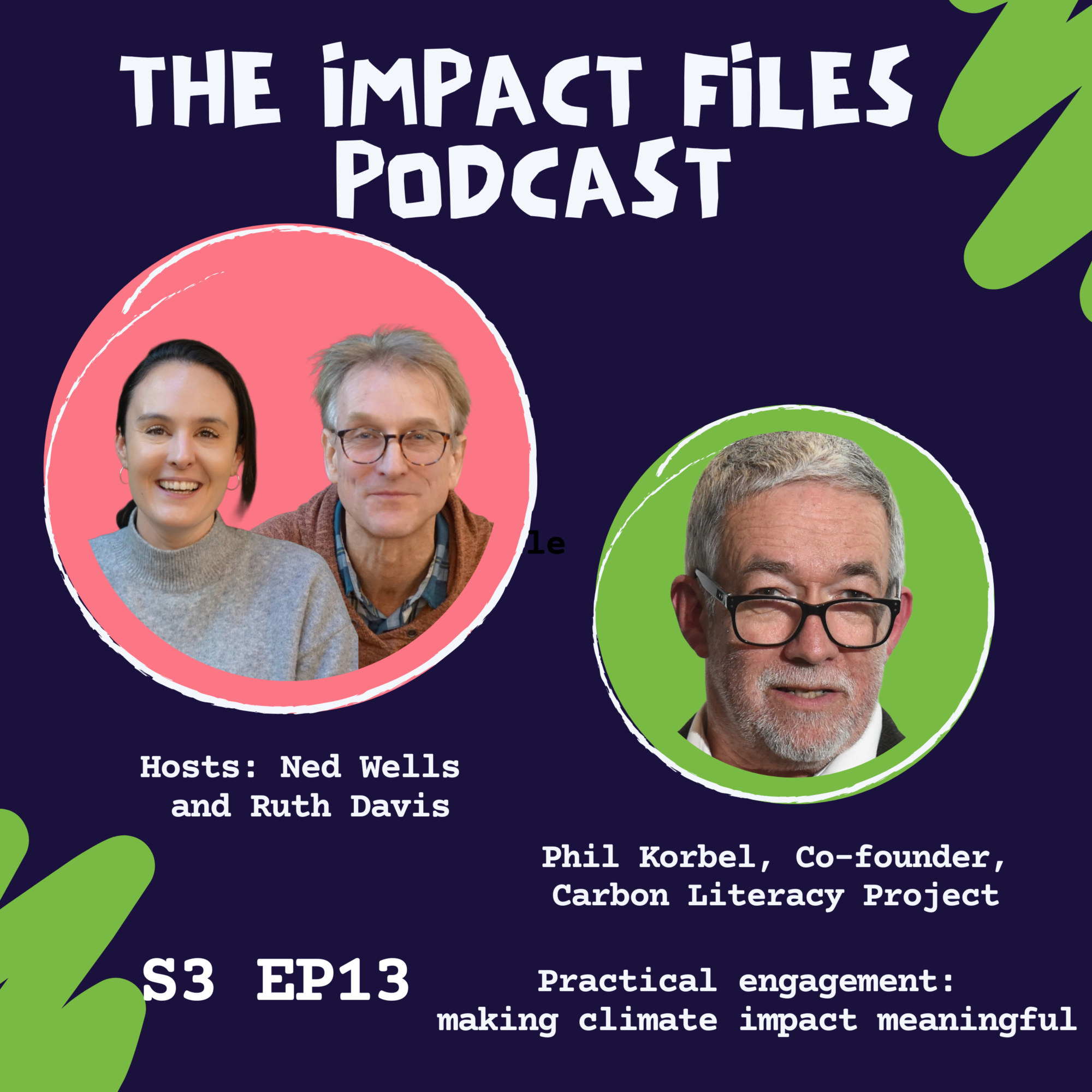
Ned Wells: Welcome to The Impact Files podcast. This week, Ruth and I are joined by Phil Korbel, co-founder of the Carbon Literacy Project. Phil, welcome to the podcast!
Phil Korbel: Great to be here. Thanks for inviting me.
Ruth Davis: Hi, Phil, welcome.
Ned Wells: Phil, let’s start with an introduction to you, to the Carbon Literacy Project, and its mission. What do you do over there?
Phil Korbel: We’re a fair-sized charity that simply enables anyone to train their own people in a day’s worth of climate action skills – learning and doing, as it were. We exist because we’ve just got to break out of the eco niche – the eco-ghetto – and get everyone on board. I think the vast majority of people want to do their best thing, and we’ve devised an adaptable framework for a day’s worth of training that enables anyone, whoever and wherever they are, to discover, devise and start their best climate thing.
We do that by certifying courses to our framework – a very adaptable framework – and certifying learners and organisations. So it’s not just an impactful methodology: you get a badge as well – external verification. As of today, we have certified 164,000 people across more than 50 countries, and actually across all seven continents. I can say that with confidence, because we do have training in Antarctica.
My co-founder, Dave Coleman, and I started this 13 years ago.
Ned Wells: Hmm.
Phil Korbel: And it keeps going, and keeps growing. I’m sure the reasons have changed since we started, but it’s a joy, and endlessly fascinating.
Ned Wells: And where did it start for you, Phil? I’d love to hear about your journey from when you started work to where you are now.
Phil Korbel: I discovered there’s a name for the degree I got: it’s a Desmond – as in a Desmond Tutu, a 2:2. I scraped a 2:2 in law, quite proudly, at Manchester Poly. And the reason it was a Desmond was that I was very constructively distracted by the world of media.
I ended up running the student newspaper, which proved to be an intro into the BBC, and I was a radio producer and presenter, mainly for network radio, for quite a while. That was a really good job for a young person with low rent. So that was my first career.
Now, this must have been 1989 – yes, I know, I don’t look that old – I made a documentary, which I’ve found out is now on BBC Sounds, about two people riding a tandem from Sydney in the cause of rainforest conservation. I was getting cassettes back from the four corners of this ride, and I got so swept up in what I was hearing from these two lovely people that I had to make the jump from producer to participant.
In 1990, my then-partner and I packed a tandem onto a plane, took the thing to Sydney, and rode it back. Twenty months and 14,000 miles later, I think it’s fair to say I came back a different person. If a trip like that doesn’t change you, nothing does.
That eventually led me to set up a charity to establish community radio stations on the estates where the BBC said it was unsafe to go unless accompanied. So it very much broadened my vision of sustainable development. I’d always been a member of my local Friends of the Earth group, Manchester Friends of the Earth.
Ned Wells: Hmm.
Phil Korbel: And my vision then was, I suppose, a fairly standard “save the whale, save the tree, save the shrimp” type of environmentalism. You do a ride like that through the Global South, and you see how sustainable development needs to land – and involve people, society and the economy. That’s one of the changes that happened to me.
Giving voice to disadvantaged communities was the first thing I could do using my skills, and it professionalised my enthusiasm for sustainable development. So Radio Regen was at the forefront of what was then an explosion in community radio. That was great and worthwhile. We kept the thing going and it got national standing.
But I also became a dad. And I started having imagined conversations with my daughters – imagined, because they were babies, and these were slightly more sophisticated conversations – where they were going, “Dad, what did you do to stop this blooming mess?”
Ned Wells: Referring to climate?
Phil Korbel: Climate change. It was a growing voice in my head that I had to do something to protect my girls. That eventually led to setting up a social enterprise consultancy with Dave Coleman, with the idea of bringing a not-for-profit attitude, alongside professionalism, to getting people on board with climate change.
That got us involved in Manchester’s first climate action plan, and that’s where we really started. It was a proper stakeholder process. The City Council rightly said, “We can’t do this on our own. This has got to be a whole-city thing, so we need to hear from the whole city.” And we were brought in as part of the team to enable that.
This was around the time of the Copenhagen COP. As you’d imagine, we were getting some brilliant ideas – “We can do this, we can do this” – technological innovation, policy innovation, all sorts of great stuff that would really move the dial.
Ned Wells: When are we talking, Phil?
Phil Korbel: When was the Copenhagen COP? We’re talking 2010, when this was really gestating. I may be getting my dates slightly wrong, but it’s in the right zone.
Ned Wells: Gotcha.
Phil Korbel: But it occurred to me that everything we were talking about was supply-side. These were things people could buy, implement or do, and no one in this new enterprise was looking at demand. We all knew it was right, and that we had to do it, et cetera, but the thought of actually building demand and engagement for it really wasn’t there at all.
Ned Wells: When you say “it”, what specifically are you thinking of?
Phil Korbel: Climate action. So, engaging the populace in the mission to decarbonise, in an impactful way.
Ned Wells: Hmm.
Phil Korbel: In one of these big committee rooms, I just piped up and said, “Well, we need to get people on board. We need Manchester to be carbon literate.”
Ned Wells: Hmm.
Phil Korbel: And you could see people go, “Ooh.” It became a big, audacious goal, in the way of snappy headlines. We sort of knew what we meant, but there was very little detail. I was the first to put my hand up.
Twelve months later, it was embedded in the plan. We’d worked with some very wise educators, employers and campaigners to say, “Right, we need large-scale, impactful engagement. How do we do this? Training. Should we go out and train people ourselves? No, no, no – if we went out and trained everyone ourselves, it would be criminally slow.” So we needed a methodology, a framework, that was adaptable enough to address people’s actual priorities, whilst having enough consistent elements to maintain impact and quality. That’s where we came up with the framework, and external validation through certification. And that’s how we started.
Ned Wells: What was the conversation around whether you’d do that through a consumer channel or by talking to businesses? That must have been an interesting one.
Phil Korbel: Oh, we solved that one. It’s everyone. We had to get through to everyone, so all channels, basically. Our pre-eminent people at the beginning were Manchester City Council – a large local council – and a FTSE 100 company in Auto Trader, and all points in between.
Ned Wells: Okay.
Phil Korbel: So we find advocates and champions who implement Carbon Literacy, and then they spread it.
Ned Wells: I ask because the way you tell the story makes me feel the motivation would be to talk to families and people, rather than organisations and businesses. And I guess the approach is different, isn’t it?
Phil Korbel: It is. Actually, our emphasis is on workplace action. We believe domestic action follows once the penny drops – you’re going to do stuff – and there’s lots in a typical course about carbon footprints and things you can do. But we believe the most impactful stuff tends to be in the workplace. Horses for courses, though.
Within the day, everyone has to devise their two best actions: the best action you can take as an individual, and the best action you can take as a group. And that always has to be proportionate. If you’re a chief exec, it’s got to be bloomin’ big. If you’re on a zero-hours contract at the bottom of the pile, well, there’s still a good thing you can do. We’ve got great examples of that, too.
Ruth Davis: Thanks, Phil. I was wondering if you could tell us a bit more about how Carbon Literacy works in itself. Say someone like me comes to you and says, “I want to do Carbon Literacy.” How does the model work? What does my team get? What do I get? If you could tell us a bit more about how it actually operates, that’d be really helpful.
Phil Korbel: I’ll give it a go, Ruth. When Ruth Davis PLC knocks on our door, the first thing we do is get an instinct for your priorities. Like any task, it’s: how do we enable you to thrive by taking up what we do? We look at your sector. We try to introduce you to people like you, who are already doing the thing. We have an extraordinary community of practice across the thousands of organisations working with us. There are so many open doors, and so much enthusiasm – people want to talk about it.
So we’d introduce you to people in your sector. Where possible, we’d try to get you onto an existing course, so you can try it for yourself. It might not be exactly right for you, but you’d get a sense of what it’s about. Then we’d work with you to do a learner needs assessment: who am I going to train, and how will they best respond, in terms of content and methodology? And we’d work with you to create your own course.
We’ve got a fantastic team that works on content, and there are some free foundational materials. So the joy is, you don’t have to get your crayons out and draw the greenhouse effect. We’ve got all that stuff – the generic materials. We walk you through the framework, with its eight learning outcomes, its three methodologies and so on. Imagine this framework has got all this stuff, but loads and loads of gaps. You fill those gaps with your stuff: the stuff that enables you, collectively, to thrive. What are your priorities? What are you responding to? What might you respond to? How do you unlock the risks and opportunities inherent in tackling climate change? All of that goes into the framework.
Ultimately, sadly, there is a form you have to fill in. You fill in the form, submit it, and pay us to certify the thing. The price is, as you’d expect, on a sliding scale: from zero, if you’re an unfunded community group, right up to a modest few thousand if your turnover is over a billion pounds.
We also support your training capacity. To deliver the training, you basically have to be carbon literate yourself, and then we support you, and off you go and train. At the end of the training, you submit evidence from the learners, which is basically a description of those actions I talked about. That comes back to us, we read it, and we issue certificates. As a sweeping average, there’s about an 85% pass rate. It’s a pass-fail thing, and if you fail, there’s a chance to catch up.
Ruth Davis: Okay, that’s great. And how long would you say the process takes for an individual to become certified?
Phil Korbel: From dropping the evidence to us at the end of the course, it’s about a four-week time lag at the moment, though that varies depending on demand. And from first contact to your first delivery, if we’re really shifting, you could think six weeks. That’s going at quite a lick, but yes.
Ruth Davis: So I’m hearing it’s very tailored, depending on organisational, sector and industry needs.
Phil Korbel: It absolutely has to be. Our three methodologies: relevance, or local learning, is the first. It all has to be about your place, your sector and your organisation. We insist on that. We also insist on maximising peer-to-peer delivery. The last thing you want in a room on the shop floor is some beardy, worthy guy going on about polar bears – and I speak as a beardy person. You want someone like you talking about this. And thirdly, active collaboration. You can’t just have a long lecture, or a load of e-learning. All the trainers tell us it comes alive when people are talking to each other.
So we insist on those three things happening in a way that’s appropriate. Sometimes people sit down for a whole day. Sometimes it’s half e-learning, half live, or a series of modules.
My favourite example of stretching this quite a bit: you know that lovely red Antarctic research vessel, the Sir David Attenborough – the one everyone wanted to call Boaty McBoatface? That’s my favourite training venue for Carbon Literacy, because we work with the British Antarctic Survey. The only time people get together on the Sir David Attenborough is for an hour after dinner in the ship’s lounge. And because it’s a bit social, they’ve actually put an element of pub quiz into the training. So it’s an hour a day over the course of six or seven days, as they chug their way down to the Antarctic ice, with a bit of a pub quiz flavour. So we have polar explorers and scientists in our community.
That’s a great example of fitting it in. Others do it with shift workers, or with people with low IT skills, et cetera. It’s very adaptable in how it works. And again, we enable people to find out what others like them have done to tackle these challenges.
Ruth Davis: Just a clarification question, Phil. So you train people to train in Carbon Literacy?
Phil Korbel: We support people. When we started, we trained trainers. There are some brilliant train-the-trainer offers out there now as well, and a few independent trainers run those too. You don’t have to have training experience to deliver; you have to be carbon literate.
Then, if you run three courses with a bit of self-evaluation, we can issue you a Carbon Literate Facilitator badge. We don’t insist on that. Then you can become a Carbon Literacy Trainer. And the crème de la crème – the crown jewels – is a Carbon Literacy Consultant. There are only 11 of that species in existence in the world, and we’re trying to increase that population at the moment.
Ruth Davis: Wow, thank you.
Ned Wells: Our audience on The Impact Files podcast, Phil, are leaders of established SMEs, with perhaps 15 up to maybe 50 employees, in every flavour of product and service. That’s the context I’m thinking about. When the trainer or facilitator has trained colleagues in their company, is it a one-off thing, or is there ongoing support? Do you revisit them? How does that work over the longer term?
Phil Korbel: It’s a really good question. To some extent, we stay in our lane. We’re the starting gun – we’re the foundation. Become carbon literate, and the light bulbs will go on, and you’ll crack on with stuff.
Ned Wells: Hmm.
Phil Korbel: But to address how we sustain it: we don’t monitor the delivery of actions – we just don’t have the capacity for that. What we do have is our Carbon Literate Organisation scheme, which is a bronze-to-platinum award that organisations can climb.
For bronze, you basically need the boss or the chair to be carbon literate, and to have a course – and do a quick video, that type of thing. Silver is 15%-ish of staff, and at silver you have to have a formal process for supporting carbon-literate actions. That’s normally KPIs, supervisions or appraisals. Some folk have run competitions to make sure it’s sustained. Going into gold and platinum, it’s about increasing the number of staff trained, but also about how you spread Carbon Literacy outwards. There’s a menu of those activities. So that’s the main way we sustain things.
But we do find that if a company is serious about this, it sustains itself. Staff enjoy Carbon Literacy training – that’s the strongest bit of feedback we get. And I think that comes from, as I say, most people wanting to do the right thing but not knowing what it is. Then work pops up and says, “You know this climate stuff? We’re going to give you some skills and let you crack on with it.” That’s really empowering. It’s a good bit of wellbeing, and it’s part of being a good employer – a purposeful employer. All those things come into play. Often a green group will pop up, or an internal messaging network. There are very different ways in which it sustains itself.
And it also aligns with other standards. We stay in our lane – it’s about Carbon Literacy – but in BREEAM, in ISOs and in B Corp, there are lines about staff engagement and staff education.
Ned Wells: Hmm.
Phil Korbel: Which we fulfil very nicely. So it helps with those wider standards as well.
Ned Wells: My thoughts are turning to the business of running the Carbon Literacy Project. I’m curious about it as an organisation – numbers of staff, and anything you could share about revenues. There must also have been conversations about the business model. Is it a one-off charge, and then how do you sustain your clients for ongoing revenue? I’d love to hear about that.
Phil Korbel: This is me stretching for the figures, but I think last year’s turnover was £1.8 million-ish.
Ned Wells: Hmm.
Phil Korbel: The vast majority of that is certification revenue. We’re a registered charity, but we’re very much a social enterprise. We live off revenue for our charitable services – our educational objects and so on. And normally, again, that comes simply from people being trained.
Certification for Carbon Literate Organisations has to be renewed every three years. One thing I haven’t covered yet is that we have sector-facing training toolkits. So if you’re in the public sector – central government, local government, health, education and so on – you don’t have to design a course. You can buy a licence to use a pre-prepared training toolkit, which renews every two years, for example.
So there are renewable badges. But really, even at 164,000, we’re only just starting in terms of demand. We’re absolutely looking at ways to maximise value from each client, but the starting point is the number of people getting trained.
Ned Wells: Over the 13 years the Carbon Literacy Project has been going, have you seen a change in the appetite for this kind of training?
Phil Korbel: Very much. When we started, it was enthusiasm. It was “Are you green? Is that part of your, and your organisation’s, identity?” And it’s moved more and more into the mainstream. What organisation isn’t adversely impacted by extreme weather? People are starting to see that. And many organisations – there must be some exceptions – are either implementing, or on the receiving end of, regulation or procurement requirements. That’s how it’s moving into the centre, and thus our demand grows.
In procurement, our headline example is the tiny tunnel being built under the Thames – the Lower Thames Crossing – with jaw-dropping budgets and the like. National Highways has oversight of this humongous piece of civil engineering, which is billed as the greenest construction project, et cetera. In the tender, the three prime contractors – one for the roads in the north, one for the roads in the south, and one for the bridges and tunnels – had to commit to becoming silver Carbon Literate Organisations within 52 weeks of project inception. So there it was, in black and white.
Another contract came out of the government’s Department for Energy Security and Net Zero, DESNZ. They put out a tender for a retrofit information service, RISE. They didn’t mandate Carbon Literacy, but they said that another metric they’d be interested in was the number of certified carbon literate staff you have. So again, a smart would-be supplier goes, “Oh, hang on, this isn’t a nice-to-have. This is going to get us the gig.” Which it did. That one was won by the consultants Turner & Townsend, who really did have their heads around Carbon Literacy.
Ned Wells: And how interesting that they chose Carbon Literacy certification, rather than any of the others that are out there.
Phil Korbel: Well, this is the thing – there are others out there. I like Climate Fresk, for example. Fresk is quicker and cheaper, but it doesn’t have the external validation, or the explicit emphasis on action. So if you want something that’s externally validated and customised to your sector, I think we’re pretty much it.
Actually, I’m going to rewind on that. ISEP do some fantastic stuff as well, but it’s not as customised. And the Cambridge Institute for Sustainability Leadership is right up there, if you really want in-depth expertise. But I think, for that foundational thing that’s recognised at scale now, I’d like to think we’re it. You’d have to ask the people who wrote the tender. I’d love to claim some credit for saying, “Oh, you need this in the tender, mate.” But no.
Ned Wells: And half a day, you’re saying, is the training requirement?
Phil Korbel: No – Fresk is half a day, thereabouts. Carbon Literacy is a day’s worth, and that can be chunked in any number of ways.
Ned Wells: That makes it very accessible.
Phil Korbel: Yes, but impactful. Oh, the arguments, Ruth and Ned, when we were putting this together! “A day’s too short, you can’t do anything in a day.” “A day’s too long, no one’s going to do a day.” You can see how it went.
Ned Wells: Yeah.
Phil Korbel: Together, we hit on a day as the sweet spot for still being impactful.
Ned Wells: Ruth, over to you.
Ruth Davis: Thanks, Ned. Phil, it’d be really interesting to hear, in your own words and from your point of view, what the business case is for organisations pursuing Carbon Literacy. Imagine you’re speaking to the CEO of a 30-person professional services business. I really, really want to roll it out, but my finance director isn’t on board. He doesn’t think it’s relevant, he thinks it’s a distraction, and he thinks it’s a waste of money. What do we say?
Phil Korbel: Where do I start? Wake up and smell the coffee!
I’ll give you some headlines. Motivated staff will save energy, which saves money. Who doesn’t want to lower their overheads? That’s a biggie. There’s an engineering SME near us – specialists who make machines that make machines, specialist lathes and things. Someone on the shop floor said, “Well, what if we do this, and this?” They saved 60 grand on their annual energy bill, just from people going, “What if we…?” So, one: motivated staff save money.
Two: get and keep work. If you’re in a supply chain, or you’re just public-facing, it’s not that people are asking, “Are you doing the right stuff on climate?” They’re saying, “What, you’re not?” Not doing this is trashing the planet. It’s a bad look. And if you’re in a supply chain for the public sector, you absolutely have no choice. Every public sector organisation is legally obliged to put net zero and climate targets into its contracts.
Ruth Davis: Yeah.
Phil Korbel: The third heading is risk management. Particularly as the CFO, if you don’t have a handle on your risk exposure to extreme weather, new climate regulation, et cetera – how do I put this? You’re incompetent.
Ruth Davis: Hmm.
Phil Korbel: You’re actually professionally incompetent. So wake up and smell the coffee, if you’re really dozy enough to think this has nothing to do with business. There’ll be exceptions, of course, but really.
And the other thing that comes in is attracting and retaining the best staff. A whole bunch of people want to work for purposeful employers. This came through really strongly with Auto Trader – I know they’re not an SME – who live and breathe by attracting and retaining the best talent. They’re an immaculately good employer, because it’s the right thing, and because it attracts and keeps the best talent. This is part of that package.
You’ll notice I haven’t mentioned polar bears at any point. Profit flows. It’s all about stuff where – duh – why would you not?
Ned Wells: Hmm. Yeah.
Phil Korbel: It’s also really, really popular, and once you do it, you get it. So it’s one of those things where I’m always happy to say: just try it. Start small. Dip your toe in the water, and see how it enables you to thrive.
That’s what I’d say – obviously with fewer sweeping generalisations, and more about their sector and their business. Professional services is really interesting. We’ve got some big commercial law firms – DLA Piper, DWF and Osborne Clarke, amongst others. They’re doing it because their clients are absolutely insisting on it.
But it’s almost a case of “name the sector”. Automotive, via Auto Trader: if anyone watching or listening is in automotive, there’s a freely available training toolkit for anyone in the automotive sector, and monthly free introductory training. So you can come and try it, and hopefully go on to deliver the training. It’s very widespread. Really, it’s about saying, “Look at what these guys are doing. Don’t get left behind.”
Ruth Davis: Thanks, Phil. I also love the point about training the people who are actually in a position to make the little tweaks that are going to make a big difference. And I think it’s great that all our listeners now have a very good elevator pitch to take to any senior leadership.
Phil Korbel: My job is to open these conversations with all and sundry. We had our awards the other week, and the two platinum awardees sort of say it all.
One was Groundwork Greater Manchester – a great charity. They’ve done amazing work with offenders around green building skills, to improve life chances once they get out; with NEETs – young people not in education, employment or training; and with corporate clients. So they’re out there, stretching the brief on who it can align with.
The other platinum awardee was a company I hadn’t heard of, but I was quickly schooled. They’re called Bobst. The brilliant woman from Bobst, Gwyneth, said, “You might not have heard of us, but virtually every piece of packaging on a supermarket shelf has probably touched a Bobst machine.” They make machines that make packaging.
Ruth Davis: Pretty wild.
Phil Korbel: And she was a specialist in – get this – the shiny aluminium film that goes on the inside of crisp packets. That’s the particular thing her factory in Manchester does. So all life is there, and we can always introduce people to that community of practice.
Ned Wells: Are there sectors where you feel you’re lagging behind, and would like to get more penetration?
Phil Korbel: Yes, and I think it’s slow for good reason: retail. I think that’s mainly because of the vast numbers of staff, and staff churn is a thing there.
Just today, I was reading about a learner from B&Q, one of our high street brands. This is training made by B&Q for B&Q staff. What did he say? I think he said 10 million litres of paint are wasted every year – I might have the figure slightly wrong, but it was definitely millions. His action was to do customer-facing awareness-raising about the damage that waste does: “Use all the paint.” That’s a very solid message, and something people could do. So the power of retail is really great, and I hope the example of B&Q will inspire others to do the right thing.
Interestingly, that started with the commercial team, not yet the shop floor, but it’ll trickle out.
Ned Wells: That would be really powerful.
Phil Korbel: And, again, it’s about making it normal. When B&Q are doing their lovely DIY sessions in the big shops, you just add this in. Don’t make it a green session – just make it part of what you do.
The other sector I’m itching to get into is agriculture. We do quite a bit with food, and we’re acutely aware of the sensitivities of many in the agricultural sector about something else being imposed on them – another cost, when they’re feeling financially fragile. “Oh, these people are just telling us other stuff to do.” Now, Carbon Literacy doesn’t tell you what to do. It says: here’s the situation, here are the risks and opportunities around it, and here’s some good stuff other people are doing – what would you do? So I think the potential for the farming community is to channel their passion for and knowledge of the land into appropriate solutions that help them thrive through climate action. It’ll come. It’s so caught up in the culture wars, particularly in farming, but we’ll get there.
Ned Wells: That’s a very nice framing, as you say – deliberately not imposing more stuff on a community that’s already having a very hard time.
Phil Korbel: We do a similar thing, Ned, with anyone on a low income. We work with social landlords’ tenants, for example. If you’re on a low income, you’re going to have a low footprint. The last thing you want is someone going, “Oh, you’ve got to lower your footprint,” while you’re going, “I want to feed my kids and be able to afford the rent, thanks.”
Ned Wells: Yeah.
Phil Korbel: So the training there is about the other benefits that come from climate action. Active travel makes you healthier. A bit less meat and dairy will make you healthier. No, we’re not saying go vegan. We’re saying maybe two fewer meat dishes a week. So, again: what’s relevant, and how do you thrive by acting on climate?
Ned Wells: I wanted to move the conversation on to the role of communications, if I may. It would be really interesting to hear from you, Phil, about what you’ve seen go well, and perhaps less well, when organisations communicate Carbon Literacy to their audiences – their partners, employees, customers and suppliers.
Phil Korbel: Where it goes wrong is where it comes across as too worthy, or as doing less. I’m a huge fan of WWF, seriously. They do extraordinary work. But Earth Hour – is that still going?
Ned Wells: Yep.
Phil Korbel: Switch everything off for an hour. Just the messaging around that: sit in the dark around a candle and shiver. I know, I’m exaggerating. But that whole thing is a bit too hair-shirt, when there are so many brilliant things you can talk about on climate action. So that whole thing about it being “less”…
Give me a second here – I came prepared.
Ned Wells: Oh! What have we got here?
Phil Korbel: This is Pablo the polar bear.
Ruth Davis: We’re on YouTube now, Ned.
Phil Korbel: Exactly – I was relying on that. You’ve got to drop the polar bear. It’s not about polar bears, folks! I love polar bears. They’re extraordinary and iconic, and I’ll lap up any number of nature documentaries. But it’s just a nature documentary. Am I going to make the changes I need to make in my life because of a starving polar bear on a melting ice floe? No. It will connect for some, of course it will. But for the folk we need to get on board, it’s not enough.
So I think it’s got to be about how we thrive, and how it matters to us. Successful stuff: our local junior football team, for example. A couple of years ago, during that really, really wet winter, they lost 40% of their practice sessions, had to abandon matches, and had their worst season ever, because the pitch got flooded. And it’s more likely to get flooded because of climate change. So there are these impacts.
We work with fire services, who get more call-outs due to extreme weather than they do for Guy Fawkes Night.
Ned Wells: Really?
Phil Korbel: Oh, yes – certainly in Greater Manchester. And we were doing some training. We don’t train, but we made an exception. There’s this guy, Andy Burnham, kicking around.
Ned Wells: Oh, yes.
Phil Korbel: And he said, “What are you going to do for the conurbation, guys?” And we said, “Okay, we’ll train some people. You give us public sector leaders, we’ll train them.” So we had a bunch of public sector bosses in a room, and we started by asking, “How does your job change in extreme weather?” We asked the chief constable, “How does your job change when it’s hotter?”
“We arrest more people.”
“What?”
“Yes. There’s more violence and more theft during hot weather.”
I said, “Come on, that’s canteen banter, isn’t it?”
“No, we’ve got the data.”
“All right, you’ve got the data. At what level does this kick in?”
“The graph starts to go up at 18 degrees centigrade.”
Ned Wells: Really?
Phil Korbel: That was the reaction of the whole room. “Oh, bloody hell.”
Ned Wells: Wow.
Phil Korbel: So it’s these tangible things, and it can be something really dramatic like that. Back in the day – this is how long ago it was – there was a drought that really hit the breadbasket of Ukraine, and the makers of Mini Shreddies had to withdraw Mini Shreddies from the supermarket shelves, because there wasn’t enough wheat. Disappearing Mini Shreddies! You know what I mean.
Ned Wells: That is a disaster!
Phil Korbel: It’s ridiculous – but it’s tangible.
Ruth Davis: You meet people where they are, don’t you?
Phil Korbel: It’s not a polar bear. So that’s the flip side – the negative impacts. And then you’ve got the whole win-win-win stuff. I’m a new adopter – the owner of my first electric car, which I got for the same price as its petrol equivalent, and I’m going to be running it for a third less than the petrol equivalent.
Back in the day, we worked with a neighbourhood retrofit going on in Manchester. There was a fairly – let’s say – indomitable member of the tenants’ committee, who turned into the best-ever champion for retrofit, because she said, “You should see my bills! Come round – lovely, snug house – you should see my bills.”
Ned Wells: Really? Yeah.
Phil Korbel: So many wins. And there’s the personal stuff: you feel better, because you’re actually doing something about it. Telling the story of what people are doing, and why it works – that’s the way to get it across. Then you can go into the science, and then you can go into the doomy stuff. But until you get connection, no one listens.
Ned Wells: So the starting point is to make it relevant and to make it positive.
Phil Korbel: Absolutely.
Ned Wells: Ruth, over to you.
Ruth Davis: Thanks, Ned. You mentioned earlier, Phil, that it’s 164,000?
Phil Korbel: As of today, yes.
Ruth Davis: Very up-to-date figures. And your goal is quite ambitious: certifying a million individuals as carbon literate by 2030. How are you tracking on that? Are you seeing the numbers go up substantially every year? Are you still hoping to hit that figure? And are there any other developments coming up over the next 12 months or so?
Phil Korbel: A lot of my work is about spotting where we can start cascades. Obviously, we can go from employer to employer, place of education to place of education, village to village. But it’s the cascades that really count.
We’ve just started an initiative called Carbon Literate Localities. If you remember, there were Fairtrade Towns. That was a thing – you’d actually see it on a roadside: “You are now entering a Fairtrade town.” We want to see that for a Carbon Literate Locality, so it becomes part of the identity of your place. So we have a scheme where the locality signs up, we do a quick survey of who’s doing what, and then a target is set for 15% of that population to be certified carbon literate within three years. We set up a website, everyone signs up to it, and we tally the numbers as they go up. That’s how we’re trying to initiate our own cascades.
Beyond that, I think more work in procurement. We’re just launching a paper for public sector procurement – for the poor, benighted procurement managers in the public sector who are going, “Oh, we’ve got net zero targets – how are we going to do this?” Well, hang on, we can help you there, by putting Carbon Literacy into tendering. So we’re always looking at the places that move us on from linear growth to exponential.
Ruth Davis: Your growth…
Phil Korbel: Our growth graph is the good hockey stick graph.
Ruth Davis: And how do these localities fit in with the sector work you’ve been doing? Does it still rely on people’s workplaces? Because that’s moving from someone’s profession more into their day-to-day life – or would they have to fund it themselves?
Phil Korbel: No, it still tends to be the workplace or place of education. I’m probably being a bit premature in saying this, but I’m hopeful that Rotary, for example, are going to come on board.
Ned Wells: Oh, that would be cool.
Phil Korbel: And there’s an organisation called the Church of England – it’s quite widespread! They have a training kit for any Christian congregation at the moment, and we’re working with other faiths too. Congregations can train their own. So it’s about seeing where we can land, where the gaps are, and equipping people to get on with it.
Ruth Davis: That’s so interesting.
Ned Wells: I wanted to move us on, because we’re approaching the end of our session, to ask you, Phil, what you think and hope the Carbon Literacy Project will look like in 10 years’ time, and how you think you’ll be measuring its impact then.
Phil Korbel: Well, in our case, size is everything. If we’re enabling people to start and do their best thing, it’s a numbers game. So yes, let’s have that million. But let’s go international. We’ve been delivered in about 50 countries, but it’s been very ad hoc. So, hopefully starting next year, we’ll be looking for international partners to be advocates for us in core regions – hopefully talking to the people who are already doing it, who can step up to play more of an advocacy role. So I think: bigger, and more sector-facing, shareable training kits, so people don’t have to write their own course.
Going back to the international side, we’re well beyond being limited by English. We have a course in Korean, and a course in Welsh. I think if you can do Korean and Welsh – and I think Basque as well –
Ned Wells: Fantastic.
Phil Korbel: – we’ve got some of the more gnarly languages covered. Obviously, greenhouse gases don’t observe national borders, and neither should we.
Ned Wells: That’s very exciting.
Phil Korbel: It’s very scalable, and it does speak for itself.
Ned Wells: And are there organisations you’ve been spotting in territories outside the UK that you think would be good?
Phil Korbel: No, it’s intention at the moment. We are working with various training organisations, doing stuff. But I’d love to lay claim to getting this to anything like a planned level. Not yet. I think that’s 2027, if that’s all right.
Ned Wells: Really exciting, though. Okay, one piece of advice for SMEs that are pursuing sustainability and financial objectives, if you please.
Phil Korbel: How predictable do you want me to be?
Ned Wells: I thought you might say that.
Phil Korbel: Get one of your team to do some Carbon Literacy training. Go to carbonliteracy.com, and there’s a drop-down called Events, I think, with loads of open training going on. Whilst the majority of Carbon Literacy happens within organisations, there are independent trainers offering open training, and there’s quite a lot going on for SMEs as well. Just get one of your people to go on a course. It’s a modest price. Go and have a go, and see what you think. And when you fall in love with it, come and talk to us.
Ruth Davis: Thank you.
Ned Wells: The website is carbonliteracy.com. And how can people find out more about you, Phil?
Phil Korbel: Well, there’s that. And I’m the only one of me on LinkedIn. I say that with some trepidation, because I sometimes go off on tangents. The dogs have popped up a couple of times. I did a recent post about the plague of littered dog poo bags…
Ned Wells: Ugh.
Phil Korbel: …with the intention of getting people to think about how you can change negative behaviours. Funnily enough, all people wanted to talk about was dog poo bags. But hey, I’ve learned that lesson. So LinkedIn is the place to find me, and carbonliteracy.com more generally.
Ned Wells: Fantastic. Phil, that was brilliant. Thank you so much.
Phil Korbel: You’re very welcome. Thank you for the invitation.
Ruth Davis: Really enjoyed it.
Ned Wells: Really enjoyed that.