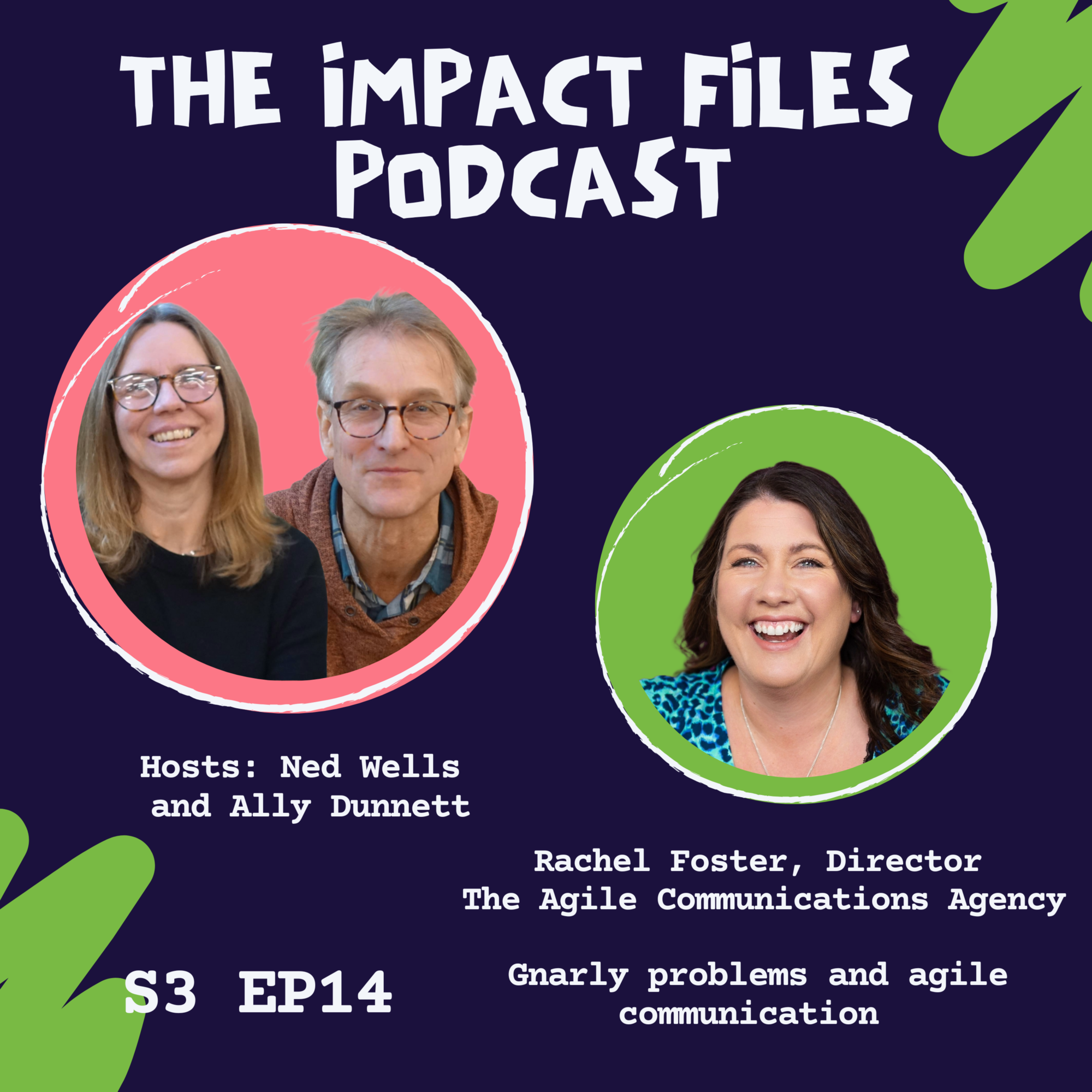
The Impact Files Podcast – Rachel Foster, Director, The Agile Communications Agency
Ned Wells: Welcome to The Impact Files podcast. This week, Ally and I are joined by Rachel Foster, Director of the Agile Communications Agency. Rachel, welcome to the podcast.
Rachel Foster: Thank you, Ned and Ally. Thank you so much for having me. I’m excited to be chatting.
Ally Dunnett: Hi, Rachel. Really nice to meet you too.
Ned Wells: So, Rachel, let’s start with an introduction to yourself, the Agile Communications Agency, and the work that you do.
Rachel Foster: Brilliant. I’m a chartered PR consultant, which essentially means I’m qualified to work in public relations. I tend to work more in integrated comms – a bit less in what I call media relations, and a lot more broadly now, across digital, stakeholder work and community engagement. So it’s a much broader approach to PR and communications.
My background is that I trained as a print journalist. I’ve just worked out that was 23 years ago – I was with colleagues this weekend when I realised it. The first part of that job was on a local newspaper, where I was doing things like inputting the cattle report, the market report and WI reports.
Ally Dunnett: Yes.
Rachel Foster: And now I’m moving into much broader digital content. I’ve been delivering some social media content, shooting and editing on my iPhone. But more broadly, my organisation works with quite large organisations on what I call quite gnarly communications problems and challenges, particularly around climate and community.
So my business is the Agile Communications Agency, and we’ve been running for about nine years now. I had another stint running a more traditional marketing agency before that, with little bits of freelance in between. I’m also a trainer with the Chartered Institute of Public Relations. The reason my business is called the Agile Communications Agency is that I’ve become a national specialist in applying agile methodology, which came from the software industry, to PR and communications.
Ned Wells: Hmm.
Rachel Foster: I developed a training course that has been running for about eight years with the CIPR. I’m off to see the rest of the trainers in London on Friday for our trainer update. So it’s quite varied, which I like. It’s nice to keep busy and varied.
Ned Wells: When you say gnarly problems, what are we talking about?
Rachel Foster: One of our clients is the International Transition Plan Network. It’s a team based in London, but they work globally, creating really high-impact thought leadership on how large organisations can transition to net zero. The outputs of their work are much revered and appreciated. They’ve recently been in Singapore for Ecosperity Week. We had a call with them just this morning, and they’re getting ready for London Climate Action Week. So that’s one example of a client.
We also have the Smith School of Enterprise and the Environment at the University of Oxford. An arm of that is the Oxford Sustainable Finance Group, and we’re getting them ready for their annual Oxford Sustainable Finance Summit at the end of June. So this month’s been pretty busy already.
Ned Wells: Mm.
Rachel Foster: And I also work with Whitbread and Premier Inn, on a campaign that’s more local to me. I’m based in Cornwall, and I’m supporting them on their St Ives hotel, which hasn’t been particularly well received by local communities. It’s really about understanding how we can get truthful and honest brand communications out about the built environment and construction elements of that project. I tend to say we don’t do PR for clotted cream, which you might expect in Cornwall. It tends to be more complex.
Ned Wells: Right. So, very briefly, what are the issues you’re wrestling with on the St Ives hotel?
Rachel Foster: There’s a very strong campaign group that doesn’t particularly want a Premier Inn in St Ives. There are some concerns about overtourism in the area. My position, and my client’s, is that one of the issues in St Ives is actually the very high level of Airbnb, and the impact that has on local housing and the community.
The reason I’m interested in this brief, from an ethics perspective, is that I’m thinking: how can we bring a bit of balance? People used to expect to pay up to something like £7,000 a week for an Airbnb in St Ives. So I felt that, for consumers and the community, this could be a useful addition to the market. It’s an interesting brief, where I’m doing a lot of listening and watching, rather than diving in and overdoing the communications. It’s about listening and understanding the issues people are concerned about. We’re just kicking that off again at the moment. I’ll be doing some very close-knit stakeholder engagement. I’ve revisited my stakeholder list for that, and put together quite a simple plan to work with them.
Ned Wells: I’d love to hear a bit more about the Agile Communications Agency. When we spoke off air, I understood that you’ve got – was it 10, 12, 15 people? – involved with the agency, but they’re not all employed by it. Is that right?
Rachel Foster: Yes. I now have one employee within the agency. When I set out, I didn’t necessarily want to build the traditional agency model, where you’re backfilling capacity and skills. I wanted to be able to work with powerful national and international brands and organisations, and bring in experience from my local supply chain in Cornwall. So for the University of Oxford, we have probably three or four other suppliers who help me work on those contracts. Whilst I’m not creating direct jobs, I’m creating a value chain of good fees coming into the agency and to the other creatives I work with, locally and nationally.
I just wanted to do things differently. And I know I’m not alone in that model. I think the agency model is currently struggling with the impact of AI. So it gives you flexibility – obviously to be agile – and to think, “What does this brief need? What does this project need? And how do I bring in the best skills and experience to deliver it?”
Ned Wells: Hmm.
Rachel Foster: People who are part of the wider team include the team from Hutch – Rob, Alex and Katie – who do really high-impact report design, for things like impact reports and research reports, and a lovely team of web developers. We also have really decent security and maintenance for our digital projects, because we need that when we’re working with the likes of Oxford. It’s just a lovely group to be working with. We’re all working together and collaborating, and collaboration is the heart of agile working in any case. So I wanted to bring that.
Ned Wells: Fantastic. Ally, I’d love to hand over to you.
Ally Dunnett: Thanks, Ned. Rachel, I wondered if we could take a step back. For any listeners who aren’t so familiar with agile methodology and agile principles – which, as you say, are rooted in software development – what exactly does it mean? I’m quite familiar with agile, actually, so I know there’s a lot to it. But could you give us a snapshot of what it means, and how it helps you with the sort of communications you’ve been describing?
Rachel Foster: The Agile Manifesto was developed about 20 years ago by a group of software developers who wanted to get together and rethink the way software, and indeed things like website projects, were being delivered. Normally that would be based on: “Here’s a set brief, and we’re going to deliver against that brief and that budget.” The success of the project would be that you’d delivered it on time and on budget. But what happens when you get to delivery, and the original brief doesn’t actually deliver value for the end user?
So agile is about thinking differently. It’s always thinking about how you’re delivering value. I’m not saying deadlines and budgets aren’t important, but sometimes you don’t understand the problem at the outset of a piece of work, so you can work it out together. I also think that in any kind of project management you need to build in really important wriggle room.
One part of the Agile Manifesto is “responding to change over following a plan”. In communications, marketing and PR, change is inevitable. There’s always going to be something out of left field that you need to factor in. When I’m teaching, I refer to something called the Excellence Theory of PR, which says that organisations deemed to be doing public relations excellently will plan up to 70% of their activity, and leave 30% as wriggle room. So generally I’m thinking: how do we plan 70 to 80% of our workload, for what we know, and build in capacity for the rest?
Agile is also about collaboration, understanding your stakeholders, and using data to make decisions. So it’s an interesting way of working, and there are different ways of starting to access it. There are practical tools, like Post-it notes to get your ideas out, which I’ve been using for a long time. And we work in sprint cycles – fortnightly sprints. For that Premier Inn project I was just telling you about, we’ve just agreed a fresh round of fortnightly sprints, to keep the content coming and keep updates to community members up to date.
Ned Wells: Mm.
Ally Dunnett: That’s great, thank you. That’s really helpful. When I first came across you and your organisation, I thought, “That’s interesting.” I hadn’t thought of applying agile to the world of communications and PR, and delivering a different type of results.
To move us on a little, I’d be interested to know your business case for sustainability. That’s a question we like to ask. A different starting point might be: what does sustainability mean to you, and what’s your business case at the Agile Communications Agency?
Rachel Foster: We’re a B Corp – we were certified last June, which beautifully coincided with me going to Glastonbury Festival, so I could celebrate in the loveliest of environments. So sustainability is crucial to what we do. But what people don’t always understand about the B Corp process is that it’s not just about environmental impact. It’s about community impact.
For me, the KPIs and structure I set for my business when we started were that it needed to be financially sustainable for me and for the people I’m working with, but ultimately it needed to offer mental and physical sustainability for us as human beings.
I had the most incredible coach when I set up my practice nine years ago: Chris Hines, an environmental campaigner and consultant, who set up Surfers Against Sewage about 30 years ago. We created a model because we recognised that he’d experienced burnout, and I was at burnout. A set of personal circumstances had led me to that point, including my marriage dissolving and leaving a business. So I was genuinely in quite a challenging place when I set the business up.
Ally Dunnett: Yeah.
Rachel Foster: It was: how can I actually work and live in Cornwall, keep a roof over the heads of my two children, who were at primary school at the time, work with hugely impactful clients on a national basis, and keep everything ticking over, financially and from a mental health perspective? So that was a real foundation. Those were the principles I wanted to set the business up on. It needed to be sustainable for me, my mental health, my family, the environment and the community.
Through that, I was quite clear that I’d be working a four-day week. I’ve now been working a four-day week for 15 years – my eldest daughter is in the middle of her GCSEs. And when I started employing people within the business, we became an accredited four-day week employer. That’s something I’m really passionate about. How can we do this amazing work – strategic, creative, really high quality? We have to protect brains to be able to do that.
Ally Dunnett: That’s so interesting, thank you. The four-day week is a great concept. Probably like most of us, I know businesses that have tried it, or have even made public statements that they’re working a four-day week, but when you scratch the surface, that’s not really the case. But it sounds like it’s been immovable for you. You’ve really been able to stick to it.
Rachel Foster: Yeah. Our full time is 30 hours. Some people do compressed hours, but the presenteeism of sitting at a desk for a full five days doesn’t make a lot of sense to me. When I’ve met other four-day week businesses – we went to Westminster in October last year and met a few others – it’s about thinking: which tasks and activities are genuinely driving value, and what can we cut out and streamline?
I saw the impact email had on workflow just over 20 years ago, and now we’re seeing the impact of AI on how we practise, in business and in agency life. If we’re going to speed up our processes and make things more streamlined, what are we going to fill that time with? We ought not to be filling it with more stuff. It ought to be more about wellbeing, amazing strategic thinking, decent creativity, and space and time to problem-solve – all the things that are difficult to sustain if you’re constantly churning it out, sat at a desk.
Ally Dunnett: So I imagine you have other strategies within that, which speak to the mental health of you and the people you work with, and which in turn enable that creativity. You’ve said a couple of times that you don’t want to be just sitting at a desk. So do you mix up how and where you work?
Rachel Foster: Yes. I’m dialling into this podcast from home. My colleague and I work from home most of the time – three of the four days. We have an office near where I live, in Truro in Cornwall, which is a lovely space to work. It’s got lots of green space, and access to a riverside trail and walk. It’s co-working space within quite a large, very creative business that distributes music online. So we have that remote, hybrid approach to work.
As part of being a B Corp, we also do something called green and blue days – up to four volunteering days a year. I was just checking our impact report, actually – it’s for 2024, so we need to update it. Through our green and blue days that year, we planted 100 trees. We’ve just spent a day with a local horticultural charity, where we spent quite a lot of time deadheading plants. That was quite interesting from a business perspective, at the beginning of the summer, because it’s about cutting away things that aren’t great and making space for new growth, which I thought was a lovely metaphor.
Ally Dunnett: You’ve got a great ready-made metaphor there. Love it.
Rachel Foster: So we do that, and we do litter picks. We’ve got access to the coastline, but we’ve done more green days than blue days, which is partly my influence – I’m interested in woodland and nature.
We also have a set amount of volunteering. Even though we have our four-day week, we’re really sensible with our capacity, so we factor in how much we’re going to do from a volunteering perspective. My colleague Charla is a B Local co-chair, which effectively means she organises local events, so that’s her volunteering. We did 100 volunteering hours in the last business year. And I’m a trustee for a local MS and neurotherapy charity. So all of those things are getting us out and about.
Ally Dunnett: That’s great. And you mentioned the 100 volunteering hours, so you’re tracking it and factoring it into your own internal KPIs and reporting – the impact that the volunteering and the green and blue days have on your wellbeing and your ability to do the creative thinking. That’s great, thank you. I’ll pass it back to you, Ned.
Ned Wells: It’s really interesting listening to you, Rachel. On the four-day week, I’d guess that for more conventionally set-up organisations, with more employed people, a four-day week is going to be logistically more complex than with a more distributed arrangement like the Agile Communications Agency’s, where you’re partnering with – I’m guessing – small organisations and lots of self-employed people. But I can imagine it could get more complicated with the sorts of clients you have, where I’d guess the culture is more around a five-day week – Oxford University and so forth. So it would be very interesting to hear how you’ve handled those client relationships when maybe they expect you to be in the office on a day when you’re just not.
Rachel Foster: A lot of that’s about boundary setting. People can be away from their desks for a number of other reasons – they could be at a conference or an event, for example. Some of our clients don’t even realise we do a four-day week. It’s not that we don’t shout about it, but it’s quite an internal message – it’s more about how we run our culture within our very small team. When I think about the reaction of my client Lucy, who works at the Smith School at Oxford, she was amazed, surprised and delighted that we offer that to our team. And clients are never let down. There’s always someone available.
We don’t tend to have a set day off – some organisations do. We tend to flex our hours depending on demand at any particular time. So as things start to get busy in June, with all these events our clients are working on from a national climate perspective, we’ll just consider that when we set our hours. It might mean some later days later in the week, and some later starts or early finishes at the beginning of the week. We try to work when our brains work best. For me, that’s certainly not between 2 and 4pm, but I’ll then get a bit of a spurt later in the afternoon. So our core hours, when we’re available internally, tend to be 10 to 3.
But it is a divisive thing. When I talk to people about it, the initial reaction is often, “That will never work for us.” I would challenge any business or organisation to explore how it could work, because there are hundreds of examples, across sectors and business structures, through the 4 Day Week Foundation, of organisations that have successfully implemented it. For anyone who says that, I’d bet there’s an example within the 4 Day Week Foundation of how someone like them has implemented it successfully. But it does feel divisive. Even the current government hasn’t been so keen, because they’re concerned about how it impacts productivity. But you have to rethink what productivity looks like. To me, productivity is not sitting at a desk.
Ned Wells: So rather than routinely not working on, say, a Friday, you’re spreading your 30-hour week across the week to suit client needs and your own needs?
Rachel Foster: Yes. We don’t close on a Friday, for example. I wasn’t working last Friday because I was working at a festival, and the previous Friday was my birthday, so I took that off. But generally I’m around. And if there’s something launching the following week, we’ll be around. So it might be that we take a Tuesday or Wednesday off, or a half day.
Ned Wells: Mm.
Rachel Foster: I think it could get more complicated if we were to grow again, with more employees, just in managing who’s in and when. But generally, because I hire very senior people who manage their own time and workload, we haven’t come across those challenges yet.
Ned Wells: Cool. Ally, over to you.
Ally Dunnett: Thank you. Thinking about the balance of purpose and profit – necessary profit – within the Agile Communications Agency, can you tell us about some successes you’ve had in achieving that balance? And, of course, it’s always fascinating to hear about things that didn’t go so well, and what you might have learned from them.
Rachel Foster: I’m happy to start with what didn’t go so well. In 2024 to 2025, I think it was, we made a loss, partly because we were looking to launch some digital agile products. I wanted to launch some work through the Agile Communications Academy, and bring some of my agile coaching to a wider audience. I wanted to see if I could bring in some passive income. And, for lots of reasons, that didn’t particularly work. We had quite a tight timescale to launch. We’d had some Shared Prosperity Funding to support us in delivering the project, and we sold probably a tenth of what we were hoping to sell. So it was a big learning curve. It was a risk that was taken, and I don’t regret doing it. It was good experience of grant funding – some of these grants are a significant amount of work – so in some ways that was useful experience.
Ally Dunnett: Yes, indeed.
Rachel Foster: Then I made some changes to the business around this time last year. I carried out a small restructure, and made one redundancy. That amazing and talented creative is now working for another local agency, and she’s absolutely smashing it out of the park. I do kind of believe in the universe, and that things happen for a reason. It was very stressful at the time.
But since then I’ve knuckled down and really thought about how we deliver value. I’ve done a lot more of that very traditional business development – picking up the phone to existing and new clients – which is how I started: with a prospect list, going out and introducing myself to people, and really reconnecting with people. Off the back of that, we closed our last financial year on 30 April. We’re still crunching the numbers, but we’re looking at up to 30% profitability this year.
Ally Dunnett: Great.
Rachel Foster: Which is a decent margin for an agency. Granted, we’re small, and we’re still owner-managed, but I’m really proud of that turnaround back to financial sustainability, having taken a risk, learned from it, and knuckled down. You’ve just got to do the work.
Ally Dunnett: Absolutely.
Ned Wells: Rachel, just rewinding to the product you developed with that Shared Prosperity grant – what was the key learning from that for you?
Rachel Foster: I think the key learning was that we were probably marketing to the wrong customer, in the sense that we were marketing to the end user, not the person making the decision. It wasn’t someone with the spending power. We do quite a lot of persona work, as I’m sure others listening to your podcast do from a marketing perspective. We were aiming at a comms colleague – your middle manager – when for some of those products we really needed to be speaking to the budget holder and decision maker.
So possibly a targeting thing. And possibly something about my profile as an agency. Over the years, I’ve had a love-hate relationship with my own publicity. It’s nice to be here, because I’m quite happy living under a rock sometimes, but every so often I’ll get out and be part of something. I do need to raise my profile as someone who’s an influencer in that space – there’s probably something there.
And maybe timescales: launching two quite different products at the same time, without letting the first one bed in. But ultimately, it came down to: does this customer profile have the spending power? It’s one of those things, isn’t it? We offer this expertise to our clients, but it’s the cobbler’s children who have no shoes.
Ned Wells: I think the learnings you’ve just come up with are definitely not unusual. The trap of not targeting the right persona sounds really simple, particularly for a marketer, but it’s so much harder to do your own marketing than somebody else’s. I think that’s always the lesson, isn’t it?
Rachel Foster: Yes. But we’ve lived to tell the tale, and I’ve repurposed some of the content. I also think the timing might not have been great. Around 2020, when COVID hit, that online training model was really popular. But by the time we launched, in 2024-25, people were looking for a richer, in-person training experience. So we might have just missed the boat.
Ned Wells: I wanted to come on to the big strategic role that media, communications and marketing play in balancing the need to achieve near-term revenues with longer-term sustainability. How does that play out in your world?
Rachel Foster: It’s an interesting one, because I’ve seen a number of agencies close in recent years, across digital and creative design. We’ve seen software and AI taking on a lot of tactical activities, like design and copywriting. We use AI in our business to support us with some of our content anyway. But we still need the human element: how do we understand this data, and this messaging?
Something we try to work on is growing audiences, putting the highest-quality content in front of those audiences, and then measuring the impact it has on them. When I think about the International Transition Plan Network, it’s not our thinking – it’s theirs. The team’s thinking on these issues is absolutely incredible – gold star. But we package it and present it to the audience so that it’s well received. So some of our complex report work is about presenting that information in a palatable way. A lot of our audiences are researchers, policymakers and highly intelligent people, but they’re busy, and they don’t have the opportunity to read long-form content. We were just having a conversation about whether it’s still valuable to offer summary versions of some of these reports, because people need a quick skim read before they go back in for more.
Ned Wells: Hmm.
Rachel Foster: So the strategic role we play, I think, is really understanding those audiences, how they consume content now, and where the best place is to meet them. Yes, you can use tech, AI and software to do that, but we still need the human aspect. And for our business, by staying deliberately small, we can flex and go where the market need is.
Ned Wells: Hmm. And I’m thinking that with your clients, where the objective is to communicate the value and impact of their work, rather than to sell a commercial product in pursuit of revenue, there’s less potential conflict. It’s more about how you use communication tools most effectively to communicate these messages and drive behaviour change.
Rachel Foster: Yes. The goals could be more like growing a media list or a community. So it could be about community growth, or event presence, or supporting sales of executive education programmes. That’s what the goals tend to be. And in other cases, I call it “mischief managed” – that’s a Harry Potter term. Are the issues contained and managed appropriately? Is the messaging managed from a brand perspective? That’s harder to quantify than sales.
Ned Wells: Great expression. Indeed. Ally, over to you.
Ally Dunnett: Thank you. As we draw closer to the end of our chat, I wondered if there are any developments coming up at the Agile Communications Agency over the next 12 months or so that you’d like to share with us, Rachel. What are the big things on your radar?
Rachel Foster: I think last year had an element of consolidation. This year is not necessarily business as usual, but about getting out there more with certain communities. We’ve got plans to attend and be part of the Blue Earth Summit in October, and we’re looking at activities around London Climate Action Week, and how we can support our clients there. So I think it’s really about being close to that climate community over the next 12 months and building those relationships. We don’t have lots and lots of clients – we have a small number of high-quality, impactful clients – so it’s about thinking where the next relationships will come from.
And we’ll probably be getting ready for B Corp recertification. The changes to the B Corp structure don’t necessarily impact us too much, but we’ll be starting to think about that over the next 12 months, what it looks like, and how we can be part of that community.
Ally Dunnett: Great, thank you.
Ned Wells: And Rachel, I was about to ask where your sector is heading over the next 10 years. But I think I’d like to ask: where do you hope your sector will be in 10 years’ time?
Rachel Foster: I think we’ll still be doing incredible storytelling, whatever format that takes. At the start of this conversation I was talking about working at the local newspaper – learning how to craft compelling newspaper copy is where I started. And last year I trained with the CIPR and a BBC journalist on how to shoot and edit content on an iPhone. So it’s still storytelling – we’re still packaging it in a certain way. Some work I did over the weekend at the festival – the impact of that content is huge, because it’s very raw and very simple. There’s still a place for really beautiful, high-impact content. It’s just about how we repurpose, and how we upskill ourselves across different digital platforms, to keep that storytelling relevant.
Storytelling has been happening since we were sitting around fires in caveman days, so I think we’ll still be doing it. But how we do it could look quite different. I don’t think 10 years ago we’d have thought we’d be recording content virtually, like this. So over the next 10 years, it’s really about considering how we, as creative agencies, deliver value through that storytelling vehicle.
Ned Wells: Interesting. Okay, one piece of advice for businesses pursuing sustainability and financial objectives?
Rachel Foster: What I’d like to share is: put your own oxygen mask on first. You can’t do brilliantly for the planet if you’re not well yourself. If we’re not sustainable mentally and financially, and okay, with the resources we need, it’s very difficult to go out there and do what you want to do for the community. I think organisations can forget this. At the moment, people are just thinking about how they can put food on the table, keep the energy on in their house, and function with the cost-of-living crisis. So consider how you can make sure you’re okay in yourself, as a business owner, to enable you to then do that sustainable and financial work.
Ned Wells: I love the aeroplane safety check analogy.
Rachel Foster: My brother is cabin crew, so I’m familiar with that!
Ned Wells: Really? That’s where it’s from. Cool. How can people find out more about you and the Agile Communications Agency?
Rachel Foster: I love connecting with people on LinkedIn, so you can find me there as Rachel Foster. My agency website is agilecomms.agency – you can find me there. But I’m increasingly upping my presence on LinkedIn at the moment, and finding out about the new algorithm changes, which has been really interesting. So that’s my current fave place to hang out. But if anyone’s in Cornwall and fancies a walking meeting – because I love a walking meeting – get in touch. And hopefully I’ll be at some of the other events later in the year, like the Blue Earth Summit.
Ned Wells: Cool. Rachel, that was brilliant. Thank you so much. Really lovely talking to you.
Ally Dunnett: Yes, thank you.