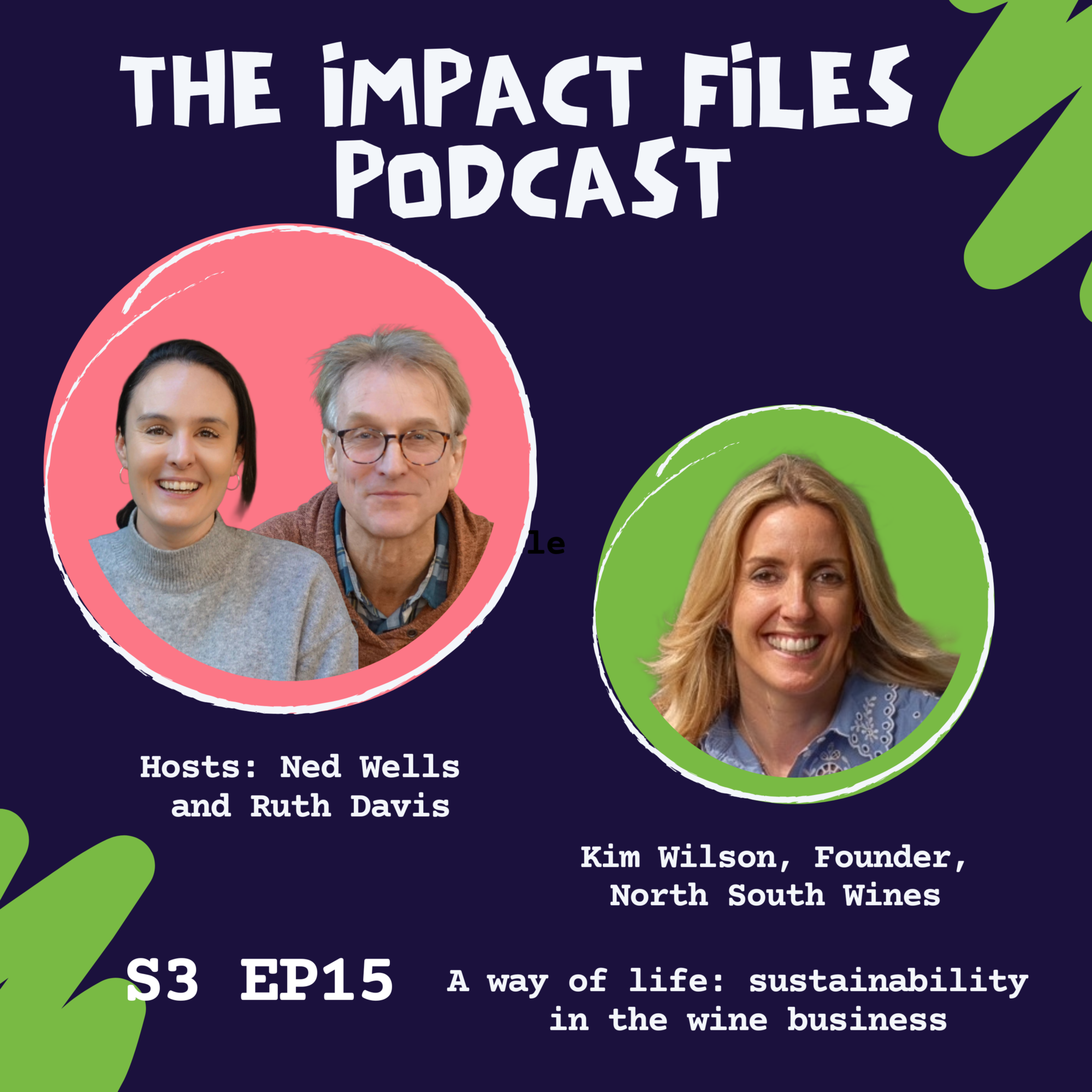
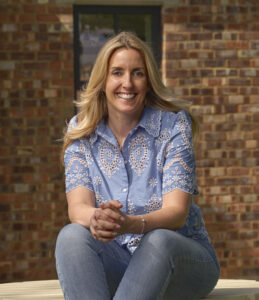
The Impact Files Podcast – Kim Wilson, Founder and Managing Director, North South Wines
Ned Wells: Welcome to The Impact Files podcast. This week, Ruth and I are joined by Kim Wilson, founder and managing director of North South Wines. Kim, welcome to the podcast.
Kim Wilson: Hiya, thank you for having me.
Ruth Davis: Hi, Kim. Lovely to have you here. Thanks for joining us.
Ned Wells: Really lovely to have you here, Kim. I wonder if we could start with an introduction to you, to North South Wines, and the work you do.
Kim Wilson: Yes, sure. As you said, my name’s Kim, and I’m the managing director and founder of North South Wines. North South Wines is a distribution business – the clue is in the name – in wine. We import from all around the world, working with over 40 producers, bringing wine into the UK market and selling it through lots of different routes to market. That ranges from supermarkets, to online places like Ocado and Amazon, through to wholesalers, brewery groups, national wholesalers, independent retailers and hamper companies. You name it – anybody who can sell wine, we’ll sell it to them. I have a team of 35.
We’re based here in Bicester now, which is really lovely, because it’s actually my hometown. We moved up here three years ago. The business started out in London, but moved up here with the changes in the world post-COVID. We import about 20 million bottles of wine a year. We’re seen as fairly successful, as far as the wine market goes – it’s quite challenging – but we’re still quite a new business within the wine industry.
Ned Wells: Hmm.
Kim Wilson: There’s a lot of history and heritage in it, and a lot of mature businesses. North South Wines is seen as one of the newcomers, but we’ve made our mark quite quickly in the 12 years since setting up the business.
Ned Wells: Fantastic. And is there a story behind the name North South Wines?
Kim Wilson: Well, I’d love to say there is! When we set the business up, we spent quite a long time thinking about what to call it, and we got right up to D-Day for launching, and it was like, “We really need to think of something.” The lady I set the business up with, Joy, was from the North, and I was from the South – so you’ve got Northern and Southern, hence the name. We said, “Let’s call ourselves North South Wines,” and literally that was it. I’m quite glad, because we could have paid somebody a lot of money to do that for us. I’d love to say it was some really big, thought-out plan, but it fits. I couldn’t ever imagine it being called anything else now.
Ned Wells: I think it’s a great name. I’d love to hear a bit more about you, Kim. What’s your story? What happened, from the early days through to you deciding to launch a wine company?
Kim Wilson: Yes, sure. I’m born and bred around this area. I was born in Aylesbury in Buckinghamshire, and I’ve stayed in the Oxfordshire-Buckinghamshire area. Going through school, I thought I wanted to be a geography teacher. I was all set to go to university in Preston to study geography and become a teacher. Then, the year before I was due to go, they introduced tuition fees – actually paying to go to university. So I thought, “Right, I’ll take a year out and earn some money to educate myself.”
I ended up working in telesales for a local pub group in Thame, and just fell into the alcohol industry. I was selling all sorts there – beers, wines, spirits, ciders, soft drinks, you name it. They were a composite wholesaler.
Ned Wells: Mm.
Kim Wilson: We used to get lots of reps coming in – whether it was Coca-Cola or Diageo in those days, and lots of others – and I’d think, “This is a cool job, coming in, selling this and talking to people like us.” So I decided not to go to university, and followed a path into sales, which I got into after a couple of years. I first worked for a cider company – it was Bulmers at the time – so Strongbow and Woodpecker.
That company got bought out, which forced a move for me to a company called Carlsberg-Tetley, as it was at the time. That’s really where I cut my teeth and learned everything I use these days – and I genuinely mean that. I’d have been about 22, and the training was very structured. You’re trained in a very FMCG – fast-moving consumer goods – way.
Ned Wells: Mm, mm.
Kim Wilson: And I’d be there going, “I’m never going to do this in front of a customer. I’m never going to go through the 10 steps of the call and the five-part brand talk.” I hated every minute of it, but I also just loved getting out in front of customers. Then it just became the way you did business – almost like your script. I use a lot of it now, and it makes me laugh when I think back to how much I pushed back on it. So I got amazing training and skills, and picked up lots of knowledge, at Carlsberg.
I was there for four years, and then I genuinely thought wine looked more glamorous – that literally was how I fell into the wine trade. I got a job with a South African company that had a brand called Arniston Bay, which you can still find in the Co-op. I met a very lovely gentleman there called Jeremy Borg, who was running the company. He was South African, but based in the UK at that time.
He gave me a job in a junior sales role, looking after cash and carry. Then, within about six or eight months, that company decided it needed to be part of a bigger company, and it merged with another distribution business called Ehrmanns. That’s how I came properly into the wine trade. Jeremy, who gave me the job, went back to South Africa – we’ll probably come back to that in a bit, because there’s a link there.
So I moved into Ehrmanns, a distribution company similar to what we do here at North South Wines, but more Spanish-focused. I worked there for nearly 10 years, and worked my way up from junior account manager to sales director. I left because, one, I felt I’d achieved everything I needed to, but also it was a family-owned business, and the sons within the business wanted to be more involved. I knew my time was up.
Ned Wells: Hm.
Kim Wilson: So I just thought, “No, you know what? I’m going to go off and do something else.” I handed my notice in, and a supplier came to me and said, “We should do something together. You’re too good to go off and just work for another company.” So that was it – that was the brainchild of North South: somebody just saying, “Yes, let’s do something together.” I genuinely thought we were just going to sell a bit of Italian wine, and there might be two or three of us.
But once that started, more and more people were coming to us, saying they were looking to do things differently in how they brought wine into the UK. The really big part of that was De Bortoli, a very big Australian wine business. They had a UK office, but it wasn’t sustainable for them to continue as a standalone. So they said, “Look, we’re up for shutting down our office and coming into a business. But if we do, we don’t just want to be somebody you distribute. We want a seat at the table, so we’d like a share in it.”
So very quickly, within the space of three or four months, North South Wines was asking, “Right, what are we going to do? One, this is going to be a lot bigger than we thought. We need some cash. How do we get it?” So we quickly put together a plan to sell 48% of a business that didn’t exist, and we sold it to three wineries, which became our shareholders.
Ned Wells: Mm-hmm.
Kim Wilson: The other 52% of the business was primarily owned between myself and Joy, the lady I talked about earlier. Joy is no longer part of the business. She left just before COVID, and the company and I bought her shares. So there are four primary shareholders now: myself and three wineries. And it kicked off from there. So that’s my story.
My personal background is that I’m local to Oxfordshire. My dad’s a farmer. I’ve always been in this area, and I was very keen to bring the business back to my hometown, but never knew when it would happen. So I’m very happy to say that it happened three years ago. And, as I’m sure we’ll come on to, we became the first wine distribution business in the UK to be certified as a B Corp, in 2023. We were lacking that B Corp community aspect where we were in London, so it actually felt like we had a home, which brought us back here to Bicester a bit. Other than that, more about me: I love dogs, and I tend to see a thing and then become quite passionate about it.
Ned Wells: What a brilliant story, though. What a whirlwind – the last 12 years sound like they’ve been pretty manic for you.
Kim Wilson: Yes, definitely. If we look at just the last six years, and what the world has gone through, would I look to do what I’m doing now, with all the challenges we have in the market? Probably not. But I’m really glad I did. As I’ll probably say a lot in this podcast, it’s the people you have around you who make you do a better job. I’ve got a great team, and I’ve had great people in the team – obviously people have moved on as well – pretty much from day one. And I’m a really big believer that if you believe in something, and you’ve got passion, drive and energy, you can make most things work. You might have to pivot quite a bit along the way, but you can make most things work.
Ned Wells: Mm. Going back to some of the commercial things: you said you’re a team of 35. Are you happy to share revenues, profitability and so on?
Kim Wilson: Yes. Our financial year ended at the end of March 2026, and we hit a turnover of £40 million, which was a milestone for us. That’s from zero 12 years ago to £40 million now, which is really good. We grew about 22% last year, which again is amazing, considering the wine market is very saturated, very mature, and in about 3% decline.
So we’ve carved out a space within that. I’ve talked to my team a lot about how we’re all fighting for the same piece of pie – we just need to fight harder for our bit, and work out what our USP is. Part of that has been our journey around B Corp, and just doing business in a slightly different way. As I said, the wine industry is quite mature, and we bring a fresher face. And I think it’s still true that I’m the only female founder of a wine distribution business of our size and scale. So it’s still quite unique, to be honest with you.
Ned Wells: Fantastic. I’d love to hand over to Ruth now.
Ruth Davis: Thanks, Ned, and thanks, Kim. It’s really amazing to hear about your journey and the business. I’ve got a question about your business case for sustainability, but before we get into it, I’m really intrigued by what you said about your dad being a farmer, and you loving geography growing up. I wonder whether that had any impact on you wanting to do business in a more sustainable way. Could you tell us a bit more about how that affected your journey?
Kim Wilson: Yes. Having said that, it could be a subconscious thing – I don’t think it was a deliberate thought. But getting into wine, and the land, and knowing about agriculture has definitely been a passion of mine. And you get to do the odd bit of travel as well, which is very nice. You get to see lots of places in the world.
I think, personally – and also Stefano Girelli, our Italian shareholder – we share very similar values. We came into this, and we’ve always thought we’d like to leave the world in a better place than we found it. We’re also very aware that we ship glass bottles halfway round the world, which isn’t the most sustainable thing in the world. The industry has certainly changed in lots of ways over the last five years, but from day one of North South Wines, it was very important to us to have a sustainability angle.
I’ll be very honest about that. My sustainability angle in the early days was, “Well, we just need to sell organic wine, and then we’ve done it.” And when you’re a start-up, there isn’t the spare cash to do some of the stuff we’ve done now. So I thought, “Great, we’ve ticked a box.” It was only when we really started getting into it, in years four and five, that somebody said to me, “You need to get your own ship in order before you look at others.” And I thought, “Yes – North South Wines, the business, isn’t actually doing anything.” And that was quite embarrassing. We had lots of lovely wineries we worked with that were doing bits and pieces, but we weren’t really making use of what they were doing, or doing stuff ourselves.
That’s what led me to B Corp. When I was introduced to it, I’d never heard of it. I started to read through the framework, and something just clicked. I thought, “This is really cool.” It’s a framework, but also a roadmap that takes you through how to do business better. And what I also loved is that you don’t have to do everything on day one. It’s about continuous improvement.
Ned Wells: Mm.
Kim Wilson: That B Corp movement has really improved how we do business. I haven’t said this yet, but we import producer brands, so we don’t really own anything of our own. So my biggest asset is my people. And when you’re a fairly new business, and maybe not as glamorous as some of the bigger ones that can do all the singing and dancing, you need to find your own way of recruiting and retaining people. What’s important to people? The B Corp side of things is really important to people – the way you treat the people in your business, but also your longer-term plan, and how you use profit differently. That’s been really important to us. And all the other stuff has followed from that: we’re looking to work in a much more sustainable way, and there’s lots we’ve done as North South Wines within that.
There’s also how we work with our winery partners. There’s always been a myth around wine that the heavier the glass bottle, the better the wine in it – which is utter nonsense. We’ve just trained the consumer to think that. In the last three years, there’s been a huge movement around reducing glass weight. So a wine that would have been in an 800-gram bottle is now in a 400-gram bottle. It still sells exactly the same, but it’s got a much lower carbon footprint. We can even go down to 300-gram bottles.
There are obviously aesthetic considerations, because a lightweight bottle does look thinner, lighter and probably less premium. But the glass companies are developing loads of great technology to move that forward. So that’s been a big part of it.
And I think that farming and geography background and interest has probably played a part. Personally, at home, I try to buy in the most sustainable way, and I’m always looking at how I can do things better. Then it gets pushed through your friendship groups and the people you work with, and they say, “Kim, I’m starting to use this company,” or “that company”, which is really good.
Ruth Davis: I love to hear that. And it’s great to have you as part of B Local Oxfordshire, because we’re in the same community, and it’s a really lovely place to be. I’m assuming that, because you’re a B Corp, a lot of your impact reporting is based around the B Corp pillars. But going back to business decisions – given that your business wasn’t initially set up to be sustainability-focused – how do your business decisions based on sustainability, like the glass bottles you mentioned, drive near-term business and financial results?
Kim Wilson: B Corp gives you a great framework – a process you go through with every business decision. And it’s not just me. It’s about ingraining that in the team as well, even in how we buy toilet roll, or whatever it is we’re buying. So there are various processes within all of that.
Anything we look to do – bringing in a new winery, for example – the first thing we’ll do is run them through a sustainability questionnaire on how they do business. Likewise with any third-party producers we work with, whether that’s a bottling line here in the UK, a freight forwarder, or anything else. We run them through our process: are they doing business in the best possible way, and how can we do that together?
Ned Wells: Mm.
Kim Wilson: And yes, there are times when we’ll go for the more expensive option, at the sacrifice of profit. One thing I didn’t mention earlier, but I’m very happy to share, is that I’m lucky to have these three winery shareholders. Because we sell their product, they also make their profit from that, as well as having a share in the business. As shareholders, in the last 12 years we’ve not taken any money out of the business for our own benefit. Obviously I’ve been paid a salary, but we’ve invested everything back into the business, and ultimately that’s made us a better business. We can drive our own cash flow, so we’re not dependent on anything any more, and we can make decisions quickly. We’ve got spare cash to make those decisions.
B Corp isn’t the cheapest thing to do, but it’s about the long-term gain. That’s the big thing for me: I’ve definitely got a vision to look forward to. Some of it can be a bit scary to begin with, wondering what we’re going to get out of it. But I’d say that, definitely in the last four years or so, we’ve seen the impact of working in a B Corp way. It has ultimately made us more profitable, and will make us more profitable going forward – and then there’s how we use that profit.
Ruth Davis: And in terms of the people buying your wine – your partners and consumers – are you seeing increased demand from them for more sustainable options?
Kim Wilson: Yes, definitely. From a consumer point of view it’s slightly different, because we’re the third party in the middle, but I’ll come on to that in a minute, because we are seeing more around that.
Because we started so early on the whole sustainability thing, and then got B Corp, I was challenged by a few of my senior colleagues in the business when we did B Corp: “Why on earth are we doing this? It’s so much money. We could just invest that in marketing or branding with a supermarket and get new listings.” And I said, “Hang on a minute. We need to look at the longer-term game here.”
Then it started trickling through. We got B Corp, and it raised our profile, because we were the first in the wine distribution sector to get it. Many have followed us now, which I’m really proud to say. Some people ask me, “Do you want that competition?” And I say, “Bring it on – the more B Corps, the better.”
You definitely see a return on that spend, and it also shows the team why we do it. From a customer point of view, I genuinely think people trade with us more. If we were up against somebody without B Corp, and we had exactly the same to offer, we’d probably win it because of the B Corp tick, and all the other stuff. We’ve got ISO 14001, and we’ve got BRC, which is another accreditation. They all give us a great framework – “framework” is such a great word – to do business in a better way.
And our customers see that, and they’re actively coming to us and saying, “You know what, North South are just a good bunch of people.” We read all of this in our staff surveys and our customer surveys.
From a consumer point of view, it’s slightly harder for us to reach the consumer. But we sell some B Corp-certified wine brands, and we’ve got our own brand now, When in Rome, which we bought in November – the first time we’ve bought a wine brand. And we do see the B Corp logo adding a huge amount of value, because you see it across a lot of different consumer goods now, and it’s a very recognisable logo.
Ned Wells: Mm.
Kim Wilson: So I think it is coming through. With things like 1% for the Planet, or anything to do with carbon, consumers are definitely engaged. Not every consumer might understand it completely, but they know they’re doing something. And I think there’s also the authenticity angle – what products are actually made of. Look at someone like M&S, which has a range that lists just three or five ingredients, and that’s it. Consumers are loving that, and we’re definitely seeing more of a push towards it. That transparency is such an important part as well.
Ruth Davis: Yes. I’m even hearing about local councils and other procurement processes having a B Corp checkbox when they’re putting out RFPs and tender opportunities. So it’s really interesting. And I’m of the opinion that climate change affects all businesses, but vineyards are affected in a more obvious way by changing temperatures.
Kim Wilson: Yes, it’s huge. That’s my biggest fear, out of everything. That, and too much red tape from our government, but we’ll come on to that. Climate change is the biggest fear. There are certain places that won’t have a vintage in 20 years’ time, and that’s really sad.
But people are doing a lot – looking at more resistant varietals, and there are new clones coming out. Like anything to do with agriculture, everyone’s having to look at how to do things differently, because of drought, or too much water, or soil erosion, or whatever it is. People are having to look at doing things differently.
Ruth Davis: Hmm. Right, I’m going to hand back to you, Ned, because I could chat to Kim about this all day, and I’m very aware we’re time-constrained.
Ned Wells: No, it’s so interesting. Kim, before I go on to my next question: you’ve mentioned profitability a few times, and some of the decisions you’ve had to make that affect it. Would you be comfortable sharing what levels of profitability you’re hitting, and what’s normal in your sector?
Kim Wilson: Yes. I’d say to anybody in business: you probably don’t go into wine for profit, because it’s not the most profitable thing in the world. I definitely won’t get rich quick from it. You do it for the love of it. Genuinely, when I set up North South Wines, in the early days I just wanted to work somewhere for 20 years that was really fun, looked after its people, and had a really good time. And I can genuinely say I laugh every day here at North South Wines. We’ve got a great team.
Ned Wells: Hmm.
Kim Wilson: So profit didn’t really enter my mind at that time. It does now. I’ll be very open: at some point, the shareholders will want to get some money out of this business. But we’ll do it in a very B Corp way. There are ways you can do it rather than – no disrespect to anybody who has sold to private equity – but I get called every day by private equity companies wanting to buy us, and I say no. It changes the culture, the company, everything.
Ned Wells: Sure, sure.
Kim Wilson: So longer term, yes, there will be a view on that. We’re business people, so we have to get something out of it, and you also feel you need something for all the blood, grit and determination you’ve put in. But for us, it’s about using the profits to be better at what we do, and also to really value and look after our staff – funding things back in so it’s a really nice place for them to work, and they see the benefit, whether through pension contributions, salaries, bonuses, healthcare or various other things we do.
From a profitability point of view, we sit at around 3 to 3.5% net, which is fairly decent in the wine trade. I think some of the most successful businesses might sit at around 6 to 8% net. We’re obviously still quite new, but there are a lot of very big businesses that turn over a lot more money than we do and lose money every year. When I say lose money, I mean they’re EBITDA-negative. So it’s a challenging market.
Ned Wells: Mm.
Kim Wilson: For me, we have to make money, because we can plough it back in and invest in the team. We came out of COVID and went into the war in Ukraine, the cost of living crisis and everything. There was a year when we literally just broke even. But what I’m really glad about is that we didn’t have to make a single redundancy or cut anywhere. We had to tighten our belts slightly, but we didn’t have to cut anywhere. And it’s really lovely that I’ve got shareholders – and obviously myself, as majority shareholder – who are willing to say, “You know what, we’re going to put the company first, before trying to get any money out of it.”
So the things we’ve invested in do cost money. Just recently, we moved to a new office, because we needed a brighter, more open and more efficient office than where we were. We’ve gone up a couple of ratings on our scoring with that, which is really good. Again, that all costs money, but it creates a really great environment.
It sounds really funny, but in the office we were in before, we had a tiny little kitchen. Here we’ve got quite a big kitchen, and we’ve invested in a good coffee machine and some great coffee beans – obviously very B Corp! And it’s great to hear that the kitchen has become the social hub of the business. We do a quarterly staff survey, and I’ve just seen the initial comments – I don’t see all of it – and they’ve been about how social the office is now, with the kitchen as a social hotspot. It’s definitely costing me some money in coffee beans, but I’m very happy to do that, because it’s changing the direction of the business and the way we work. It’s becoming an even nicer place to work – not that it ever wasn’t. All of that adds value for your team, so they want to do a good job for you and really support the business. And I’ve got that 100% from everyone who works here, which is really lovely to see and hear.
Ned Wells: It strikes me that you’re charting a really pleasing course for yourself, running a business in a ferociously competitive sector, but doing all the things that make it feel right for you. You’re a B Corp, you wanted to look after your staff – all the things that, at the end of the day, really matter.
Kim Wilson: Yes, I think so. That was the foundation of setting up North South. When I set it up, I didn’t even know B Corp existed, and I never thought that was the route we’d go down. But I’m really glad we did. I always think there are things in life that come across your path and then change it forever. And I’m really proud that we’ve made a difference within the wine industry – 100% – because we became the first B Corp. We pushed the boundaries, and almost held a mirror up to the industry to say, “Look, we’ve got to do things differently – all of us.” There are people doing amazing work out there, but there are others who are now following us, which is brilliant, because they know they’re going to get left behind if they don’t. I’m really proud that we’ve done that.
Ned Wells: Mm-hmm. I wanted to come on to some of the people, processes and skills you’ve put in place to support your desire as a business to be sustainable, as well as profitable.
Kim Wilson: The main thing we did – and our biggest investment in this – was having somebody to run the whole sustainability agenda. You need somebody who’s on it, and who’s going to bang the drum for everyone. I was quite naive in the early days, thinking that we’d get B Corp, a switch would be flicked, everybody would just work in a B Corp way, and everyone would come on the journey and love it.
Ned Wells: Mm.
Kim Wilson: There are parts of the sustainability journey that just aren’t interesting to people. It can be quite a dull subject when you’re getting into the nitty-gritty of carbon. But it’s about education. So the first thing we did was employ a sustainability manager. Ruth, you mentioned earlier that you’ve met our lovely Erin, who joined us nearly a year ago. Before that, a lady called Rebecca worked with us, and she did a great job of banging that sustainability drum for us, and pushing us to do better as well.
I genuinely believe it has to come from the top as well, so I’ve obviously been very supportive of it, and so have our shareholders. But it’s important to have that person in place who really works with us on it. The bigger part, though, is education within the team, so we spend a lot of time bringing everybody on that journey.
We’ve done various things. One is the charity hours we give. Everybody in the business gets 20 hours a year for charity work, and if they want to do more, they can. Not everybody necessarily wants to do that. But if we arrange a team charity day – we partner with Restore, a mental health charity in Oxford, and go to their allotments to do some work for them for a day – there are 10 of us, and it turns into a really lovely team day. People might say, “I don’t want to volunteer.” But actually you’re volunteering, doing something really good, and working with teammates you maybe don’t talk to regularly.
We’ve also educated the whole team on carbon literacy, and how we track our carbon.
Ned Wells: Hm.
Kim Wilson: That was quite an eye-opener for everybody. We were a business that could be keyboard warriors sometimes, sending lots of emails and lots of attachments. Genuinely, I had no idea of the impact of attaching an attachment to an email, and how many times that gets fired back and forth. So we’ve totally changed how we do that, sending links rather than attachments.
It’s just about educating people. Then people have come to me and said, “Could we have a meat-free day once a week in the office, Kim?” – those kinds of things. So you start to get champions within the team. There are always going to be some people who are more for it than others, but you slowly bring round the people who maybe weren’t interested, and they become interested. I’ve always said it has to become a way of life. You can’t force it on people.
Ned Wells: Mm.
Kim Wilson: Because we’ve continually done stuff in the business, I think it’s rubbed off on people, and they’ve slowly started thinking, “Yes, you know what? We’re just doing things in a different way.” It becomes a way of life. Obviously we’ve also got all the policies in place. And Erin’s brilliant – as Rebecca was – at getting the team together and explaining why we’re doing it. And obviously I’m quite passionate about it as well.
One thing we did was put an electric car scheme in place. It’s for the whole company, but the real incentive was to get our sales team into electric cars. I’m pretty sure all but two people are in electric cars now, and that’s only because there are circumstances where they can’t have one. It’s brilliant that in the space of three years we’ve managed to move everybody over to electric cars, because we have to use cars a lot for going out and seeing customers.
So that’s the impact of what we’re doing. Our carbon footprint is getting bigger because we’re a growing business, and that’s a bit that’s really tricky sometimes. When you’re growing, you are actually emitting more carbon than you were the year before, naturally. But it’s about how we reduce overall while continuing to grow at the same time. Again, it’s education.
And then we use that with our supply partners, to get them to work in a better way. We’ve got some wineries that are completely at the forefront of what they’re doing, and others that aren’t, just because of their size and scale. But we can share those learnings with them, so they can do things better and in a more impactful way. So there’s lots of stuff around it, but basically it’s becoming a way of life, rather than just ticking boxes.
Ned Wells: You’ve got loads going on. I’d be intrigued to know at what stage in the business – in terms of employees or revenue – you took on your first sustainability manager.
Kim Wilson: Rebecca was already in the business. She did a number of roles for us, from sales, to supporting our online function, to supporting me in an assistant role – and she had two babies as well. Her role changed every time she went on maternity leave: she’d tell me what her role was going to be when she came back. That always made me laugh, and I always gave her the role she told me it was going to be!
When I decided we wanted to do B Corp, I thought, “Rebecca is the best person to do that for us.” So we had somebody internal who could work cross-functionally, and who knew everybody. She was also a bit of a stickler – if you didn’t do stuff, she’d get on at you for it. But she had a friendly relationship with everybody in the business, so people listened to her and got on with what she needed them to do.
Ned Wells: Right.
Kim Wilson: We became a B Corp in 2023, but we started that role in 2021. To be honest, it was about three days a week on that, and two days a week on something else, because at that point the business wasn’t really profitable.
I don’t mind talking about this. Going into COVID, cash flow was – well, cash flow is just the biggest nightmare for any business. I say that to everybody: “What’s your biggest challenge? Cash flow.” It still can be, even 12 years on, if you don’t look after it properly. In the early days, we were really hand to mouth – begging, borrowing, stealing, calling suppliers and saying, “We can’t pay you this week. Can you give us another week?” Then we got to the point where we reached out to the banks for invoice financing. I was so against it, but if we hadn’t done it, we wouldn’t have survived.
And then going into COVID – I feel awful saying it, but there were positives that came out of COVID, because people had to change the way they did things. I think if COVID hadn’t happened, we’d probably have gone under. And I think I’d also be in a very different headspace from where I am now.
I had a very traumatic personal time going into COVID, where I had to reach out and say, “I’m not coping. I don’t know how to survive any more. I can’t keep working 24/7. This is too stressful – there’s too much going on.” Reaching out was probably the hardest thing. But it also gave us the platform we have in the business now, where we’re very open about mental health and wellbeing. It’s not a taboo subject, and it definitely shouldn’t be. We should talk openly about it.
Ned Wells: Mm.
Kim Wilson: I’m almost glad that happened – that I had to hit rock bottom and then say, “Right, if I don’t get my act together and work out what I need to do, this business isn’t going to exist.” At that time I had 15 employees. What COVID did was give everybody time to reset. We actually had more time, because we couldn’t go anywhere or do anything, so we were more available, and it gave everybody time to think about the long-term impact. Because COVID was something none of us had ever experienced, it really did feel like, “How are we going to get out of this? We have to change the way we’re living and doing things.” And that’s really when I went down the route of thinking about what North South was going to do, and how. That’s where B Corp came along.
Obviously, from a wine point of view, during COVID – if you had children, and you were stuck at home 24/7, teaching them all day – 4 o’clock came round and a glass of wine needed to come out. As long as we all did it responsibly! People were stuck at home, so we sold a lot of wine. There were points when we just couldn’t get our hands on enough wine – and we weren’t the only ones. So, I don’t mind admitting, we made a lot of money during COVID.
But what we did was use that money to support part of our business and our customers: our on-trade business. Pubs, clubs, restaurants and bars all shut down. People lost their livelihoods, businesses went under, and people couldn’t pay their bills. We said to our customers, “Look, don’t pay us. Just pay us when you’ve got the money. We’re not going to chase you. We know you’re good for it, even if it takes six months. We’re in a position where we can survive this at the moment.” So we used it for that, and for a lot of other things.
Ned Wells: Mm.
Kim Wilson: That has really paid dividends for us in the long term – being able to give people that security, so they didn’t have to worry about not being able to pay us, and their businesses going under. People have worked with us since, because they really respected the way we did that.
It also gave us a lot of time to invest in the team. Genuinely, I’d say that during COVID we were probably a stronger team than we’d ever been, because we all had to look out for each other. We had the time – we had the Friday calls, we had quizzes – and with half the team on furlough, that half really looked after the half who were working. It was tough – really tough – but I think the team gelled so much, and we learned how to look after each other. Coming out of COVID, it was very much, “Right, we all have to do something differently. This is a reset.”
I obviously got a lot of help and support. I don’t mind admitting I had a therapist for nearly three years, and there were lots of things I came to understand about myself that were probably holding me back. Part of it was that – as I said, the industry is really mature – I was trying to fit in with a crowd that had been there for 20 or 30 years, whereas actually I just needed to be me.
When I knew I could be me, and make the decisions, with people around me supporting me to make them, it was a light bulb moment, and the business changed completely. I’m so grateful – something that was very sad for me, the whole country and the world – but I’m glad, in a way, that it happened, because it gave me a reset and made me think we’ve got to do things differently. I think that definitely changed North South and me.
There are days now when you think, “Oh my God, there’s too much on.” I go back to that time and think, “You know what? Think about what it was like then – and we came through that.” And I’m really happy to say we’ve come out of invoice financing – we don’t use it any more – because, as I said earlier, we haven’t taken any money out of the business, and we use all our profit to drive cash flow and growth. So we operate completely off our own cash flow now, which is really lovely, and we’re able to grow and bring in new businesses within that. We’ve just recently brought in a very big new South African business, which has added about 150 new wines to our portfolio. That’s a significant investment for us, but again, it’s about looking forward: how are we going to grow, change and adapt in what we do?
Ned Wells: Really exciting. Ruth?
Ruth Davis: Thank you, Kim, for being so transparent and open about what you went through. I find it quite inspiring that COVID actually turned out to be quite a good thing for you and your business, which is something we don’t hear very often.
Kim Wilson: Yes, and it feels awful to say it. It was obviously an awful time. But I genuinely believe that in bad situations you have to try to change and pivot, or else you’re just going to go down with all of it. Things have to happen, and it’s the resilience you have throughout that counts.
Ruth Davis: Amazing. You’ve mentioned a couple of successes – your new office space, the glass bottles. But in the interest of learning, we’d also like to touch on things that didn’t go so well. Are there any challenges North South has had on its sustainability journey? Things you implemented and then thought, “Oh my God, why have I done that”?
Kim Wilson: You know what, I was genuinely trying to think about this when I was looking at the questions last week, and we haven’t had anything that’s been a complete disaster. I can’t think of anything that’s come along that’s been a real problem for us. I’d definitely say that getting close to certification – whether it’s ISO or B Corp – there are challenges where you think, “Oh my God, why on earth are we doing this? This is too stressful.” But it’s about breaking it down into chunks. Sometimes you just think things are worse than they are. I’m fortunate to say we haven’t had any disasters.
We were risk takers, but calculated risk takers. If something wasn’t going well, we’d probably change it straight away, because we’re really agile. We’d change very quickly, and then we wouldn’t really register it as a disaster, because we’d have turned it round. You’ve probably realised I’m quite positive – definitely a glass-half-full person.
Ruth Davis: I was just about to say: I wonder if the reason there were no challenges is that you turned everything into a positive move.
Kim Wilson: Yes – or my team are just so brilliant that they never have any problems. That’s what I’ll put it down to! But no, I wouldn’t say there have been any disasters. There are bits where you think, “Okay, how are we going to get round this? What do we need to do here?” But because we’re that proactive type of business, it almost doesn’t feel like a problem. It’s, “Okay, right, let’s problem-solve it.” And you come out the other side.
You mentioned B Local Oxfordshire – that’s been brilliant. People within it are so willing and giving with their time. Something you think is a problem, you just check with them, and they say, “Oh, well, we did it this way.” And you think, “Okay, fine, that’s it – we’ve got the answer.”
Ned Wells: Fantastic. I wanted to turn to media, communications and marketing, and get your take on the role of media and communications in driving long-term sustainability alongside those near-term results.
Kim Wilson: I think it’s hugely important. When we were first starting up, it wasn’t something we invested in at all. Now we have a gentleman called Chris, who runs our North South brand and all our marketing and communications around it. We’re on all the platforms – from Instagram, to Facebook, to LinkedIn – and it’s about looking at a mix of platforms.
Ned Wells: Hm.
Kim Wilson: We definitely get feedback from the industry that people see all the stuff North South are doing, and we’re making people raise their game, because they’re seeing it. There’s either a FOMO effect, or we’re putting peer pressure on them to do better. So marketing has a huge impact in what we do.
From a B Corp point of view, we also have an impact report, which is massive for us. It’s a marketing tool for talking about what we’re doing, and also for getting out our long-term plans, and our plans for the next year. So it has a huge impact.
And globally, the more people talk about this, the more it becomes a way of life – and it has to become a way of life. You only need to look at things like the David Attenborough series. That was a really big change around plastics. We now work in an industry where we can’t send anything in plastic. It’s completely changed the way we do business. And we’ve pushed back, saying, “No, actually, we can’t do this,” and made manufacturers go, “You know what? We’ve got to find different solutions.” And they can, and they have. They just didn’t want to, because it was a faff and was probably going to cost them a bit of money. But everything can be achieved if people look at it in the right way, and I think media puts peer pressure on people to do that.
I always describe North South as a very small fish in a big pond, globally. There are some very big fish in that pond that need to do better. There are people out there doing amazing, amazing work, but we’ve all got to look at our impact. And I think media really helps put more of that pressure on the industries we work in.
Ned Wells: So interesting. My reflection is that you may be a smallish business in the sector, but £40 million turnover isn’t negligible. And your energy and go-getting, positive, fun attitude, in a business that’s doing well – if you’re communicating all about how you’re going about that, including the sustainability, it’s going to give people a bit of FOMO: “Hang on, what are they doing?” That’s a really fun and positive way to use your communications and media to drive change in a wider culture.
Kim Wilson: Yes, definitely. I also think that, as a business leader, you have a responsibility to do that – I genuinely mean that.
Ned Wells: Yeah.
Kim Wilson: Five years ago I couldn’t do that. I didn’t have the time or the resource – we were scrambling for every penny we could get. But now it’s given me a chance to have a voice within the industry, on many things. It can feel like it comes naturally, but it’s difficult as well. It’s hard to put yourself out there and do it.
From a personal point of view, I’ve got a voice in championing females to set up their own businesses, and to go out and do what we’ve done. And from a sustainability point of view, I’m pushing back more. I sit on one of the industry’s trade associations, the Wine and Spirit Trade Association, and I’m one of the first small to medium-sized businesses to sit on it as a board director. Again, it’s about raising that profile, and pushing back – particularly as a trader, and on the red tape I mentioned earlier – on government, to really think about the policies they’re putting in place and how they impact businesses. A lot of what they’re looking at is really great in intent, but they’re not thinking about how you actually implement it, how it impacts a business, and what it costs a business. If they just engaged a little more with the people on the ground doing those jobs… We’re all for change. Everybody is for change. It’s just about how we engage, so it comes across as the right change.
So I’ve got a voice, we’re a growing business, and we need to use that. It’s also about inspiring people to do better in what they’re doing. And if you’ve got an idea, go out and do it. Go out and do it. What’s the worst that could happen?
Ned Wells: Mm-hmm. Make it happen. Exactly. Ruth?
Ruth Davis: I’m really excited to hear, given everything you’ve done so far, what on earth is coming up for North South Wines over the next 12 months or so.
Kim Wilson: I’d love to say a rest! That’s what I’d love to say. But no – if you stand still, you go backwards, is what I say.
As I alluded to earlier, we’ve got a very big new South African partner coming in, which again is amazing. From a sustainability point of view, a lot of South African wineries are really focused on the people side of things, around employment and so on. The partner we’ve got is called DGB, and they’ve got some great brands – if anybody knows Boschendal and Bellingham, they’re in the portfolio. And what they’ve done from an environmental point of view is just outstanding. So again, we’ve made a change within our business to make sure we have the best of what we possibly could. Five years ago, I would never have been able to bring a business like that into ours.
So the year ahead is definitely focused on getting them embedded in the business. But there’s also just been a lot going on. I’ve got 40 other suppliers, and we need to make sure we’re doing what we need to for them. Things just get thrown at us, and I’ll probably talk to you in six months’ time and say we’ve done this or that. But the plan at the moment is really just to keep doing what we’re doing, believing in what we’re doing, and building the North South brand and our producer brands. In my mind, every bottle of wine we sell makes a difference, so for us it’s about continuing to do that.
Ruth Davis: Yeah.
Kim Wilson: And continuing to look at our carbon footprint – that’s a really big thing. In the last year, we’ve been doing all our carbon footprinting, going down to Scope 3. The big thing for me now is pushing back on businesses to be more sustainable. Freight is obviously a massive part of our carbon footprint, and I’d love to spend more time with freight forwarders and the industry, to see how we can develop some material change there, because shipping is a big thing. The glass manufacturers are really looking at what they’re doing – there are electric furnaces now, lightweighting, and doing things differently. But the freight side is a big part the industry needs to look at next, for sure. So there’s lots going on – definitely lots going on.
Ruth Davis: Amazing. I definitely feel we’ll have to check in in six months to hear how that’s been going.
Kim Wilson: Yes.
Ned Wells: Gosh, there’s so much you’ve told us – my head’s in a spin with everything you’ve got going on. It’s brilliant. I’d love to hear your take, Kim, on where you’d like your sector to be in the longer term – in 10 years’ time.
Kim Wilson: As I said earlier, the sector is definitely being challenged. We’re in about 3% decline. Consumer habits are changing: people are drinking less, and drinking lighter ABVs. The younger demographics definitely aren’t coming into alcohol the way I did when I was 18 or 19. We’ve got climate change. And at the moment we’ve got a government that doesn’t really understand the alcohol industry, so it’s hard to achieve growth and change. I think wine has been caught within a duty band aimed at binge drinking, but wine isn’t something you sit and binge on.
So it’s challenging. But I think what will happen – probably as in a lot of industries – is that there will definitely be more consolidation.
Ned Wells: Mm.
Kim Wilson: We’ll have to look at how we do business, and there will be a lot of new product development. We’re already seeing a lot in the no and low space, where some really, really great things are happening. I definitely think – and the industry would agree – that wine is behind spirits and beer in that direct comparison, from a flavour profile, taste and quality point of view. But the industry has been pushed to get better, and there are some great technologies coming out on no and low, particularly in wine.
For me, there will definitely be other packaging formats coming out. Cans are something we see a lot in wine now. We’ve got the cardboard bottle – the Frugal Bottle. As technology evolves, we should start to see more of that on the market. And there are other things coming out: there’s a brand called Pulpex, a paper-pulp-based bottle, and they’re looking at categories like detergents, wine, soft drinks – all sorts.
Ned Wells: Yeah.
Kim Wilson: It’s about getting those products to a point where – and I think the consumer understands they’re going to be slightly more expensive – they become commercial enough to be everyday, so the consumer doesn’t just think wine has to come in a glass bottle. But I do think there will be things forced upon us, given the way things are going over the next five to 10 years.
Maybe more local as well. England produces some great wines – there’s an oversupply at the moment – so it’s about building on what we can do there, and seeing things more locally. And, as I said earlier, there will definitely be a shift in where wines come from, because certain places just won’t be able to produce going forward, because of climate change.
So I think it’s positive, in the sense that there’s always going to be an industry – it’s just going to consolidate. We need to think about how we’ll work within that going forward. For us, there might be some diversification into a slightly different side of the business, but at the moment there’s nothing we’re looking at.
Ned Wells: It’s a really interesting combination: what looks from the outside like quite a traditional, conservative industry, but actually there are loads of interesting things going on. The whole cardboard and different-format packaging thing is really interesting, forward-looking stuff.
Kim Wilson: Yes, it’s exciting.
Ned Wells: I wanted to wrap up with one final question: one piece of advice from you for businesses pursuing sustainability and financial objectives.
Kim Wilson: I’ve talked about it a lot, but I’d say: B Corp. Go and have a look on the B Corp website. Even if you don’t become a B Corp, the assessment tool on the website is a great way to evaluate where your business is now. There are really small changes you can make that make a big difference longer term. So for me, I’d always say go by that. I wish I’d known about B Corp when I set up North South Wines, because I think it would have helped me sooner – but hindsight’s a great thing, isn’t it? That B Corp way makes you think differently about the way you do business, particularly from a sustainability point of view. But from a profit point of view, it’s been shown that B Corps make more profit long term. So they go hand in hand. Yes, there’s some investment up front, but it becomes a way of working. So B Corp would be my number one recommendation for anyone.
Ned Wells: And it’s really given you differentiation, hasn’t it?
Kim Wilson: Yes, definitely. As I said, a lot of people have followed now. I can claim we were the first to do it in the wine industry, and others have done it because of us. That’s great, and we can be real advocates for B Corp as well.
Ned Wells: Fantastic. Right, Kim, that was brilliant. I could ask you questions for hours more. But finally, how can people find out more about you and about North South Wines?
Kim Wilson: More about North South – you don’t want to know more about me! Our website is northsouthwines.co.uk. We’re on Instagram, Facebook and LinkedIn as well, with different messages for different channels. So go and check us out.
Ned Wells: Awesome. That was brilliant – a right whirlwind. Really enjoyed it. Thank you so much.
Ruth Davis: Thanks, Kim.
Kim Wilson: Thank you for having me. Thank you.