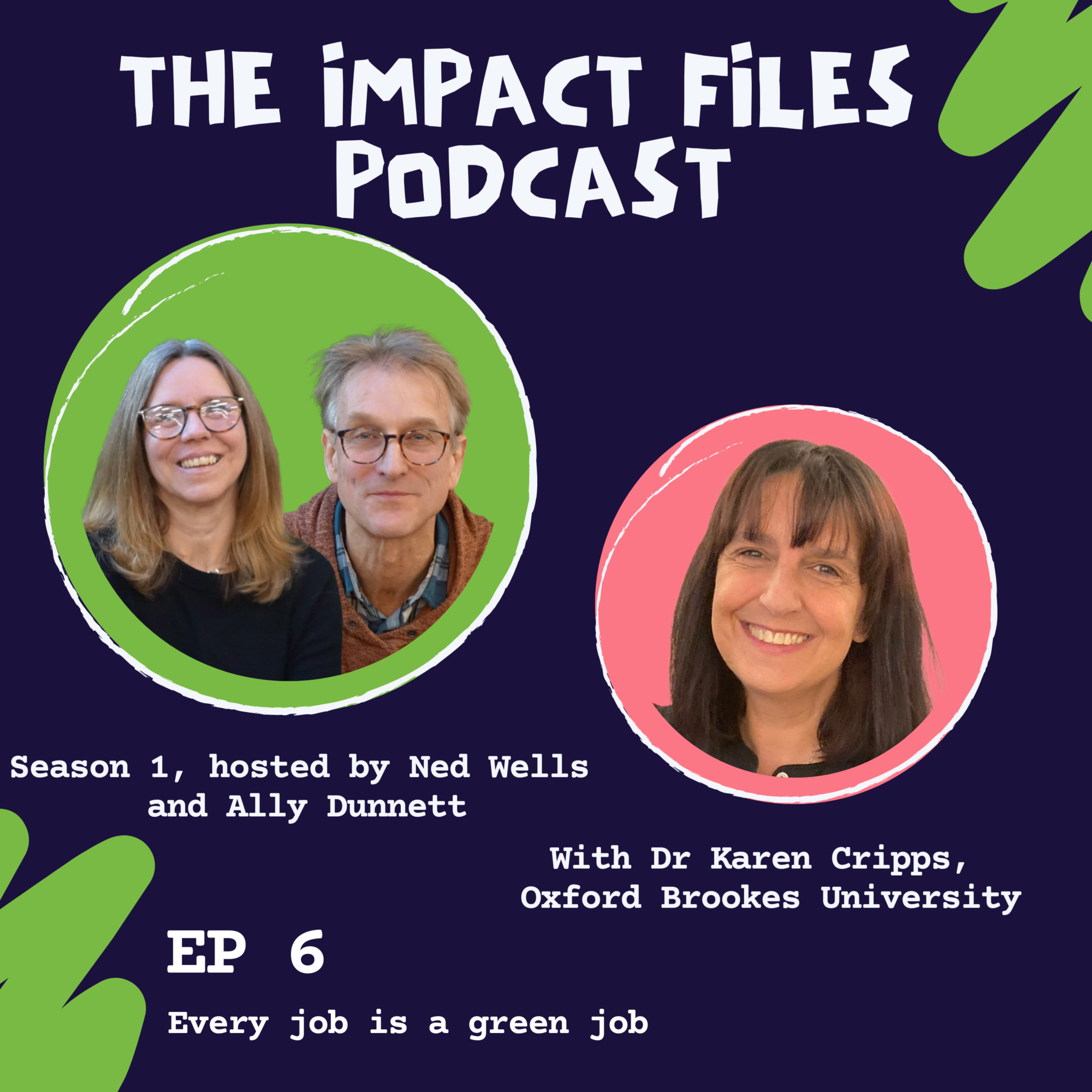
The Impact Files Podcast – Dr Karen Cripps, Associate Professor of Responsible Management and Leadership, Oxford Brookes University Business School
Ned: Welcome to another episode of The Impact Files podcast. In this episode, Ally and I are delighted to be joined by Dr Karen Cripps, Associate Professor of Responsible Management and Leadership at Oxford Brookes University Business School. Karen, welcome.
Karen: Thank you for having me here. I look forward to our discussion.
Ned: It’s really nice to have you here. Karen, I’d love to start with an introduction to yourself, your background, and your personal story.
Karen: I’ll try and keep it concise. I’ve been studying the world of business ever since my own undergraduate degree back in the 1990s, where I began to develop an interest in the environmental impact of business — and that has been a consistent thread throughout my career, progressing to a PhD in sustainable supply chain management in tour operations.
In more recent years, through research and teaching projects around business sustainability, I became increasingly interested in students, graduates, and employability for sustainability. A lot of my research began to look at that intersection of how to encourage as many students as possible towards careers that have purposeful, meaningful impact — meaningful to them in their own career development as well.
And that, most recently, has become very much focused on green skills: the increasing opportunities and need in the job market for reskilling and upskilling for a green economy, and looking at the skills needed for that transition. With a particular focus on the transferable, transformational skills that leaders and managers need, alongside the technical, knowledge-based learning. Green skills is very much what I’m thinking about most these days.
Ned: Many of our listeners won’t be in the academic world at all, so it would be fascinating to hear what the mix of your day job looks like. How much pure research are you doing, and how much contact time do you have with students? And when you are with students, how does that work?
Karen: Academics have an allocation of teaching workload and research workload — or possibly knowledge exchange — and depending on your output and contributions, your teaching might be higher or lower according to measures such as publications and the quality of those publications, research funding attracted, or engagement in knowledge exchange activities and impact case studies.
Teaching typically involves large group lectures followed by smaller group seminar sessions, running from undergraduate through to postgraduate. As you move into postgraduate or MBA-style teaching, it tends to be more workshop-based — a blend of some lecture-style delivery but much more interactive throughout.
The particular modules I’m currently responsible for include one called Developing Skills for Leadership and Employability, for MSc Master’s students in business management-related pathways. I also deliver sessions on ESG — Environmental, Social and Governance — within our global MBA programme, looking at how that fits within broader modules on marketing, operations, and global strategy under uncertainty. So it’s embedded within other subjects rather than always an explicitly named sustainability module — but it is meaningfully integrated as a component.
Ned: That’s so interesting. So you’re bringing sustainability understanding into the normal fabric of business learning.
Karen: Yes, because it needs to be integrated and embedded — much like workplace processes. The same notion applies entirely: sustainability is relevant to every job, every function, every team. But the danger within education, just as in the workplace, is that saying “it needs to be integrated” can risk it becoming invisible and not properly prioritised.
So it’s important to ensure there is meaningful integration — which in an academic context means that sustainability must be reflected in assessment outputs and module learning outcomes. Not just ticking a box by mentioning the Sustainable Development Goals briefly in a lecture, but actually requiring students to formally integrate that into their summative assessments. In the workplace, the equivalent would be embedding it in KPIs, performance reviews, and reward systems.
Ally: Where are you in terms of that integration actually being reflected in grading and assessment outputs? Is it something you’re lobbying for, or already in place?
Karen: There is great variation. At Oxford Brookes University Business School, we are well progressed in that space. Within business and management generally, it tends to be well addressed, represented through an organisation I’m very much part of called PRME — the Principles for Responsible Management Education — a United Nations-supported initiative that now has over 800 global business schools as signatories.
It’s similar in principle to the UN Global Compact for business, signing up to standards around environmental and social responsibility, anti-corruption, and so on. PRME is the educational arm, committing to embed responsibility, sustainability, ethics, and the SDGs into research, teaching, knowledge exchange, campus operations, and community outreach.
By signing up to those principles, it becomes a guideline so that when programmes are developed and periodically reviewed — a BA in Business and Management, for example — each module is mapped against one or more of the 17 Sustainable Development Goals. Some universities even produce public reports on that mapping.
There is relatively good progress within business and management, because it’s integral to that subject area. It’s not necessarily the case across all university programmes, but the sector as a whole does recognise this. Organisations like Students Organising for Sustainability UK carry out ratings of universities against these measures, and the Quality Assurance Agency for Higher Education has produced guidance on embedding Education for Sustainable Development into teaching and research.
But where I’ve begun to have concerns is in how this translates into employability skills. We can be very fluent in talking about the importance of education for sustainable development, but what does it really mean for students going into the world of work — seeing the connections between all of that effort in the classroom and actually taking it into their roles? I think that connection needs to be made more visible.
Ally: You used a phrase in our pre-recording conversation that really resonated with us: “every job is a green job.” Can you tell us more about that idea — where progress is being made, and where there’s more work to be done?
Karen: There’s certainly more work to be done. Linking to an organisation called ISEP — the Institute for Sustainability and Environmental Professionals — there are sustainability specialist roles, the skill sets for which are changing significantly. It used to be a very siloed function within organisations — somebody solely responsible for reporting. Now, sustainability professionals in those roles are responsible for a great deal more: integrating sustainability across functions and teams, which brings implications for how those skills need to evolve.
Then there are what some call the enabling roles — anyone working within marketing, supply chain, procurement, or operations who isn’t necessarily a sustainability specialist, but who needs to reskill and upskill to address sustainability within their own area of decision-making: to avoid greenwashing in marketing communications, to embed environmental standards into procurement decisions, and so on.
In supporting the work of sustainability specialists, every role becomes a sustainability-related role. Every job is a green job.
There is a lot of evidence for this. The LinkedIn Green Skills Report consistently shows that demand for green talent is outstripping supply. And there is growing discussion about what green skills actually means — the distinction between technical green skills for the energy and construction sectors, and the skills more relevant in my sphere of work within a business school: the skills that all managers and leaders need.
That’s been very clearly articulated in a report by the Chartered Management Institute called Leading the Pathway to Net Zero. Our programmes at the Business School are accredited by the CMI, which helps ensure that those industry-required skills are embedded in our learning programmes. And one of the striking statistics from their report was that over half of managers — 57% — in organisations with a net zero plan say they lack clarity on what they’re expected to do.
That lack of clarity and awareness means so many opportunities are being missed to empower people across the workforce to look for where they can contribute to the organisation’s targets. That requires a baseline of carbon literacy awareness. It’s not necessarily complex — I deliver carbon literacy training myself, using the eight-hour programme from the Carbon Literacy Project, and that is enough to give people the basic awareness to begin to question: what am I doing in my everyday practices, and how could I reduce the environmental impact — or more positively, enhance it?
Enabling the workforce to become more aware will help organisations meet increasing regulatory requirements, innovate, build resilience, manage risk. It will give employees more meaningful careers, attract talent into the organisation, and retain it — because people feel they’re working for a business that cares for longer-term futures, for the environment, for wellbeing, inclusivity, and equity.
Ally: You mentioned resilience and motivation in the same breath, and that makes a lot of sense. Managers who have targets and mission statements but no tools or steps to get there — that’s demoralizing. It sounds like in your teaching, you’re taking a very holistic view and equipping future managers with those skills of resilience.
Karen: Yes — and it comes back to whether we’re really connecting education for sustainable development with the skills that employers most ask for: resilience, critical thinking, problem solving, systems thinking. I’ve begun to change my modules in recent years to make sure I am connecting those skills into sustainability-related learning.
And resilience is where I found myself, a couple of years ago, working with Charlie Cox of Climate Change Coaches, a local Oxfordshire B Corp. We met because Charlie was an entrepreneur-in-residence at the business school, and connected over a shared interest in what’s called the sustainability mindset. Through that, I understood that the coaching work Charlie does with sustainability professionals is needed because there is increasingly complex overwhelm for those people charged with delivering on sustainability goals and net zero targets — particularly the challenge of bringing everybody else along with them, across teams and functions where sustainability may not be an explicit part of anyone else’s job description.
That can carry a heavy emotional toll. Many sustainability professionals have gone into this field because they are so passionate about it — and possibly anxious, even, observing the daily reality of climate change impacts and social injustice. That’s what’s driven them there. And then to face the resistance, the knockbacks, arguments that climate change is not real — to hold those conversations, navigate them, and continue to positively influence change — that’s an enormous challenge.
That’s where Climate Change Coaches come in. Charlie described all of this to me, and I immediately wanted to support what she was doing. Together, we produced a research report called Holding Back Climate Progress: Sustainability’s Critical Skills Gap, which outlined the importance of the transferable, transformational skills — communication, engagement, influence, resilience — and the importance of organisations recognising the emotional wellbeing needs of those leading on this work.
Through that report, it gave sustainability professionals something they could bring to their senior leaders to say: this isn’t just me. Many managers and leaders are feeling the same way. We need to be better resourced and supported. And that is very eye-opening from an educational perspective, because while I am encouraging as many students as possible into this line of work, it’s also about preparing them for the reality — that hopefully they walk into their dream role enthusiastic, ready to change the world, but genuinely resilient for the resistance they will encounter.
Ned: As you were talking, I was reflecting on the spectrum of organisations your graduates will be joining — from very large multinationals to very small local businesses — and the variety of cultures and sophistication around sustainability, from those where it’s thoroughly embedded into every role, to those where people are sceptical or don’t yet see the business relevance. That’s a very real context in which resilience matters.
Karen: Yes, and the business case is critical. It’s really the cost of inaction — but a person can only understand that if they’re aware of what climate impacts mean in practice: the insurance risks, the reputational risks from controversies in the supply chain, the increasing regulatory pressure around plastics and emissions reporting, the cost savings available from environmental efficiencies, and the changing demands of consumers. Without that awareness, it’s easy to have a blind spot. Systems thinking helps people see where sustainability fits into all aspects of operational strategy. It’s not a nice-to-have.
Ned: And the relevance of sustainability can manifest itself through so many different channels — regulatory pressure, market forces, supply chain requirements, recruitment and retention. There are so many entry points.
Karen: Yes. And it’s particularly difficult right now with the loud political voices against progress that has been made, and the withdrawal from climate commitments — with some organisations following that lead. That sends an alarming signal everywhere, including to educators and students, who may begin to think: well, this isn’t relevant anymore.
But actually, the research and media coverage is illustrating that whilst organisations may have removed commitments from websites — particularly US-linked businesses — the implementation hasn’t slowed down. And it is more important than ever not to put down the tools. How can a business believe that climate change won’t impact its operations? Climate change hasn’t stopped just because climate commitments have been rolled back.
Ned: And as you say, while commitments may have been rolled back at a national level, it’s encouraging to hear that organisations are continuing the work.
Karen: Yes, because those organisations see it as part of strategic, longer-term risk and resilience. Sustainability has always been up against this — I’ve been in this field since the 1990s, and yes, it’s frustrating that we keep cycling through progress and withdrawal. It’s not a linear path. But resilience is knowing how to navigate that, and hopefully it will be good business sense — the evidence of organisations that produce profits by solving the problems of people and planet — that carries the argument, rather than alarming world events. To quote Professor Colin Mayer of Oxford’s Saïd Business School: the purpose of business is to produce profitable solutions to the problems of people and planet, and it’s through doing that that they make profit. There is ample evidence of small and medium-sized organisations, the B Corp movement, through to large global corporations, implementing this approach and building it into strategic decision-making.
And coming back to my own area of focus — graduates and the world of work — another research project worth mentioning is with Windō, a platform created by Ollie Coles from Oxfordshire. Windō helps talent find job opportunities with recruiters aligned to their personal values. It takes organisations’ CSR reporting and breaks it down into an accessible format covering commitment to equality, diversity, inclusion, LGBTQ+ rights, and environmental standards — so that anyone looking for work can assess an organisation’s ratings in those areas before applying or attending an interview.
We produced a research report with Windō called Sustainability in Early Careers, which involved surveys and interviews with businesses of all sizes, from small and medium-sized enterprises to global corporations. What we found — which connects directly to the CMI report — was a visibility gap. Organisations want to recruit people with a passion to get involved and help solve sustainability challenges, but they fail to signal that within job descriptions. At Oxford Brookes, we have placement and internship students who are desperate to find sustainability-related roles, and they get disheartened because those roles appear so rare — when in reality, the opportunity is embedded in almost every role, just not visible.
Our job within education is to give students the mindset to go into any placement or job actively looking for ways to get involved, having those conversations, and not waiting to be invited. And from the organisation’s side, the opportunity is to signal in job descriptions that sustainability involvement is welcomed. Which brings it back again to the CMI finding: managers lack clarity on what they’re expected to do. Awareness-raising helps people see that it doesn’t need to be extremely complex. Not everyone needs to be an accountant, but everyone needs basic financial awareness to support the accountants. Sustainability is the same. It’s about mobilising the 99%.
Ally: You’ve talked about the challenges, Karen, but it’s really encouraging to also hear about the progress being made. What do you count as genuine successes?
Karen: I see it as a success every time a student makes a LinkedIn post about the meaningful personal impact they’ve had. I received an email just yesterday evening from a student who took the time to write and say: thank you for that sustainability-related learning, I’ve really taken it into my job in the public sector and it matters to me. That’s what keeps me going.
On a personal level, there are the individual impact stories. I teach a masterclass session called Career Storytelling for the SDGs, and I begin it by asking: if you retire at 70, what year will it be? For most of these students, they’re talking about 2070. And I ask them to reflect on: what kind of world do you want to see? What do you want your career to look like within that world? I genuinely look forward to scanning LinkedIn in years to come and seeing the positive impact stories they’ll have created.
At a broader scale, there is clearly very strong interest in green skills. The webinar we ran to launch the Sustainability in Early Careers report drew hundreds of attendees — far more than any similar webinar we’ve held. And the CMI event yesterday for Leading the Pathway to Net Zero also had hundreds of people. There is clearly an appetite for understanding what green skills are, how to develop them, and how to leverage them across the workforce.
Ally: And I suppose where there is resistance and adverse messaging on a topic, it very often triggers renewed commitment and community-building among those who believe in the importance of the agenda.
Karen: I think that’s exactly right — and I see it particularly from what’s happening in the US. I’ve been working a lot with authors in the United States on the forthcoming book, and it’s extraordinary to see the number of communities of climate professionals supporting each other and helping people break into green jobs. There’s an organisation called Climate Voice which is the voice for employee advocacy in this space. Because of the political climate they’re in, it has made people campaign harder and fight back.
Ned: You mentioned advocacy, and that brings me to a point I wanted to explore: the role of communications and media in its broadest sense in driving sustainability action within businesses.
Karen: Internal marketing is certainly important here — internal communications teams have the skill set in communication, engagement, and influence. A great example is a chapter being contributed to my forthcoming book by Gemma Butler and Michelle Carvill of Can Marketing Save the Planet? — a brilliant podcast illustrating the role that marketing plays in those internal communications.
But something I find particularly important, and which I’m focusing on more in my teaching, is climate policy advocacy — enabling and empowering students to have those voices, to ask the right questions, to advocate internally as well as externally to trade associations and policy leaders. The skill is being able to speak up and speak out without being seen purely as an activist — because many organisations aren’t looking for that. It needs to be done in a professional, considered way.
I’m deeply inspired by a US example here. Holly Elmore and Will Alpine had their dream jobs at Microsoft and began to recognise a discrepancy between big tech’s climate reporting and the environmental impacts of AI expansion and data centres. They campaign through something called the Enabled Emissions initiative, calling out the fact that the contracts big tech companies hold actually enable more oil and gas drilling — and this goes entirely unaccounted for in their emissions reporting. Holly and Will initially advocated internally, and their senior leadership personally agreed with them — but that wasn’t enough to change the system. They ultimately chose to leave their roles and campaign from the outside. That story raises all sorts of questions around whistleblowing, the contexts in which people feel safe to speak up — and illustrates advocacy as a professional communication skill that is more needed than ever.
Ned: And crafting the message in a way that’s going to land with the people you’re seeking to influence, and doing that at scale across all the competing priorities of a business — that’s quite a challenge.
Karen: Yes, and that’s exactly where the work of Climate Change Coaches comes in — giving individuals and teams the skills to navigate those conversations without them becoming hostile.
Ned: You’ve mentioned so many useful resources. We’ll make sure that all of these are linked to in the show notes. Ally, over to you.
Ally: Thank you, Karen. We’re heading into our closing questions now. Can you tell us what you’re most looking forward to in the next 12 months?
Karen: We’ve just begun stakeholder consultation workshops on a project called Green Skills for Green Jobs, funded by the Quality Assurance Agency for Higher Education. We ran our very first pilot workshop just yesterday, bringing together industry leaders, students, and educators from across university programmes to talk the same language about what these green skills are, where things are working well, and where more is needed. That project is led at Oxford Brookes, with about five or six university partners across the UK. The report will be published by early summer.
I’ll also be continuing to develop work around careers and green skills — making sure that what organisations need and are looking for is meaningfully integrated into our module and programme design.
And the book — An Organisational Guide to Skills for Green Workforce Transformation — won’t be out until September. We’re sending the manuscript to the publisher in January, and as anyone in publishing will know, there are quite a few months at the publishing end.
Ned: Looking at the macro picture — equipping graduates with green skills for business — where do you hope your sector will be in 10 years’ time?
Karen: I absolutely hope that the higher education sector is able to clearly distinguish between education for sustainable development and green skills — so that it is very clearly articulated and understood by educators what we need to be doing to prepare our students specifically for the green economy and green jobs, rather than bundling it all under one heading and treating it as the same thing.
And one of the biggest things I’m campaigning for — which I take great pleasure in having now introduced at Oxford Brookes — is rolling out carbon literacy training to all students. I fundamentally believe it’s wrong for any business and management graduate to leave university without carbon literacy training. I admire universities that have systematically introduced it so that every student undergoes it at some point in their programme. I want Oxford Brookes to do the same, and we have begun to make steps in that direction.
Ned: And finally, one piece of advice for employers who might think that green jobs aren’t relevant to their business?
Karen: Start with awareness. Reflect on how climate-related weather events — extreme heat, flooding — have already impacted your employees’ health or ability to travel to work. Ask whether there has been any reflection on employees’ emotions and fears around this, and whether it would feel better for them to see the organisation taking action. Then look at the cost efficiencies that can come from relatively simple changes to processes — within offices, factories, warehouses, supply chains. Look at your carbon footprint fundamentals, and begin to spot where efficiencies can be found. Then ask: who within this business could address that? That person is doing a green job.
Ned: Fantastic. What a great note to end on. You’ve mentioned so many brilliant resources — we’ll make sure they’re all linked to in the show notes, alongside your contact details and information about your forthcoming book.
Karen: I’ll send those over to you — the three reports, and let me know if I’ve missed anything.
Ally: It really was fascinating. I feel like I’ve got a great deal of follow-up to do.
Ned: Karen, that was amazing. Thank you so much.
Karen: Thank you — it was easy talking to you both.