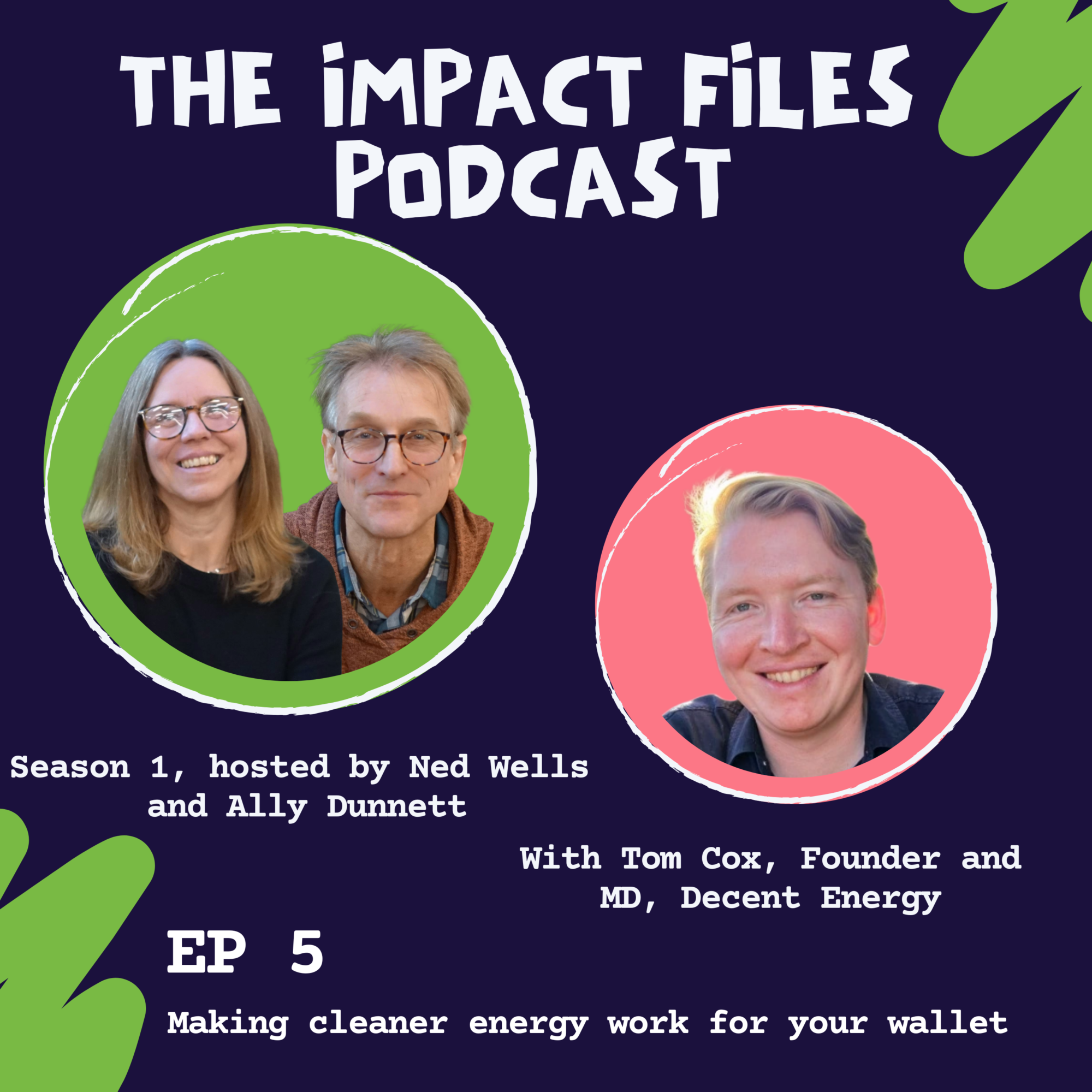
The Impact Files Podcast – Tom Cox, Founder and MD, Decent Energy
Ned: Welcome to another episode of The Impact Files podcast. I’m delighted to be joined today by Tom Cox, founder and Managing Director of Decent Energy, and host of People, Planet, Pint in Cambridge. Tom, welcome.
Tom: Thanks, Ned. Nice to be here. Hi, Ally.
Ned: So, Tom, we’ll start with an introduction to yourself, to Decent Energy, and the work that you do there.
Tom: Sure. Personally, I’ve been interested in sustainability for a very long time. I was a very early adopter of EVs back in 2014 when I got my first Nissan Leaf, and have acquired various bits of low-carbon tech ever since. A few years ago, I got solar installed, and was very disappointed with the process — I realised how none of these things seem to work together nicely. Solar panels, heat pumps, EV chargers, all the various different bits of low-carbon tech. I saw an opportunity to make them work better, and that’s how Decent Energy was born.
What we do primarily is link together those bits of technology and enhance them with data from what’s going on in the grid, what’s going on in the wholesale energy market, outdoor weather, and a variety of other factors. We use those to make decisions for the equipment, so that it reduces the cost and the carbon intensity of the energy that people use.
Ned: That’s so interesting. So it’s hitting two problems at once. We had solar and a battery installed earlier this year, and whilst the systems seemed great and we saw an immediate reduction in the cost of our electricity, the apps and websites to understand what’s going on really don’t seem joined up. It’s incredibly hard to understand the actual numbers. And it sounds like there’s a further cost-saving element to what you’re doing as well for users.
Tom: Yeah, absolutely. I’ve always said: if you want people to be more sustainable, you need to make it easy, and you need to make it cheap. The way our platform works, it actually saves you money rather than costing you money — and then we ask for a portion of the savings we’ve made for people. The way to get everyone to engage in decarbonisation is to actually demonstrate that it can be cheaper for everyone. That’s a really key driver for us, and it’s how we get paid.
Ned: On a personal level, was there a defining moment when you decided you wanted to run a business that balances purpose and profit?
Tom: I always knew I wanted to. I’ve run several consulting businesses in the past, and I knew I wanted to leverage those to launch a product at some point. When I got solar installed, I realised quickly: this has huge potential — why doesn’t every house have this on their roof? How can we speed up the rollout, and how can we make sure it’s successful for everyone?
My original thinking was: can we put solar on people’s roofs and have them pay back through some of the energy generated? But I then realised that had been done extensively — the rent-a-roof schemes from the feed-in tariff days. I struggled to find a workable business model to expedite that rollout. So really, I identified the problem — how do we get renewables in more homes, how do we get them to work better, how do we speed up decarbonisation — and then tried to find a model to fit that, rather than the other way around.
Ned: And where have you reached in terms of scale? You’re a relatively young organisation, aren’t you?
Tom: Yeah, absolutely. We only registered the business a year ago, and I only went full-time about six months ago — end of April, I switched to this being my full-time role. So we’re very, very young. But we’ve got a lot of great support from the industry. We recently won Solar and Storage Lives, start of 2025, which is great. And we’ve got various other bits of recognition coming out over the next few months that are currently embargoed.
In terms of traction and market recognition, we’re doing really well. Our first product is still in beta, but we’re already developing our second, and we’ve got a very clear roadmap of the four core products we want to deliver. When you’re founding a business like this, you can constantly feel like you’re not doing well enough, because there’s so much to do. But when you look back at what’s been done over the course of the past year, it’s a nice way to take stock.
Ned: Is that first product out on the market, available for purchase, with a brand name?
Tom: Yes, it’s called Shîfter. It’s out there for anyone to sign up to. It’s free at the moment because it’s still in beta. Interestingly, one of the most challenging things we’ve had to produce was not the forecasting and optimisation — it was producing a bill. They say it’s the simplest things that are the most difficult. For us, the biggest challenge has been telling people how much we actually saved them after we saved them the money, and getting that down to a really precise level.
We currently support three inverter manufacturers — Solax, Fox ESS, and GivEnergy — and we’re working on a fourth, GrowWatt, which we hope to have ready before the end of November. We’ve also got a fairly large project coming up with a council to provide our software over the top of some solar installations they’ve done on council housing.
If you don’t see your particular inverter on that list, please do go and sign up to the website anyway. If we find out where the demand is, who has what inverters installed, that helps drive our decision-making for what we integrate with next.
Ally: Thanks, Tom. What is Decent Energy’s business case for sustainability? How do you measure it, and how do you report it — to your board, potential investors, and so on?
Tom: We have a dual mission: speeding up the decarbonisation of the grid — reducing the carbon intensity of the energy everyone uses — and reducing the cost of energy, with a focus on fuel poverty as well. Decarbonisation leads to electrification, and electrification is the obvious endpoint.
We have two core metrics. One is the amount of money we’ve saved people. Because our commercial model is risk-reward based, the more money we save for our end customers, the more money we earn — we take a percentage of the saving. Our incentives are really well aligned: we can only have the customer’s best interest at heart, because it’s also our best interest.
The other metric is the amount of CO2 we’ve avoided. We can’t change the energy makeup of the grid — at least not at the scale we’re at now. But we can move energy consumption to times of day that are cheaper and greener, shifting demand towards times when renewables are available and away from times when gas turbines need to come online.
We express those metrics by looking at the average price per kilowatt hour our customers pay compared to the average wholesale market price, and the average amount of CO2e per kilowatt hour against the same baseline. We measure against the wholesale value because the price of energy is going up, so we need to measure against the average, not the absolute. Similarly, the carbon intensity of energy is decreasing over time, so we also need to measure against a baseline — otherwise the numbers would be misleading.
Ally: And Decent Energy was recognised as a high-growth company by Innovate UK Business Growth — can you tell us what it took to convince them?
Tom: We actually had a contact there from a serendipitous meeting a couple of years earlier, at an event in Cambridge. When I was thinking of starting the business, he sprang to mind. He’d given a talk on how to put together a pitch deck, so we reached out, I shared the idea, and we managed to convince him it was a compelling enough proposition to take forward. Our growth specialist, Dan, really saw the inflection point in the flexibility market — where the grid asks consumers to put energy in or take it off at particular times to manage demand. He championed us internally, which was no small feat — it’s quite a rigorous process.
Ned: I was really interested in the risk-reward model you’ve chosen. It’s pretty bold. How did you decide to go risk-reward?
Tom: It gets bolder than it sounds, actually — not only do we only charge a fee when we save you money, but we also guarantee we won’t cost you money. If we have a significant bug that sets your inverter charging incorrectly and we can’t send another command in time, we will pay back whatever that costs you. We really are backing ourselves.
For me, the key things were: I wanted a simple model that was scalable in both the B2C and B2B space, and I wanted something that was extremely low risk on the side of the consumer or business. There’s zero financial risk on their part — we’re guaranteeing we’ll save them money.
Trust is the key thing here. What we do is really quite complicated for the average consumer to comprehend. The real problem is convincing you that we’ve saved you money — because if we’re doing our job right, you shouldn’t really see much. We want this to be something that quietly works in the background, requiring zero effort on the consumer’s part, but constantly saving you money.
Combined with the risk-reward model, at the moment we’re not requiring people to sign a contract or commit for 12 months — you can leave at any time. I like to say we’re the only subscription service that saves you money: every month we tell you how much we’ve saved you, and then we send you an invoice for a small portion of that saving. We’ve actually saved you the money before we get paid.
Ally: And that trust is clearly resonating with investors too.
Tom: Yeah, one of our major investors specifically cited this when providing a comment for a press release — he really likes the idea that we help people be more sustainable, and it doesn’t just cost them nothing, it actually saves them money. That’s a really compelling case for getting customers on board.
We’re completely transparent with data, too. Anyone can see the actions we performed on their equipment, and the rationale for why we performed them. That goes a long way towards building trust — even if working through all that data to verify the savings themselves would be quite a big ask for the average person.
Ally: Can you just remind us — what size is Decent Energy currently?
Tom: We’ve got four employees working directly for Decent Energy. We also have an investor, a software and data science firm called Adaptavist, based primarily out of Ukraine, who’ve provided several additional heads — data scientists and data engineers — to help expedite getting our products to market. So four permanent staff, but at various points the business has had up to ten people working on it at any given time. We’re very, very small but growing. In the past year we’ve hired two additional heads, so if we keep that up, that’s quite an exponential growth rate.
Ally: Can you tell us about the balance of purpose and profit — successes and lessons learned?
Tom: It’s an interesting question. Consulting, which was my previous career, doesn’t really lend itself well to balancing those two things — you’re largely doing what large corporate clients dictate. The one sustainability-focused project I did earlier in my career was running a Sustainability Audit Programme for a large power generation company, which was nicely aligned with purpose and profit.
In Decent, it’s a constant challenge working out the optimal way to run the business. There’s an obvious win in things like optimising data centres — looking at how we can carbon-balance them rather than purely load-balance them. That would be worth an awful lot of money. But we are very focused: we can focus on one hard-to-abate sector at a time. Right now that is the domestic market, and that’s also the obvious gap in the market for us — connecting all these disparate bits of tech together and making the home, and small businesses, work better.
Ned: How is sustainability and profitability built into your day-to-day processes?
Tom: It’s baked right into the model. Our two key performance indicators are the average price per kilowatt hour — how much money we’ve saved people — and the average carbon intensity per kilowatt hour — what impact we’ve had on the carbon intensity of the grid. If the work we’re doing contributes to driving down those numbers, we know we’re doing the right things. If it doesn’t, we can step back and ask whether it’s the right thing to be doing.
We also follow an agile development methodology. Once a week, we go through the process of deciding what we’re going to work on that week, based on a prioritised list. At the end of the week, everyone in the team demos what they’ve done — including me, which usually means telling people what meetings I’ve had. It’s less visible but just as important. The transparency we need with customers, we also need internally.
Ned: So sustainability and profitability are really running hand-in-hand at Decent.
Tom: Yeah, very purposefully so. If those are our key metrics, then we know we’re headed in the right direction.
Ned: Tell me about the role of marketing in driving what you’re building.
Tom: It’s a really good point, and it’s one of the other problems we’ve got. What we do is complicated. The wider question of energy and decarbonisation itself is also really complex and poorly understood. It’s not just a case of selling widgets that everyone loves the look of. We first have to explain a very complicated market that people aren’t familiar with, get them to care about it, explain how it’s going to save them money, and then convince them that we’re the right tool to do that. It’s a critical challenge.
We’ve recently launched a feature on the website called Power Hour, which I quite like as a way of starting to explain these concepts. If you go to decentenergy.io and you’re in Great Britain, it will tell you when the cheapest and lowest-carbon time to use energy is tomorrow. So you could manually shift — even if you have no battery, solar, or EV — just change the time you run the dishwasher to align with that time of day. That would reduce the carbon intensity of your energy, because you’re using energy when more renewables are online. It’s a great demonstrator for the broader thing that Shîfter is doing, and a nice give-to-get: providing some value for people as a one-off exercise, and if they like it, it could lead to further engagement.
Ally: I was on your website earlier, Tom, and the Power Hour feature pops up straight away. I thought, how interesting — and then realised it can be used by people who aren’t on clean energy yet, not just those who are already switched.
Tom: You’ve raised a really important point, and it’s a bit of a bugbear of mine in the clean energy space. Energy companies have long had marketing campaigns saying “all the energy you buy from us is green.” I don’t want to discourage anyone from choosing a green energy supplier — it means they’re putting the equivalent amount of clean energy into the grid, and that’s genuinely important. But the carbon intensity of the grid does fluctuate throughout the day, and “green electrons” don’t magically find their way to your house. If you make your dinner at exactly 7pm, you will be contributing much more heavily to the carbon intensity of the grid than if you made it at 9pm or started it in a slow cooker earlier in the day. We need to explain that to people.
Ally: Can you give us an overview of where you hope Decent Energy will be in 12 months’ time, and beyond?
Tom: We’re targeting four key products. First, Shîfter — open beta right now, anyone can sign up. If you’ve got a Solax, Fox ESS, or GivEnergy inverter, all the better — you could be using it this afternoon.
The second product is called Flêxer. That enables consumers to participate in flexibility markets — similar in concept to things like Octopus Saving Sessions or OVO Free Energy Sundays, but instead of points or free hours, we give you cash. If we use your equipment to participate in a flexibility trading event, you get 80% of what we earned; we retain 20% as a service fee.
The third is called Swîtcher. That looks at your exact consumption — either from smart meter data or inverter data, which gives a much better view of household energy consumption — and makes a recommendation for the cheapest tariff based on the exact way you use energy. We’ll also constantly monitor usage and make recommendations to switch when it makes sense to do so.
And our end state — the final destination we’d love to reach — is peer-to-peer energy trading. So rather than drawing from the grid, you could buy electrons directly from your neighbour. Let’s say Ned, with his solar panels and battery, is producing excess energy, and Ally has just put her car on to charge — if they lived next door, Ned could sell that excess energy to Ally rather than creating greater demand on the grid. That reduces primary energy demand, and also reduces what’s called transmission loss — the energy lost simply moving electricity from a distant power source to your plug socket.
The challenge is there’s currently no regulatory framework that enables peer-to-peer energy trading, but we’re in regular communication with Ofgem and DESNZ about when that might be coming to market.
Ned: What about the relationship between Decent Energy and energy suppliers — are they partners, competitors, or both?
Tom: It could end up being that suppliers become customers, using some of the optimisations and integrations we’ve built — because the process of integrating with all these bits of low-carbon tech is extremely costly, complex, and requires constant maintenance. At various times, they could be competitors, but we’re energy supplier agnostic. We’ll look at your consumption, look at what dynamic tariffs are available, and make a recommendation. We could help sell some of their products, or help them with integrations and optimisation.
Generators are also really interesting for us. Think about what we call curtailments — situations where excess renewable energy gets wasted. If there are lots of homes near where an offshore wind turbine connects to the grid, could we work with that generator to give local residents batteries, making them a decentralised battery that stores that excess energy? Even if we could delay curtailment by 30 minutes or an hour, we could significantly reduce the cost of energy for people in that location, reduce the curtailment cost to the UK taxpayer, and ensure more of that energy actually gets used and consumed.
As I always say: if you’re working in sustainability, in clean tech, we’ve all got a single competitor — and that is carbon. As long as we’re all working in the same direction, that’s what matters.
Ned: Where do you hope your sector will be in 10 years’ time?
Tom: The vision I’ve described to you — that’s roughly where I see this moving in the next decade. Energy managed hyper-locally, decisions being made based on the load of an entire street, village, or low-voltage feeder. This is the really big opportunity for energy independence, decarbonisation, and reducing the overall cost of energy for people.
It’s also going to become a problem if we don’t get it right. Look at the Netherlands — they’ve had a hugely successful renewables rollout, which has resulted in what they’re calling grid congestion: too many renewables on the grid at any given point in time. People are actually being charged to export energy from their solar panels in some parts of the Netherlands. That’s a very real problem we could face in a few years too.
There’s a quote I have on my pitch deck from an Australian academic called Saul Griffiths: “We need to decarbonise demand with the same urgency that we decarbonise supply.” Building solar panels and wind turbines is absolutely essential, but we need to make sure we’re looking at both sides of that coin.
Ned: One piece of advice for other start-ups pursuing sustainability and financial objectives.
Tom: Make sure you have a really clear business case for what you’re taking to market. Sustainability needs to wash its face. Up until now, there’s been a lot of investment on attractive ideas or novel material science, but we’re getting to the point where we need to know that these solutions are commercially viable. That’s how we protect sustainability as a bottom line. It doesn’t matter which side of the aisle you sit on — everyone wants to save money. The one thing we can all agree on is that more money left in our bank accounts at the end of the month is a good thing. So let’s hit people in the wallet.
Ned: Fantastic. What a great episode. Thank you so much, Tom. Finally, how can people find out more about you and about Decent Energy?
Tom: Come to the website — decentenergy.io. You can sign up to the product there. We’re also very active on socials: LinkedIn, Facebook, Bluesky, Instagram — come find us there. And if you’re interested in this space, feel free to get in touch. There’s contact information on the website too.
Ned: Fantastic. That’s been very, very interesting, Tom. Really appreciate it. Many thanks, and we’ll see you again soon, I hope.
Tom: Great stuff. Thanks a lot, Ned. Thanks, Ally.
Ally: Thank you so much, Tom. Bye-bye.