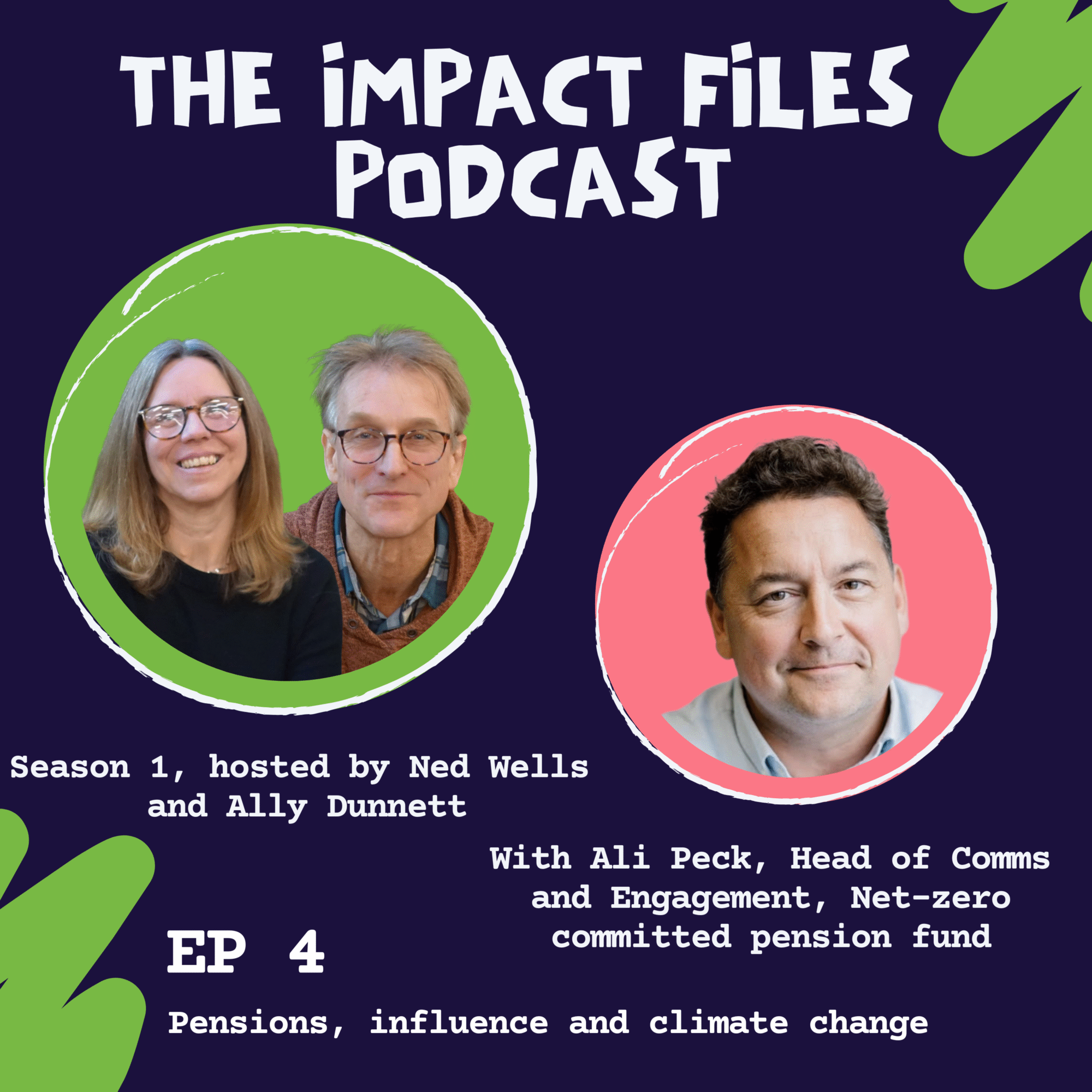
The Impact Files Podcast — Ali Peck, Head of Communications and Engagement, London Pensions Fund Authority
Ned: Welcome to another episode of The Impact Files podcast. In this episode, Ally and I are delighted to be joined by Ali Peck, Head of Communications at the London Pensions Fund Authority. Ali, welcome to the podcast.
Ali Peck: Good afternoon. I’m very pleased to be here. Thank you for having me on.
Ned: Really nice to see you. So Ali, let’s start with an introduction to you, to the LPFA, and the work that you do.
Ali Peck: We are an £8 billion pension fund. We are linked to the Greater London Authority, so our ultimate boss, I guess, is Sadiq Khan. We have 100,000 members — people who work in London, for the likes of the University of Greenwich, the British Film Institute, and the Greater London Authority. And we invest for our members for when they retire.
We invest in things that are really around you. We have trains in East Anglia, ports in Aberdeen, solar farms on the south coast, and business parks in Cornwall and Tunbridge Wells. And we use the income from those investments to pay people their pensions when they retire. Pensions is not just a bank account that sits in the sky — it’s actually invested in the assets that surround you in your daily life.
We have a team of three communications professionals. We cover the entire marketing mix, from website and digital to media, public affairs, right the way through to conferences, events, and annual reports. And we also, with a slight twist of fate, cover the operational sustainability of the fund.
The fund made a net-zero commitment in 2021. Climate change, and the impact of climate change, poses a financial risk to our fund and undermines our ability to pay people their pensions. So our net-zero commitment is about managing that risk and making sure that in 40 years’ time, the infrastructure that surrounds us exists to allow us to maintain that income and pay people their pensions.
Ned: I wonder if we could rewind just a moment and ask about you — what’s your story? What brought you to the London Pensions Fund Authority? Where did it all start?
Ali Peck: For my sins, I trained as a stockbroker years and years ago, then really hated it, and was probably quite bad at it, to be honest. I went into communications — it was around the time of Tony Blair, and I found the role of the media absolutely fascinating in terms of shaping people’s opinions. So I worked for a PR agency for a while, and then for a pensions consultancy. I find pensions really, really interesting — as my children say, I am very, very boring. But pensions is so fundamental to the UK, as you can see from the discussions government is having at the minute.
I started at a big American pensions consultancy and was European head of communications for a while. I got to the top of that tree, looked around, and thought: I don’t like it here. So I tried to do something with a lot more purpose, and the LPFA were looking for people to help them communicate their net-zero work. Hugely important to their membership, hugely important to the management of financial risk — but also emotionally hugely important to me, because I’ve got two children who are going to grow up in a world that is very, very challenged unless we all take action.
I’ve been there for six years. My role has been mainly making sure that all the stakeholders of the LPFA know that what we’re doing as a fund is making progress on net zero. And that means being vocal — in the press, on social media, at conferences. The reason for that is not just about profile. It’s about making sure that others in the industry are doing the same: that our suppliers are doing their own net-zero work, because they know what the LPFA is looking for, and that the asset managers who want to work for us are doing their own net-zero work. It’s trying to drive change through communications.
Ned: Fantastic. The people that would have their pensions with the LPFA — are they employees of London-based organisations that have become your members because they’re in London? Is that more or less how it works?
Ali Peck: Broadly, yes — there’s a historical reason for it. There are a load of different pension schemes in the UK, from large ones like NEST to private ones and university schemes like USS. We sit within an industry called the LGPS — the Local Government Pension Scheme — so it’s organisations related to local government in London. These are replicated around the UK; in total, the LGPS alone is about $300 billion in assets. We have about 116 employers paying into the fund and around 100,000 members. Those are split broadly: around 30,000 active members who are working and paying in every month, plus retirees taking money out, and then people called deferreds — who used to be paying in but are now working in the private sector or somewhere else.
Ned: So these are public sector organisations and employees in London.
Ali Peck: Correct.
Ally: I’m just interested to know whether the LPFA were among the leaders or the early adopters of their commitment to net zero, or whether you’d say they were riding a trend.
Ali Peck: No, we’re one of the first — and probably one of the better ones. Certainly among the first, if not the first, and I think we’re quite widely recognised in the industry as being one of the leaders in climate action. We’re also members of an organisation called C40 Cities, which is a network of mayors, and part of our role in being vocal is speaking to other city funds across the world — Johannesburg, Cape Town, Detroit and others — to try and get their city pension funds to not necessarily divest, but to invest in green technologies and in the transition, and to share what we’ve learned, including the mistakes we’ve made. You tend to see a lot of action in those areas among Democrat-led cities in the US, rather than Republican ones, for obvious reasons.
Ned: So you’re investing huge amounts of money with a view to making a return that can fund the pensions of your members. How did it all start at the LPFA? When was the decision made, and why, and who drove it?
Ali Peck: We operate within a concept called fiduciary duty. As a pension fund, that means we need to act in the interests of our members. Climate change poses a financial risk. Take a company that builds a factory on a floodplain — a floodplain that flooded once every 100 years that is now flooding every five. If we’re invested in that company, the factory’s flooded more often, staff are less productive, insurance is higher, profits are lower. There’s an impact on our investment and less money coming into the fund to pay pensions. So we want to make sure that the companies we’re invested in are protecting their operations and their workforce. This is a financial decision, a risk-based decision. However emotional I feel about climate change, this is hard facts around money.
We are asking all the investments we have — from Danone to Alphabet, right through to real estate and commercial properties — to prove that they are making a transition and taking the impact of climate change into account. That could be as broad as asking Coca-Cola to make sure their profits in the Middle East will be maintained, because climate change creates more drought there, which could impact their market share and reduce profits. Everything is really interconnected.
That’s our fundamental reason for doing it. Companies that are ignoring climate change are a reputational risk to us and a financial risk to us. And as a member of a pension fund, everyone has a stake in this game — so make your voices heard to your pension fund. It’s very, very important.
Ned: I don’t come from a finance background, but I’m beginning to visualise how, as a pension fund, you have professional investment managers who are managing existing funds or looking for new organisations to invest in, and you’re requiring those companies to prove they have a net-zero commitment. How do you go about asking them to prove that, and what’s the governance around it? Is that the communications function’s responsibility?
Ali Peck: No — our remit as a communications function is to communicate the pension fund’s progress, drawing on the information that all our departments submit to our responsible investment team. We started off reporting on our listed equities exposure — about 50% of the fund, so around $3.5 billion. Three years ago, we reported our emissions at a certain level. Since then, the communications team has been tracking how we’ve increased coverage across more asset classes and how our emissions profile has changed.
We’ve also done work with an organisation called The Good Economy to map out our infrastructure and real estate investments across the UK — including a climate risk component. That mapping project, which you can see on our website, shows exactly where our investments are within the UK. It was a governance piece: a way of verifying that our investment managers are genuinely following their net-zero commitments and not investing in high flood-risk areas.
In terms of what we require from the companies we invest in — if they don’t have a sustainability report, that’s the first point of call. They should have discussions around climate change at board level and should have a transition plan in place. Some don’t, and we will divest from them if they’re not showing evidence of transition. We divested from a lot of fossil fuel extractive industries two or three years ago, and we no longer have any assets in the equities part of our portfolio that extract fossil fuels from the ground.
There’s always a balancing act — something like Sainsbury’s, which operates a lot of petrol stations. Purists will say get rid of everything. But we’re a society built on fossil fuels, and we’ve got to maintain the ability to pay people their pensions. A lot of these companies generate a lot of cash. It’s a very difficult balancing act.
Ned: I wanted to dig down a little further into the reporting side. You’re operating at scale with lots of organisations reporting into you. How often do they report? Do you have a large team? Is it automated?
Ali Peck: Luckily, that’s handled by our fund managers, with our RI manager overseeing them. There’s a variety of databases and systems. From our own side, we use the Planet Mark to monitor our operational emissions — it’s a helpful organisation that helps smaller organisations assess, monitor, track, and reduce their operational emissions. We’re also required by the TCFD — the Task Force for Climate-Related Disclosures — to report on our climate-related risks.
We have to explain to our stakeholders how we’re aligned with the Paris Agreement, for example. There isn’t actually a requirement for funds to set net-zero targets — that’s often voluntary. But it would surprise me greatly if the vast majority haven’t done so by now, given that it’s fundamentally a risk issue.
The framework we use is the Net Zero Investor Framework, established by the IIGCC — the Institutional Investors Group on Climate Change. They set criteria for how you assess emissions from your private equity, global equities, and infrastructure holdings, and you have to use that framework.
It’s a laborious process, and the strength of the data we receive changes over time. Five years ago, the data in this area might have been fairly weak. Five years later, it’s really improved because people understand it better. So bizarrely, you might see your reported emissions jump — not because you’re suddenly invested in more fossil fuels, but because the companies you’re invested in are now capturing and reporting their data much more accurately. It can be a bit of a roller coaster.
From a communications perspective, we do several things: social media reporting, and we publish a voluntary annual net-zero progress report. We’re not required to do that, but we think it’s important. Part of demonstrating net-zero progress is actually proving you’re making it — not just saying so and then going quiet when people ask questions.
Ally: I wanted to come back to something: how directive can you be with the companies you’re invested in? Can you tell them what processes to follow, or do you essentially look at the data and decide whether they’re performing?
Ali Peck: We have a set of policies on our website — from our climate change policy, which makes clear we won’t invest in extractive fossil fuels, through to our responsible investment policy, which identifies around six pillars of things we’re concerned about as a fund. Those include AI — both a major opportunity and a risk — and the circular economy, which we see as a significant opportunity.
These policies signal to the market what we’re looking for and what we support. On the flip side, if our fund managers invest in an organisation that contradicts those policies, we will have a conversation about why. Fund managers generally follow our policies, because they know our requirements.
There’s an eternal debate around engagement versus divestment. If you invest in BP, for example — yes, they have oil and gas, but they’ve also invested in renewables. Are you backing their future, or is it regressive because of the fossil fuel exposure? And there’s the question of whether it’s better to stay invested and keep asking management hard questions, or to divest — knowing that the stock might be picked up by capital that doesn’t care and won’t ask those questions. It’s not a simple conversation.
We do divest when necessary. Exxon, for example — we held them for a while, but around five years ago we got rid of them because their management had no interest at all in moving to a low-carbon future.
One other thing worth adding: as part of a net-zero commitment, you’re not only lobbying companies to change — you’re also actively allocating capital to what we call climate solutions. These are organisations doing things like wetland restoration, battery storage, solar farms, and wind farms. We’ve allocated around 5% of the fund — about $400 million — directly to climate solutions, to encourage the growth of that space and support the transition to a cleaner, greener future.
Ned: So — the role of communications. What’s the remit of the communications team at the LPFA?
Ali Peck: Four areas. Internal communications — helping staff do the right thing at the right time, performance reviews, all the information people need to function properly. External communications — website, conferences, events, reports, all the rest. Employer and member communications — our 100,000 members get newsletters and updates that help us run more effectively as a fund. And, with a slight twist of fate, operational sustainability.
To give you an example of how we use this: if you send someone an email saying “please register for the online portal,” they’ll think, I’ll do that tomorrow. But if you send them something saying “did you know we’ve invested in a wind farm near you? By the way, would you register for the portal?” — they’re far more likely to act. The responsible investment agenda drives engagement, and that drives action.
Ned: And what does longer-term success look like? What messages are you trying to communicate, and to drive what kind of action?
Ali Peck: We’re moving more towards the social agenda — fair pay, responsible use of technology, AI, support for the circular economy. These aren’t yet as materially significant a risk as climate change, but they’re coming up the agenda, particularly as inflation and the cost of living have risen.
Our member surveys — we run them every two years — used to come back “climate, climate, climate.” Now they’re coming back with: “we’re happy with where you are on climate, show us what you’re doing on the social side.” That’s absolutely right.
What comes back consistently is that members want two things: they want to know the pension is safe, and they want to know they’re not destroying the planet. And of course they want a return, because people need to live. The responsible investment agenda is a way of saying: here’s what we’re doing, here’s how your money is being used. No one is perfect, and there are always debates about which companies are in the portfolio. But broadly, we’re trying to push things in the right direction.
I’ll also say: there’s a lovely ethos in the public sector, particularly in the LGPS, about people doing things for the right reasons. You can earn more in the private sector, I’m sure, but people here tend to be doing things for others. After ten years at an American consultancy, I find that quite illuminating.
Ally: Tell us about greenwashing and green hushing — what’s your take on managing that balance?
Ali Peck: That’s one of the reasons we’ve taken such a transparency-focused approach. We’ve done three things at the LPFA. First, we made our net-zero commitment. Then we partnered with a fintech called Chimele to set up an Equity Dashboard, which gives real-time insight into what we’re invested in on the equities side. When we made the net-zero commitment, someone could go onto our website and check for themselves. That’s a transparency tool — we’re being actively open about how we’re invested. Then we built the infrastructure investment map I mentioned earlier, also on our website.
More broadly, we publicise everything we do — reports, press, social media. Generally, people don’t shout about things they’re worried about. Our view is: it’s there, you can see it. If we’ve made a mistake, we’ve made a mistake — we’re human after all. Transparency is really important, and people can take the information as they find it.
We still get people saying we’re not transparent enough — even though 70% of our assets are online and checkable. And the reporting gets more complex every year: when I wrote our first Net Zero report, we had six goals. The latest has 25, and making that accessible in plain English for someone outside the pensions industry is genuinely challenging. But that’s the job.
People do engage, though. They love being able to see how we’re invested, and it does generate challenging questions. Should we be invested in BAE Systems? That comes up in the industry. We run an annual members’ forum where people can put questions directly to our executive committee, and these conversations about defence investing can get lively. That’s absolutely right — people should quiz us on how we’re investing. It’s their money.
Ned: Where do you hope your sector will be in ten years’ time?
Ali Peck: I hope that the question “is sustainability a good thing?” will have ceased to be asked — because it’s simply become part of business as usual. It’s making sure there’s something left for future generations to use. It’s not a complicated concept. I hope the people currently blocking progress will no longer be blocking it, and I have real faith in the younger generation to drive much more change than we’ve managed to do.
I’m also really positive that people will become more engaged with their pensions and understand the relationship — because the most power you have in this world is your wallet. Whether it’s who you bank with, or where your pension is invested, put your money somewhere where it does some good.
Ned: And finally, one piece of advice for businesses pursuing sustainability and financial objectives.
Ali Peck: Don’t make it a top-down approach. Get your employees doing this, because they’re the ones with the ideas, and they’ll bring real change. A bottom-up approach — getting people engaged and helping them understand why it’s being done — is far more powerful than the managing director standing up at a town hall saying “right, we’re all doing this to save money.” People need a sense of purpose. Create champions in your business.
Ned: Absolutely wonderful. That’s been such an interesting conversation. Thank you so much.
Ali Peck: It’s been a pleasure.
Ally: You’ve made a complex area accessible and understandable — certainly for me.
Ali Peck: It’s been lovely talking to you both. Thank you.
Ned: One final thing — how can people find out more about you and the LPFA?
Ali Peck: Please do connect with me on LinkedIn — just search for Ali Peck and London Pensions Fund Authority, and you’ll find me. I’d love to hear from people and share ideas.
Ned: Fantastic. Ali, thank you so much. That was brilliant.
Ali Peck: Lovely speaking to you. Good luck with it all.