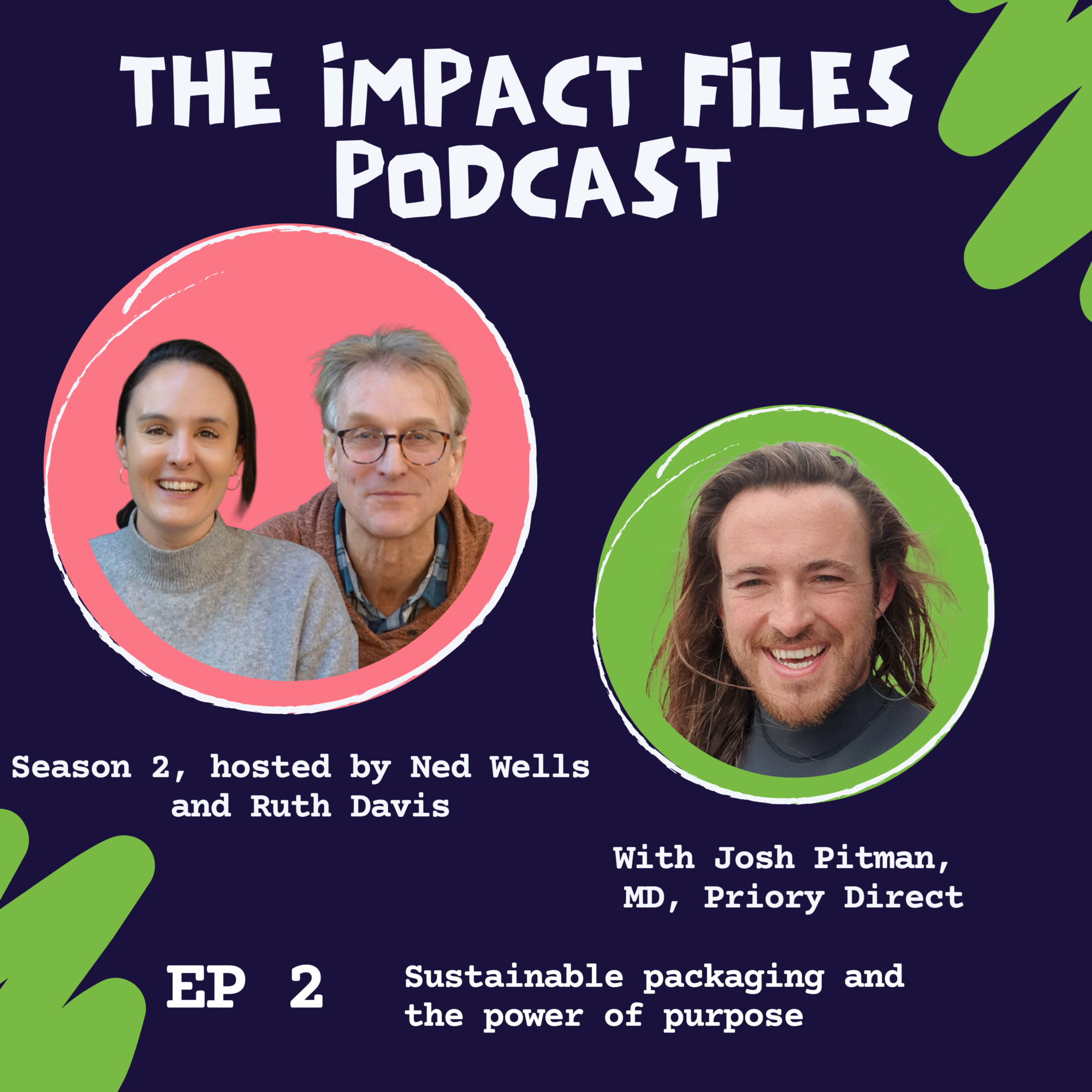
TRANSCRIPT: The Impact Files Podcast – Josh Pitman, Managing Director, Priory Direct
Ned: Welcome to another episode of The Impact Files podcast. We are delighted to be joined today by Josh Pitman, Managing Director of Priory Direct, and avid kitesurfer. Josh, welcome to the podcast.
Josh: Thanks for having me, nice to be here.
Ned: Really nice to have you here. Perhaps we could start with an introduction to yourself, to Priory Direct, and to the work that you do.
Josh: So, as you said, my name’s Josh. I’m Managing Director of Priory Direct. I’ve worked with the business since I was 16, so a long time, and I’ve been through quite a journey. Priory Direct is a sustainable packaging retailer, focused on minimising the impact of e-commerce on the planet through optimising packaging material choice and its supply chain.
Ned: I’m so looking forward to hearing more about that, because it’s such an important area, particularly with the growth of e-commerce — which, as you mentioned when we spoke before, is still in its infancy. It would be really interesting to hear your personal story, how you came into Priory Direct, and something about your values and how they work with the business.
Josh: Well, it was my dad’s business — a print management company, providing print to insurers, banks, and similar. And really, what we do as a business hasn’t changed in its core focus, which is supply chain: reliable supply chain to businesses, providing inbound supply to service demand. That hasn’t changed. But obviously the purpose of the business, the complexity, and the industry we serve has changed massively over the years.
I did some holiday work for my dad’s business in the warehouse, helping out during breaks from school. My dad started the business the year I was born, so it’s always been something of deep interest to me, and that entrepreneurial spirit is in the family. What really drew me into the business was when we started to focus on the online sector.
I was cutting out address labels to sell kitesurfing equipment in the UK when I was young, because you couldn’t get it from anywhere but America. I was bringing it over from eBay, then had bits left over or other things to sell on, so I had this little idea of selling kitesurfing equipment in the UK when it was a very new sport. Dad saw me cutting address labels out of pieces of paper and said, look, we could put a label behind that — because of his print knowledge — and that could be an integrated label. So we started a new venture: we launched IntegratedLabels.net, which was a bad URL but a great idea.
Long story short, we created label layouts that lined up with eBay and Amazon, and we had a lot of success. We got 3,000 customers in six months. Very quickly, that started turning over more than the print management business itself, because we began supplying River Island, Hotel Chocolat, and Photobox, who own Moonpig. The demand for what we’d created was way larger than we’d expected.
At university, I did an exit basket survey, asking what people were sticking the labels to — and by this point we had labels for Magento, Actinic, osCommerce, and various other e-commerce platforms. 80% of our customers said jiffy bags. And it was at that point that I said: we should think about becoming a packaging supplier. That was the inception of the journey.
The purpose and values piece really didn’t click into place until quite a few years after that. I’d read Simon Sinek’s Start With Why, and I’d read Yvon Chouinard’s book — the founder of Patagonia — Let My People Go Surfing. I loved both of those stories. Start With Why looked to me like an opportunity to find a more future-proof purpose for the business, and to create a marketing proposition that was both impactful and aligned with a purpose. And Patagonia stood as a really good marker of what a company can do with a solid ethos and a long-term vision — their only shareholder is now the planet, they’ve taken the profit-for-shareholders element out entirely and deliver it to environmental causes instead. I just thought it was extraordinary.
My initial attempt at a purpose, working from Sinek’s framework, was: SMEs are the backbone of Britain, and we support SMEs. I don’t think that’s a bad purpose, and it is true — we have a lot of SME customers. But it really, really wasn’t it. It wasn’t motivating, it wasn’t future-proof, and I didn’t think it was a good enough purpose to want to scale a business around.
And then I went kitesurfing in Cape Verde, and there was plastic on the beach. Shortly after I’d been working on this purpose question. That was my facepalm moment. That’s it. We supply a waste material of a rapidly growing industry. Our purpose is to do better in that space, and minimise the impact of e-commerce on the planet. That was the light bulb moment, and we’ve been on that journey ever since.
Ned: I’m really pleased you said that, because my next question was going to be: was there a light bulb moment? Before we go on — can you give me a sense of the main categories of things the business sells, and the scale? People, revenues, anything you’re happy to share.
Josh: Very happy to. It’s called secondary packaging — secondary and tertiary packaging, to use the technical terms. Primary packaging is the stuff that touches the product. When you get an iPhone in its box, or when you buy something at the supermarket, that’s primary packaging. Secondary packaging moves products from A to B — either in bulk distribution, or in our case more often than not, directly to the consumer through e-commerce.
That’s the area that has grown exponentially because of e-commerce. Supply chains used to move things in lorries between large business locations. Now, if you look at any road near a home-working area, you’ll see an army of white vans doing final mile delivery, all containing secondary packaging. That’s what we do. In terms of categories: cardboard boxes, paper mailing bags, dispatch labelling, postal tubes — that’s where we focus. We have 2,000 stock products available for same-day dispatch, and a lot of SMEs have a pure-play e-commerce relationship with us. And then we have some very large accounts where we produce dedicated, custom-engineered packaging to solve specific challenges — typically at much higher volume and often branded.
In terms of scale: we turn over just over £10 million, we’re 35 people, and we supply around 16,000 UK businesses.
Ruth: Going back to your light bulb moment — you’re working in an industry that’s quite often villainised, and I really admire how you’ve thought about that. Can you talk about the tension between, say, the necessity of packaging and the controversy it carries — including working with clients like fast fashion businesses that some people would put on a red list?
Josh: My goodness, I could talk about this for a long time. A lot of people view packaging as a waste stream, and it is a waste stream — but what we have to remember is that it serves a vital function in our supply chains. Packaging gets products from A to B in a usable, good condition, which is the most sustainable journey we can put them on.
When it comes to fast fashion — whether those products should be going on those journeys at all — that steps outside our remit. And that’s why I have a very clear standpoint: we take existing supply chains that are growing or not, and we try to make them more efficient and less harmful. That’s why I feel we’re justified in working with any client. I really don’t mind who that client is, as long as we are focused on minimising impact. We’re not enhancing fast fashion’s route to market, we’re not expanding it — we’re taking an activity that arguably exists, will exist, and will continue to grow, and we’re optimising it. That’s a great purpose, and we’re really proud to be doing it.
We also build CSR contributions and components off the back of those relationships that are meaningful and impactful. In a nutshell: packaging exists for a very good reason, it makes supply chains more sustainable, and we try to make the packaging people are using interface properly with the recycling network, use minimal resources, and cause the least environmental harm possible.
Ned: When you say you’re optimising the supply chain — what does that actually mean? What are you doing to minimise the impact?
Josh: We act as an aggregator of the packaging consumption of all the businesses downstream of us. When I say the supply chain, I’m talking about the material journey upstream of these operations. We buy and manufacture packaging on behalf of 16,000 businesses, and we approach that as an efficiency challenge.
There’s something in supply chain called the bullwhip effect, which means that small amounts of volatility at the user end are magnified as you move up the supply chain. If three or four people have a small fluctuation down here, by the time you get upstream, it can look like wildly unforecastable demand. The way we reduce the impact of the supply chain is by coordinating our forecasting to make the most efficient manufacturing journeys upstream. We aim for 100% vehicle utilisation upstream of all logistics coming into us. For large accounts, we do 100% full dedicated vehicles, travelling the least distance possible from a manufacturer directly to their operation.
So instead of rushed manufacturing runs of 10,000 units shipped in half-full lorries going into vans to hundreds of people, we hold buffer stock and manufacture in the optimal way upstream. It’s commercially advantageous for us as well — it’s not all altruism — but it really is the way to solve that problem: identify the pattern out of the chaos, and align it with the most efficient upstream processes.
Ned: So if I physically walked around your operation, what would I see?
Josh: We have one central distribution hub in Aylesford in Kent — 5,000 pallet spaces, with nine packing benches and a roller. You’d see a team pick-packing at scale, and an awful lot of storage cube — we’ve got 14-metre eaves. We’re a heat sink for the supply chain: we hold that buffer stock, buy it in the most efficient way possible, and provide just-in-time downstream delivery. The difference from a typical warehouse is there’d be very little single-use plastic in the packing approach. And you’d see an awful lot of vehicles collecting goods from us day in, day out, heading to different operations around the UK.
To clarify: we’re not a fulfilment operation, we’re not a third-party logistics company — we’re purely focused on packaging consumables. To give you a complex example: Dryrobe, as a customer, uses a 3PL for their pick, pack and dispatch. They’d normally be charged per pallet per week to store packaging on-site with the 3PL, plus a management fee. We do that for them, intelligently monitor their consumption rates, guarantee continuity of supply, and we’ve designed, optimised and rationalised the packaging for their SKUs to make it more efficient for the 3PL. That’s what we do in a complex scenario.
Ruth: It’s so fascinating. Going back to when you said it’s also a business case — can you talk about how your sustainability-based decisions drive success at Priory Direct? And have you seen growing demand for a more sustainable approach to supply chain?
Josh: Definitely, and I can talk about how we’ve grown up along that journey, because we started by going on sustainability instinct — this is more sustainable than that, let’s get rid of single-use plastic. We’ve grown up a lot since, in terms of becoming more data-driven, and understanding the complexity of materials upstream and the inbound logistics.
There was a huge amount of learning about just how much of the footprint associated with packaging comes from how it’s moved around. Shipped air, for instance — customers shipping boxes that aren’t full — is actually one of the most wasteful problems in packaging supply chains, because most parcels leave a business and go on six vehicles before they reach the end consumer. Most people don’t know that, but we use central sortation in the UK, so a parcel travels to the Midlands for sorting, back out to a local hub, and on to a delivery depot. Reducing wasted space and material is massively impactful — but we didn’t know that until we started leaning into the data.
We started on a journey of “let’s get rid of plastic, let’s have sustainable choices,” and we’ve had so many great discoveries along the way about what is and isn’t sustainable, where harm actually lies, and where the most impactful changes can be made. When people hear I work in sustainable packaging, they ask: is it the mushrooms? Well, maybe there’s room for that, but it’s actually a bit more straightforward than that. It’s about minimising waste. And the beauty of focusing on sustainability in our space is that we can often drive commercial advantage and sustainability improvement simultaneously — that’s the golden combination where you don’t have to make a sustainability decision purely on ethics. We can bottom-line justify it.
In terms of the timeline for demand: the first six years of being a sustainable packaging company were really difficult. We got very good at justifying bottom-line improvements as the main selling point, with “and by the way, it’s more sustainable” as the secondary message. We still have to do a lot of that when winning large accounts. Extended Producer Responsibility for packaging is currently generating significant costs for businesses — John Lewis declared £22 million in EPR costs for the first half of this year alone. There’s nothing like a bill to make people scrutinise their packaging. The packaging recovery note cost for plastic is £250 per tonne, compared to much less for paper, so all of a sudden paper products and more readily recycled materials look more attractive.
Then around COVID, there was a huge swing towards sustainability. A lot of people became more consciously aware, and businesses suddenly noticed the discrepancy between their sustainability claims and their packaging materials. More recently, with economic pressures over the last couple of years, we’ve found more pressure to lead on commercials and less sustainability first. But we were already prepared for that, because of those first six years of having to hone our ability to demonstrate commercial benefits.
Ned: Can you give me an example of a typical client?
Josh: Could I give you three customer personas? So we have Sally in her shed with an eBay shop, Ollie the Ops Manager, and Henry in Head Office.
Sally in her shed represents a micro-business or SME, typically running from a residential address — eBay shops, Etsy sellers, not on the high street, possibly multi-channel. Some of them are impressively large from very small locations. They need packaging consumables. For them, we have stock products on priorydirect.co.uk, with mix-and-match savings and an EcoScore for every product. 1% of their spend gets given back to charity, and they can protect 1,000 metres of rainforest with every order. Those customers are so important to us — we allow businesses of that kind to access good, sustainable packaging supplies from a reputable supplier.
Ollie the Ops Manager represents an SME up to around £50 million turnover. Also has a hybrid relationship with us — predominantly ordering stock products in larger volumes, possibly with custom pricing and some branded items. Runs in a fairly automated way, would have a dedicated point of contact.
Henry in Head Office represents our Tier 1 and Tier 2 retailers, with more demanding supply chains in terms of volatility, volume, branded product, and technical challenges. For them, we have a dedicated account manager, we manage their continuity of supply as a service, and provide all packaging consumables alongside carbon footprint reporting, EPR compliance, and all the data they need to be compliant.
As for what Ollie’s company sells — from photo frames to carbon bike wheels to cosmetics, pet food, supplements — we’re across a huge number of verticals, which is really exciting because the network effect of having that data allows us to do what we call global forecasting. When we see apparel volumes rising, we can forecast demand based on uplift across all customers in that sector. We put a lot of work into understanding and cleansing that data to make sure it generates good efficiency.
Ned: What are the people and processes you’ve put in place to support your need to be sustainable and profitable?
Josh: The first thing to say is that initially we didn’t dedicate resource to it — we democratised it, and it still is that way. I’m a big believer in what’s measured is managed. So we started from a KPI perspective and made sure our sustainability goals were present in every department’s KPIs. They sit on the same list as turnover, profit, number of customers, customer churn, and customer satisfaction. We immediately started measuring our non-recyclable waste streams, our charity donations, and our Rainforest Trust contributions, and made those metrics front and centre, giving every department responsibility for them.
If businesses are going to make sustainability genuinely important, there’s nothing wrong with piggybacking off whatever performance management framework you already use. And I would argue that if you don’t do that, you don’t demonstrate you’re taking it as seriously as the structures already present in your business.
Then, through our B Corp assessment and B Impact application, we realised we needed a coordinating person — dedicated resource. Our HR manager took on that role. It’s interesting, because it often ends up in accounts or HR. It seems HR and finance are the people driving sustainability in a lot of businesses, unless you’re large enough to have a dedicated sustainability or impact manager. For us, HR was the space, and now that person is dedicated to the role — 50-50 with HR responsibilities, though it fluctuates. Having a person owning it and coordinating it has been invaluable. B Corp has been an invaluable framework — sustainability is never done, it’s not a destination, it’s a journey, and it’s more about process, documentation, goal-setting, and iterative improvement one step at a time.
Ned: The early sustainability metrics you mentioned sound quite intangible and hard to measure. How did you actually find those numbers?
Josh: Painfully, to be honest. But there were some really easy wins to start. We had our charity programme already in place, so those numbers were straightforward, and just by making them headline metrics, we improved adoption rates — live chat, emails, prompting people to give their reward points to charity at checkout. Because it hit the KPIs, people went: oh, we should try and improve that, rather than treating it as an afterthought.
For carbon footprint, we went through a carbon audit. We worked with a company called Grain Sustainability, who gave us our baseline report. We then did a stakeholder survey across suppliers, customers, and our own team — really interesting to identify what people understood sustainability to mean for us and for themselves, what they thought we were doing well, and where they thought we weren’t.
From that baseline report and stakeholder survey, we decided to put our waste streams on the KPIs. If we’ve got it measured, we get reports from our waste partner — let’s put those front and centre. I’m a big fan of expressing things in percentages, numbers that will make sense regardless of how the business scales.
It took us two years to do a full baseline report and B Corp application, because we have a lot of moving parts. But the key step after going through that process is not to go: great, we’ve done it. Go: right, let’s make it public, let’s make it something everyone can see and talk about regularly. That has two effects. One, it means you have to keep it updated, so you put a process in place. And two, just by being visible, it becomes something people engage with. What’s surprised me most — and not because I’m a pessimist, but it’s been a genuinely positive surprise — is that if you give people a structure and get out of their way, more often than not they impress you. They go further than you’d expect.
We’ve introduced recycling bins at the end of every aisle in the warehouse. We’ve eliminated single-use plastic from our operation, apart from pallet wrap. We use second-life cardboard boxes for a lot of our dispatches — they’re perfectly reusable, so let’s not just put them in the recycling stream. All of that came from our head of operations, Darren, looking at the waste stream KPIs and saying: I can reduce that, here are some ideas. Every time we’ve put that structure in place, we’ve been positively surprised by what the team does with it.
Ned: And are you rolling those stats up and reporting them monthly, including to the board?
Josh: Yes. We run weekly sprints as a business — we’re quite agile — and then we have a monthly all-in town hall where everyone gets a chance to present their ideas and we all look at the KPIs, wins, and challenges together. Giving people that platform is another encouragement: if you do something, it’s going to be noticed, and you’re going to have a chance to talk about it.
Ruth: I’ve never actually heard of a business that gives the sustainability role to HR to manage — for me it’s often ended up in marketing.
Josh: And maybe it’s because we’ve come at it from a people perspective that I can talk about it in some of these positive lights. In truth, I’d love to say there was some brilliant insight behind the decision. It was more: we have an HR manager who isn’t kept fully busy with pure HR requirements, so why don’t we do this? And in all honesty, when we asked who could take on sustainability, everyone else stepped back. So it’s a great connection and a great result, but it wasn’t through deep forethought.
Ruth: Can you talk about some of your successes — and things that didn’t go so well?
Josh: I cannot fully articulate how positively impactful having a purpose has been. From decision-making to focus, to staff morale, to recruitment. We have a careers page that generates inbound inquiries from people wanting to work with us. I don’t know how many companies in the packaging sector of our size are experiencing that, and I can only put it down to our sustainable differentiation. The level of engagement we get from our team is because we have a North Star — people, planet, profit. We are genuinely trying to do something good with our business, and we evidence it and track it. The success around that is really that corporate differentiation.
In addition, we’re a very small company in a very large sector. Packaging in the UK is a £13.7 billion sector. Turning over £10 million doesn’t even give us fractions of a percent of market share. But we’re working with some very well-known, large brands and retailers, and I cannot see how we would have got to the table for those conversations without our certified B Corp status and our core differentiator. If we’d turned up and said: we’re a packaging supplier, just like all the other ones, we’re really small, would you entrust us with your supply chain? — that conversation doesn’t begin. If we turn up and say: we’ve been dedicated to sustainability for nine years, we’re a certified B Corp, we work with these brands, we’ve driven supply chain efficiency and reliability, we can evidence it, and we can potentially give you a commercial advantage — those two propositions are streets apart.
Now for some failures, because I’m making it sound all roses and it isn’t. Part of that initial rush to be ultra-sustainable upstream meant committing to large stocks of items we believed had a great future — sourcing them in the most sustainable way, committing to good quantities for full vehicle loads, and then working to establish the route to market for them.
Compostable mailing bags rotting on the shelves is one I remember well. Aisle 3 smelling funny because they’re doing what they’re going to do — they have a shelf life. We were also very excited about grass paper. It has a lower carbon footprint and massively lower water consumption than wood-derived paper, so we invested quite heavily in grass paper mailing bags. Turns out there wasn’t the appetite for them. I still think it’s a great product, but we simply couldn’t generate enough demand to provide it sustainably. Being at the innovating edge means you’re going to have to roll the dice a few times, and we definitely don’t always get it right. But we want to be at the front edge of that conversation and be open to change.
Ned: That’s fascinating — and having a lot of stock sitting in your warehouse costs you money. But it sounds like you have to do that to make the business work and be agile and responsive.
Josh: It is a messy challenge. A lot of the larger companies in our sector solve it by sheer volume, and that’s very inefficient. One thing we can say is that we’re very, very efficient, and that is also the most sustainable way to do it.
We’re currently in the middle of a Knowledge Transfer Partnership, funded by Innovate UK. If any listeners don’t know about KTPs, I cannot advocate them highly enough. It’s government funding to innovate in your business — you have to write an essay and make a business case, it’s not easy, but it’s worthwhile. We’ve secured £300,000 of government funding to build a machine learning forecasting and material resource planning platform.
The bullwhip effect problem I described — aggregating demand across a large customer base and forecasting where it’s going — we’ve been working on a software system for that for eight years, called Usage Analysis, which we built ourselves. It does some statistically solid maths, but it’s not machine learning and it’s not embracing AI. So we wrote the business case for stepping into that space, and we’re now employing a full-time PhD mathematician and working with two doctors of maths and heuristics at the University of Kent, in a 30-month project to build a forecasting platform. The meetings are at mad professor level — very engaging and challenging. If it delivers against the vision, it could be massive for us and for the sector. The idea of using pattern recognition to make supply chain as efficient as possible — we think that’s a very big opportunity.
We’ve also just completed an accelerated KTP to build a dedicated lifecycle assessment tool to monitor the carbon footprint and environmental harm factors of all packaging materials. The LCA models most people use are based on standardised databases with a lot of rounding and smoothing, and they vastly underestimate environmental harm. Everything gets standardised to greenhouse gases, which is a useful yardstick but we felt there was room for much more detail and dedicated focus. We’ve taken 14 environmental factors into account in our model. It’s a new tool we haven’t even really got out of the box yet, so I’m very excited to start applying it properly.
Ned: Tell me about the role of marketing, media, and communications in driving this business.
Josh: This is a really interesting space, because there’s a huge amount of scepticism and fear around marketing and sustainability being aligned with each other. Green hushing — people not willing to make any sustainability claims or share their challenges, stories, and successes because of the risk of being seen to be greenwashing — is a potentially really harmful trend. I fundamentally feel that marketing and sustainability have a perfectly synergistic relationship, as long as you base your claims in reality and are honest and open.
For us, this started as a marketing thing. I wanted to differentiate our business in a massive sector, to grow, to have a commercial advantage. That was really where we started. But in that journey of finding a proper triple bottom line purpose, we’ve created a virtuous circle: if we’re profitable, we can improve our impact, we can generate more return for charity. When you are marketing something, you are also potentially growing its positive impact, and the knowledge you’re accruing. That is a wonderful flywheel. Marketing and sustainability aren’t in conflict — they’re complementary. Stories are what change the world, and marketing is storytelling. If you can create a good purpose and articulate it well, that’s marketing. There’s nothing wrong with that.
Ned: And being brave enough to root it in reality — being honest that you’re on a journey.
Josh: Yes. We have a PR article going out next week, and the first thing it leads with is how much single-use plastic there was in our own operation. We’re not saying we were perfect. We’ve been on a real journey, and there is still single-use plastic — pallet wrap, for instance, is a big problem. Stretch wrap for pallets isn’t solved yet. But we’re being transparent about that, talking about the wins we’ve had, and the challenges we still face.
Ruth: So you’re transparent, agile, you have buy-in from your team, you’re working with big players, and you’re innovating. What is next?
Josh: We’d still like more scale. We’re growing at about 17% per annum, which is great, but it’s a very big sector and we still have aspirations to grow.
The lifecycle assessment tool has only just come online, so I’m very excited to start applying it to our large accounts and understanding the impact of their materials with much more dedicated analysis.
The forecasting project — my end vision is an ability to enhance supply chain efficiency for more and more retailers. With pattern recognition and machine learning, the additional waste we could remove from the upstream supply chain for businesses in the UK is enormously exciting.
I’d also love to see more circularity and better recycling infrastructure. We’re launching an open letter next month asking for a ban on the 100% recyclable LDPE Möbius loop label. Soft plastic has no recycling infrastructure in the UK. To be using that material and labelling it “100% recyclable” — even sometimes with a smiley face and “planet-friendly” — is complete greenwashing. That material is technically 100% recyclable if it can get to the right infrastructure, but the infrastructure to recycle the volume we’re using simply doesn’t exist in the UK. I’d love to achieve a bit more of a campaigner status around that, and really help businesses align with circularity. We need to be reusing the materials we’re consuming a lot better.
We’re also coming up for B Corp recertification next year, and I welcome the tightening of the standards. You shouldn’t really be able to offset poor performance in some areas by being outstanding in others — having a minimum threshold across a broader set of criteria is a great change. Anyone who’s gone through the B Impact Assessment has some genuinely strong credentials, but there are some in there with dirty little secrets that shouldn’t be in the framework. Tightening the standards doesn’t devalue the community — if anything, it raises the bar for the future.
Ned: Where do you hope the sector will be in 10 years’ time?
Josh: Much more circular and less wasteful — I can’t make it more simple than that. There is so much waste still in this sector. E-commerce hit 37% of UK retail during COVID. There is still so much more retail that’s going to flow into this space, and if we don’t get the waste streams and material choices right, it’s going to be harmful. So we’ve got to get better. And actually, that’s an exciting opportunity.
Ned: Gets you up in the morning?
Josh: Massively so.
Ned: And one piece of advice for businesses pursuing sustainability and financial objectives?
Josh: What’s measured is managed. Structure your performance reporting and infrastructure around your sustainability goals, and then get out of people’s way. If you give people a speedometer, and make it really clear that it is front and centre and important for your business, my experience says you’ll be surprised at just how far people take it, and what standards they hold themselves to.
Ned: Brilliant. And finally, how can people find out more about you and Priory Direct?
Josh: We’re on priorydirect.co.uk, and on all the socials — do connect with us there. Our blog is full of resources on navigating EPR, improving your own sustainability, and there are lots of great stories on there, some of which I’ve spoken about today. Get involved.
Ned: Josh, that is fantastic. Thank you so much. It’s been brilliant talking with you.
Josh: A pleasure, I really enjoyed our conversation. Thanks, Ned. Thanks, Ruth.
Ruth: Thanks, Josh.