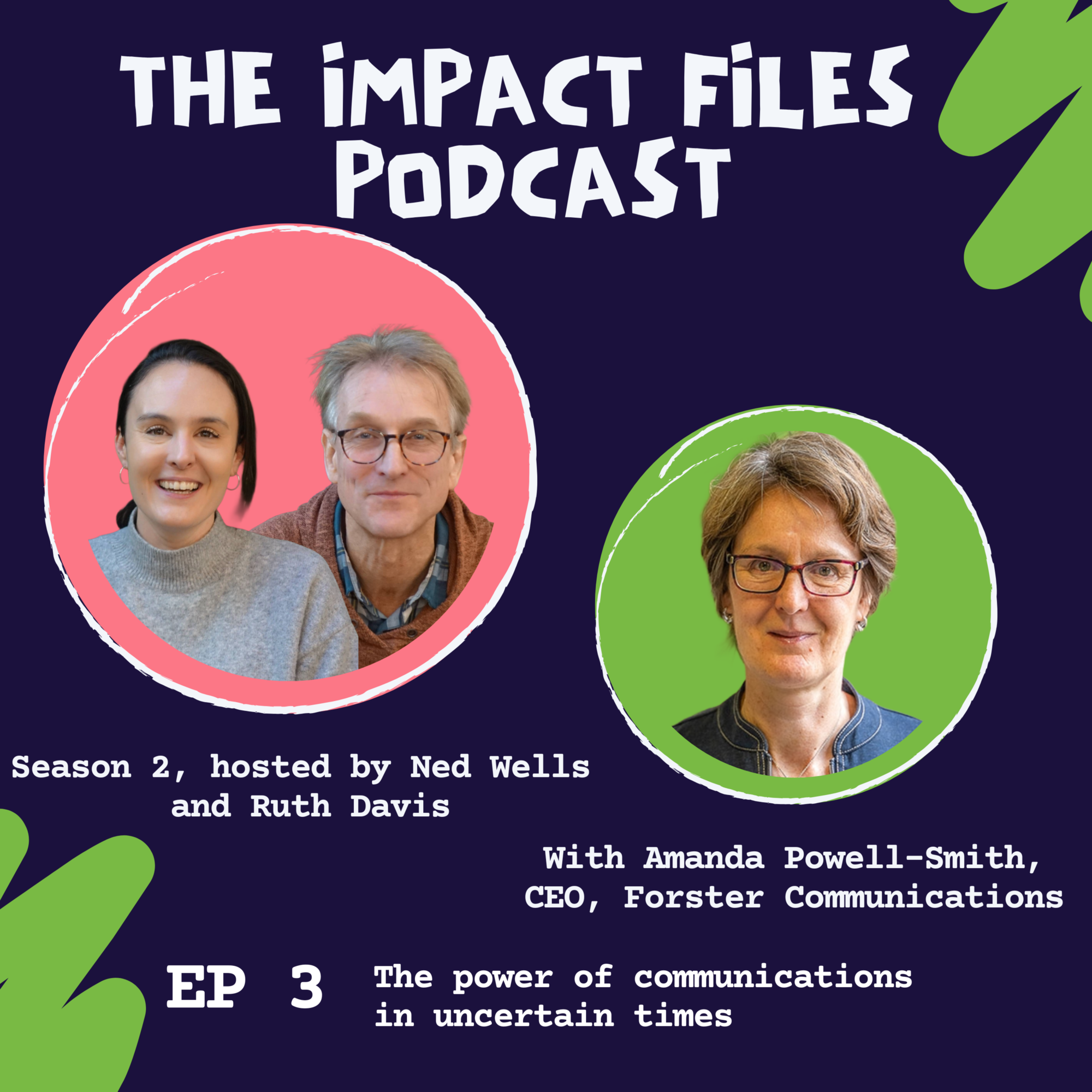
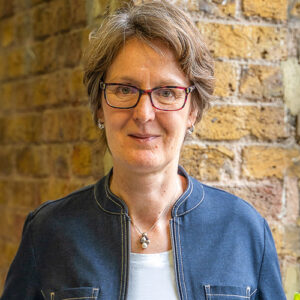
The Impact Files Podcast – Amanda Powell-Smith, Chief Executive, Forster Communications
Ned: Welcome to another episode of The Impact Files podcast. In this episode, we’re delighted to be joined by Amanda Powell-Smith, Chief Executive of Forster Communications. Amanda, welcome to the podcast.
Amanda: Hello, thank you, lovely to be here.
Ned: So, Amanda, perhaps we could start with an introduction to yourself, to Forster, and the work that you do.
Amanda: Yes, of course. So Forster is a purpose-led communications agency. We were founded back in 1996 with one ambition, which is to use the power of communications to protect and improve lives. Nearly 30 years later, that is still our ambition, it’s still our purpose, it’s still what we do. And we obviously have an evolving portfolio of clients and who we work with and what we do. I joined in 2001, so also quite a long time ago, and now I’m very privileged to be Chief Executive and leading the team there. It’s a great role.
Ned: Fantastic role. And I’d love to get an idea of the scale of the business – whatever you’re comfortable to share.
Amanda: Yes, of course. We are a small business. We are about 2.7 to 3 million turnover, a core team of 23 people, and really a model where we want to be the best at what we do, and so we surround ourselves with allies and partners and collaborators who are also the best in what they do, and bring those in when needed. So we’re specialists. We are growing, and we will continue to grow. We don’t have an ambition to take over the world or anything. It’s about being the best, working with others who are the best, and delivering great services around that.
Ned: And what sort of organisations do you work with, when it comes to your clients?
Amanda: Because of what we do, which is purpose-led, we’re actually very selective about who we work with, but we place ourselves deliberately at the centre of change. So we work with private sector organisations, some of the big established businesses like Unilever, Patagonia or BMW, across the sustainability agenda. We work with some of the big global organisations, like the World Economic Forum or the Consumer Goods Forum, again across sustainability. And we work with charities and civil society organisations – Centrepoint, the National Education Union – and a range of other more B2B-facing organisations.
And then increasingly, we’re doing a lot with scale-ups – some of the really exciting new solutions that are coming along, whether it’s nature tech or climate tech. How can we help them to scale and grow, and build a system that is currently in place? So a range. One of the things we do, and we believe in, is that it takes all sectors of all organisations. So working across different sectors, whether it’s private or public or not for profit, is incredibly important to create change.
Ned: I’m sure we’re going to touch on that more a little bit later on. When we spoke off-air, two or three weeks ago now, you mentioned Forster’s origin story, and I’d love to hear a little bit about that, because it’s really quite interesting.
Amanda: Yes, so we were founded by Jilly Forster, who had been marketing director of The Body Shop, working with Anita Roddick and the team to grow The Body Shop and build that – really demonstrating that business can be a force for good. So all the campaigning that The Body Shop used its shop window for, but also its supply chain, really leading in that area. Of course, we take that sort of thing a bit more for granted now, but it was incredibly progressive in those days.
So when Jilly wanted to form a business of her own, that was the essence of what came together. It was all about business being a force for good. So not only through our purpose to use the power of communication to protect and improve lives, but what could we do as a business to really stand out in the way that we look after our staff, work with our suppliers and embed ourselves in the community – and how can we lead that journey?
So even from that time, 1996 onwards, we were looking at impact reports ourselves – what difference were we making? It’s probably then not a surprise that we’re a founding UK B Corp. That was 10 years ago – they’ve just celebrated the 10th anniversary of B Corp. And we’re always trying to push ourselves, really, and think, what else can or should we be doing? And how can we try things out? I think that’s the joy of being a small business. You can try things, you can test things, and you’ve almost got that flexibility that you don’t necessarily have in a really large organisation.
Ned: To have been operating in that area 30 years ago, helping organisations to be more sustainable – it’s something we talk about a lot now, and certainly in the B Corp world it’s very much a natural language. For the organisations that you’ve said you work with, that’s all very much day-to-day, even though it’s potentially not a conversation that as many organisations as we’d like are having. But 30 years ago, it was really quite rare. And I’d be fascinated to hear – looking across that 30-year time span, things have changed enormously.
Amanda: Yes, things have changed enormously. As I said, our client base has changed, and language has changed. At that time, there was the rise of corporate social responsibility as an area and a phrasing, and whilst that is still used sometimes, it’s now much more about sustainability. What we’ve got now is a really strong push for a lot of organisations on decarbonisation, and the rise in technology that didn’t even exist back in that time. Environmental and social change is the core, whatever you call it – how can we look after people and look after planet, and which organisations are leading on that?
And I think what we’ve seen is that not-for-profit organisations – the charity sector, civil society – are always leading in this area. Government comes and goes in some ways, according to who’s leading what, and also according to what budgets there are. But what we’ve seen is an incredible rise in the private sector as well, and that’s exciting. So how can we keep that going, and how can that be embedded?
Ned: I think that’s so exciting, because being as we are in this capitalist economy, that’s where the money is, and that’s going to drive this area – particularly in the face of it being increasingly difficult to raise funds for charities who do this essential work, and the uncertainties of various administrations around the world. You never quite know what’s going to come next. It can be fairly short-term. So that’s all really exciting. Ruth, over to you, if I may.
Ruth: Thanks, Amanda. That was such a great overview of the business. As someone who’s in communications, it’s so interesting to hear how you were pioneering that such a long time ago.
I think one thing that’s come up a lot for Ned and I in these chats is the need for a solid client framework, and you’ve obviously got yours pretty solid by now – you’ve had a lot of chance to refine it over the years. You mentioned that you’re very selective about who you work with. It’d be interesting to hear how that works day-to-day, in terms of how you incorporate multiple viewpoints and opinions across the business. I work in a much, much smaller agency, and I find it can be challenging at times with just the five of us, so I’d love to hear how you manage that with a slightly bigger team.
Amanda: Yes, of course. Just firstly, to put that into context – as I keep saying, we’re a small business, so when we look at our impacts internally as an organisation, they’re relatively small as well. The biggest way that we can make an impact is who we choose to work with and who we choose to bring on board as our suppliers. So that selection – client engagement principles, to use the formal terminology – is incredibly important.
We have some clear red lines – sectors we definitely won’t work for. They won’t surprise you: weapons, tobacco, and now, people who are dominantly producing fossil fuels. We joined Clean Creatives, and that’s a red line for us as well. We have some obvious yeses as well. And you do end up with a grey area in the middle sometimes, around: okay, this is an organisation – no one is perfect, no organisation is. Even people who are really progressive will be calling out issues that they want to solve.
But the question for us, when we look at people who aren’t on the wrong side of our red line, but are in a space where it might be a little bit more complicated, is that we will, A, look for evidence and data about what they’re committed to. That’s where we find things like: have they signed up to science-based target principles? Are they members of the living wage campaign? What are they signed up to publicly that they’re doing and tracking and following? And then particularly the role that we’re going to be playing – is it genuinely going to be adding a positive contribution to change in the solution?
That requires research – sometimes we bring in an independent person to do some research – and it then requires a discussion between directors to make that decision. And you’re balancing a lot, because if you take food or agriculture, everybody needs to be able to eat. There’s a massive rise in the cost of food, but you might also have some views about which food is right or wrong. So you’re juggling quite a lot of things. If you change a small piece of a big system, you might have a bigger overall impact than if you change a big piece of a very small system.
So that’s a long answer to your question. It’s as evidence-based as we can make it, combined with our judgement as a business coming back to this purpose of wanting to use communications to protect and improve lives. That’s what helped us make that decision.
Ruth: Thank you, that’s so insightful, and so interesting that you’ve sometimes used third parties as well. I think that’s the first time I’ve come across that. One thing you mentioned is this complicated web of sustainability that we’re in today. Given that Forster has been operating for 30 years, do you feel it’s become more complicated in that time? When you set out, was it more clear-cut in terms of who you would and wouldn’t work with, given the systems world that we live in? And with greenwashing, and everybody wanting to show that they’re an impactful business for sales purposes, has it become more complicated for you?
Amanda: I think the thing that’s possibly become more complicated is that our client base is much bigger now. We do much more work with internationally-based organisations, and with multinationals who have quite long and complicated supply chains. Whether that’s more complicated because of time, or because we’ve evolved – that’s there. But in some ways it’s become easier, because you’ve got more information about organisations online, more demand for transparency, and you’ve got systems set up – as I say, science-based targets, or the We Mean Business Coalition – so what are they publicly pledging to and committing to? That’s in the private sector. So it’s a bit of both, I think, probably.
Ned: Amanda, I’d love to hear if you can think of any examples of clients or potential clients that you assessed and deemed suitable, and then found out eventually that perhaps they weren’t as suitable. Were there any learnings out of that that you could share?
Amanda: I’m not going to name any organisations, but sometimes genuine intent can only come from working with an organisation and seeing. And actually, that’s where you can be positively surprised as well as negatively surprised. Understanding the difficulty for the stakeholder – the individual you might be working with to push change through an organisation – and how you can help them, that’s going to make a massive difference. So it might make you lean more into some of the more complicated sectors.
At the other end, we do turn things down. We turn down quite a number of briefs each year, because even if we help them with a particular project, we can’t see how that fits into an overall system of sustainability – and therefore we’re not actually supporting a positive outcome overall.
So what’s the key learning? It’s to be constantly inquisitive and asking questions, and to never stop – always seeing what’s in front of you, rather than what you want to see, and not being afraid to really try and understand some of the why around that.
Ned: And I imagine there are situations where you’re working with a very sustainably-minded individual in an organisation who is keen to do all the right things, but perhaps the organisation isn’t quite ready for the work they want to do, and the work that they’re talking to you about.
Amanda: Exactly that. And sometimes, the bigger organisations are, the slower it is to create change. It doesn’t make them bad people or bad organisations – it’s just the reality of what happens within that. And that’s where the challenge comes if you’re running a principles-led business. You also still need to have a certain income – you need to be able to pay, et cetera. So you’re constantly juggling these choices. That’s where you need to have a portfolio of clients, so you’ve got options and you can say no – which, again, I recognise is a privileged position to be in when it’s a hard fight for work sometimes.
Ruth: Thank you, Amanda, that’s really interesting. Sorry, I’ve just got cogs turning in my mind at the moment. We’ve touched on the external side of that purpose, in terms of your client framework, and the juggling act you mentioned between being able to pay salaries and being values-led. Maybe we can zoom in on the more internal initiatives you have, and the people and processes that you’ve put in place to support the business’s needs to be sustainable and profitable. You mentioned quite a few things on our other call that it’d be really interesting to touch on.
Amanda: Thank you. We’re a people-based business. We’re offering services to our clients from our team, and that means it’s really critical that our team are well in the broadest sense of the word, because sometimes we are dealing with quite a lot of tricky issues – climate change, inequality and so on. So looking after people in a mental and physical health way is really key.
One of the things that we do is encourage sustainable travel. It started as: how do we cut our carbon emissions as a business? That was about encouraging people to walk or cycle to the office, and it’s incentivised. For every journey that someone walks or cycles to the office, they get 5 minutes’ additional holiday, which could be 10 minutes a day, which, if you did it every day, can add up to two and a bit days’ extra holiday.
It’s been in place for a while, and it’s incredibly successful. It’s supported by helping people access bikes through salary sacrifice, and colleagues will buddy up and help them get to work if they live in the same area, so that whole familiarity with cycling has been really key. Actually, it’s not just good for cutting carbon – it’s really good for wellbeing as well, so it’s had a double impact. That’s been a really nice example of something we started which ended up doing two things instead of one.
Ned: Amanda, I’d love to ask – what’s the forum within the business where you come up with these kinds of ideas?
Amanda: It’s a longer story on that one, if that’s okay. A few years ago – I can’t remember exactly when – B Corp had a Boardroom 2030 initiative, which asked people to imagine what the boardroom should look like in 2030. So we invited all our staff and team to get involved in that, recognising, again, that as a small business, there is quite often not very much churn at the more senior level – so how can you increase participation when people like me have been there for a very long time?
That resulted in people joining the board on a temporary basis, and it’s resulted in more colleague-led working groups. We now have a colleague-led impact group and a colleague-led diversity and inclusion group, and they are ongoing. A number of years later, they have a formal remit, they report to the board, and they’re responsible for delivering different ideas and initiatives, and involving the rest of the company in coming up with those. It’s been really successful.
Ruth: That’s so great to hear – that’s fascinating. Flipping the coin slightly, have there been any initiatives that haven’t worked so well, or were more challenging, if you’re happy to share any of those?
Amanda: We had some challenging conversations around becoming a plant-based office. Again, we were looking at how we could cut our impact as a business, and it came up in a brainstorm from everybody. People didn’t mind cutting meat, but cutting dairy as well…
It was really interesting. It wasn’t about us telling everyone what they ate themselves – they can bring and buy what they want to. It was only what the company was going to buy. We are a plant-based office. It just took two or three months for everyone to talk through the idea and understand what it meant, and for us all to be able to find tasty alternatives, so that people weren’t compromising on enjoyment. It wasn’t like a punishment food. And now, of course, there are tasty alternatives – it’s become easier and easier over the last few years, because there are many more really high-quality vegan places to eat if you’re going out for a team meal or something. So it took a while, but it’s really accelerated, and it’s the right thing to do.
The other thing that’s difficult, as I’ve mentioned already, is that as a small business, we are challenged on diversity within the company. We score very well on quite a few metrics, but not so much on ethnic diversity. So how can we drive that forward? One of the things that we do in response is run an internship programme in partnership with – for us – the Taylor Bennett Foundation, which is an industry organisation. We recognise that we can be more flexible in creating access and early-stage interventions with people, because that’s where we can do things quickly and support people. Of course, we have all the recruitment policies in place, but given that we don’t have ongoing recruitment, that’s a slower way of creating change. So we’ve had to really think a bit laterally about how we address that.
Ned: When you say early-stage interventions, what sort of things are you talking about?
Amanda: The Taylor Bennett Foundation supports people from minoritised backgrounds who are at university, so we’re providing a paid internship over the summer holidays – anything between two and three months – so that people get experience where they can test and try PR and comms, start to build networks, and have experience for their CVs.
Ned: Interesting. Amanda, I’d like to turn to the broadest context of communications, media and marketing – Forster’s position on communications in driving a sustainable future. I know that’s an enormous question in one way, because it’s what you’re all about, but if there’s a way of summarising that, that would be fascinating. And then it’s about the bear traps, isn’t it? How do you motivate people and steer that route between greenwashing and green hushing? I’d love to hear your views on that.
Amanda: Yes, of course. The marketing communications industry is in an incredibly strong and powerful position to create change. It’s what it’s designed to do, isn’t it? It’s designed to drive audience behaviour, to raise awareness, to create understanding, to build support for new ideas, to tackle taboos, et cetera. So the industry overall is really desperately needed. It’s very easy to say “now more than ever”, but now more than ever – it’s hard at the moment. As change pushes through, and as some of the status quo does start to be upturned, and we show that we can have a rise in renewable energy and we can have change, you see an increase of pressure from the status quo – the people who are making a lot of money out of what’s already there. You can see the rise in counter-narratives, the rise in people kicking back and saying that sustainable futures and solutions are wrong.
So we need, more than ever, a really powerful narrative that shows not just that change is needed to counter the disaster and the climate change, but that it brings benefits for people today, tomorrow and for the future. So all those skills in marketing and communications are so important for helping us all to build a positive future.
We’ve joined Clean Creatives, as I’ve said before, as our way of putting a line in the sand around what we will and won’t do. I’m not saying everyone has to do that, but imagine if everyone was really thinking about it, and using all those marketing skills to push for positive change. And that comes down to greenwash as well. What we need now is trust. We need to know who we can trust. We need authenticity. We’ve got so much content everywhere, so many channels, so much noise. How do people know what’s real? There’s a whole rise in misinformation and disinformation. So real voices and real evidence are really important.
Ned: And as a provider in the communications and marketing space, but really focused on impact, how are you finding the market? What are budgets looking like at the moment, and the sort of competition that you find yourself facing?
Amanda: It’s been a tough economic climate and a big geopolitical shift since last autumn, particularly with the change in US administration in the new year. With that has had to come a real repositioning of quite a lot of sustainability actions and programmes, just to reiterate that they’re common sense, and that they’re linked to positive outcomes and opportunities for organisations as well as for individuals. Whilst at the beginning of the year quite a lot of organisations went, “Oh, I’m not going to say anything”, certainly over the last few months people are slowly, softly coming out again and showing that they haven’t stopped doing the work. They know that they need to tackle issues. They are rebuilding confidence in talking about it. So it is different this year, certainly compared to two years ago, in terms of the feel in communications.
Ned: I’d love to hear your take on organisations positioning for longer-term sustainability being a positive driver of shorter-term revenue. Is that a conversation you find yourself having with people, or is investment in sustainability being done because it’s the right thing to do, but not necessarily going to drive the economic fortunes of an organisation?
Amanda: It’s definitely not just about being the right thing to do. It has to be linked through to being economically sustainable itself, if you like. It has to be a return. I think people are getting happier to talk about that. The phasing of returns might be slightly different – it might take longer, and you might look at impact metrics as well as financial metrics. So what are we seeking to achieve here? It’s more multidimensional than one-dimensional, but at the end of the day, it’s about making sure that organisations have the resources they need, that they have staff who are fit and well, they have talent, and they have a future.
If you need cotton, for example, you’re going to have a big problem if it’s 40 degrees heat and the cotton pickers are trying to pick cotton in that heat, unless you’re looking after that. So what do you… It’s similar for cocoa – there’s a lot in the press around the price of chocolate at the moment. That’s a direct result of climate change.
We’re already seeing the impacts of extreme weather. They are undeniable, and people running businesses know that. That’s why you get the Global Risks Report, which comes out just before the World Economic Forum annual meeting in Davos each year, and right up there are all the climate change risks. So they’re known. It’s about talking about why we need to change them in a slightly different way at the moment.
Ned: I’m so interested in that, and I think you’re right – it does bring in extra elements of complexity and risk to individuals within organisations, and to organisations, with the whole phasing and timing. And I’m guessing that the organisations you choose to work with, because you can see they’re doing the right thing, could have people who are financially driven in the near term – that’s their responsibility, that’s what they care about. So there’s going to be a juggle there as well.
Amanda: And money isn’t bad. Money is fine – it’s about how you make it, how you use it, and what you’re turning it around to do. Organisations need to be able to generate some profit in order to keep investing going forwards. There’s something at the moment in the scales of that which I don’t want to get into, but as a basic principle, it’s okay.
Ned: Exactly. That’s so interesting, Amanda, that’s brilliant. I wonder if we could move on to hear about any plans or initiatives that you’ve got for the business over the next year or so.
Amanda: I can’t believe 2025 is nearly gone. But yes, 2026 – I’m excited about it. It feels like things are warming up in quite a fun way for us, and there is a lot to do. We are doing more and more in Europe, and I get really thrilled about that. I get very energised by meeting peers and others from across different countries, so I can really see that growing. And again, on the collaboration point, I’m really keen to keep building. We’ve got some brilliant partnerships with others, whether they’re in design or things like that, so I can just keep building those as a network. And then very specifically, we’ve got the new B Corp standards that we need to get our heads into. Those have come out, and we will make sure we’re ready for them. That will be a big thing for the year ahead.
Ned: Fantastic. Reflecting on what you were saying about working with European colleagues and partners, I found it incredibly uplifting – getting that slightly different perspective and viewpoint from people outside the UK can be really energising and value-adding.
Amanda: Yes, I really agree. We’re always all better when we talk to each other across countries. And I think when you’re running a small business in particular, you need your peer-to-peer networks beyond your own business as well. That’s incredibly important.
Ned: I’d like to start to wrap up by asking you where you hope the sector – however you care to define that – will be in 10 years’ time.
Amanda: I find these things really difficult, but I would love all the organisations in the sector to have their own sustainability targets, and to be transparently reporting on them in the broadest terms – beyond carbon, but also how they are working through their own clients and their suppliers, looking at things like impact on nature, and impact on people through fair wages. On that, I would love everybody to be part of the living wage campaign, and paying fully paid internships, which is the only way we’re going to help tackle inequality.
Ned: It sounds to me like there are going to be a number of links to these organisations and initiatives you’ve mentioned that we could share in the show notes.
Amanda: Oh yes, definitely, that’d be great.
Ned: Thank you. And finally, one piece of advice for organisations pursuing sustainability and financial objectives.
Amanda: It took me quite a long time to get there, but I think we should think about being small, progressive businesses not as a sort of… but as our superpower. By being small, and by being keen, we can be agile, we can try things, we can ask the impossible, we can say why not, we can lead the way. And it’s also okay, because sometimes we can get it wrong, but we’ll keep learning from it as well. I think we should really, really lean into that in a way that larger organisations can’t necessarily, because from that comes an incredible energy, and also your own sense of learning, which then means you can work better with clients and know what they’re going through as well. So… small is good.
Ruth: I love that.
Ned: So recognise the power and the value of being a small and agile organisation. Fantastic. Try different things.
Amanda: Give them a go. They’ve got licence to experiment.
Ned: Amanda, that’s brilliant. How can people find out more about you and Forster?
Amanda: Oh, thank you. We have a website, forster.co.uk, and we’re pretty much all over LinkedIn as well – both the company and individuals.
Ned: That’s absolutely brilliant. Thank you so much for joining us. I really, really enjoyed that.
Amanda: Thank you – how lovely to talk to you. Really, really great.
Ruth: Thanks, Amanda.
Amanda: Thanks so much, Ruth.