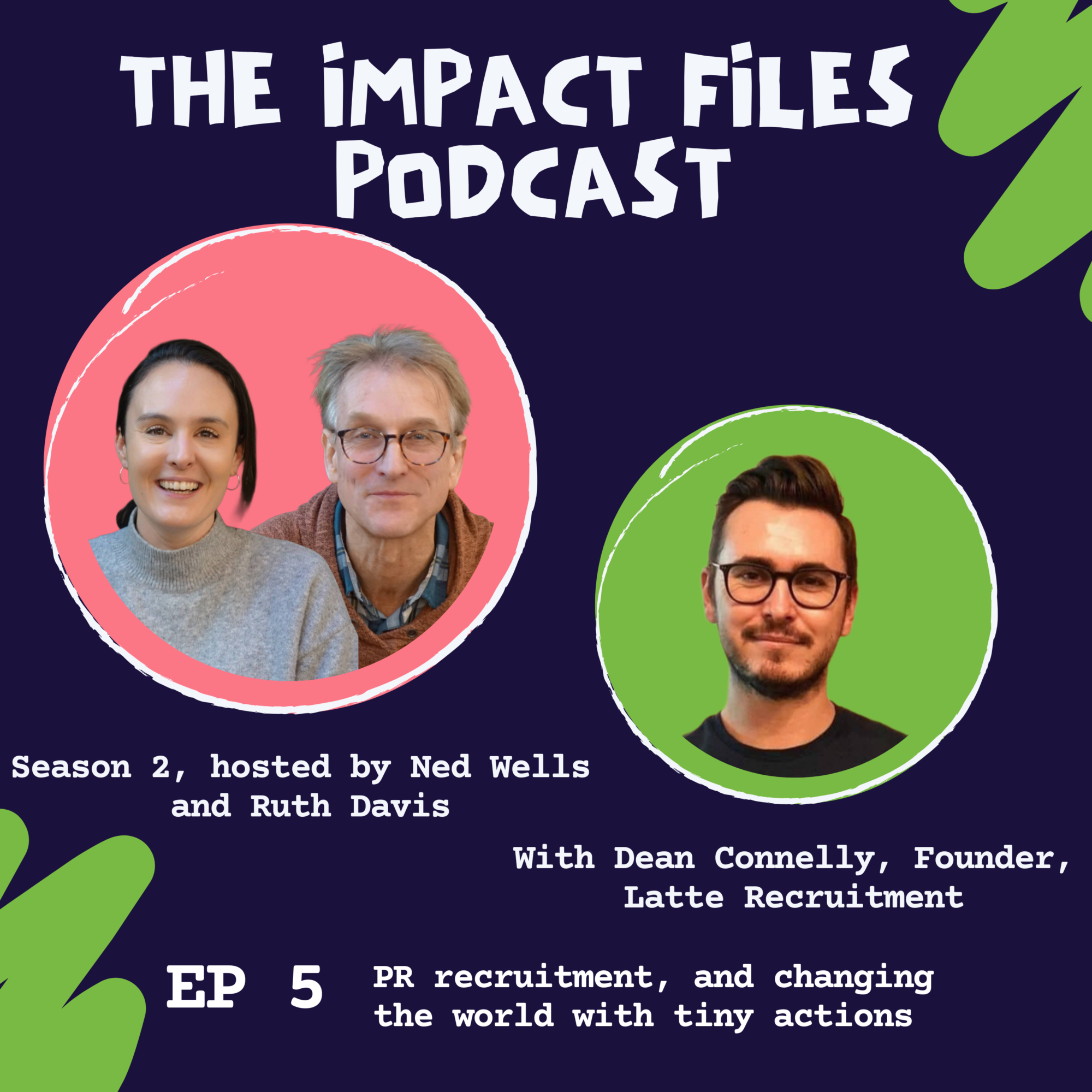
The Impact Files Podcast – Dean Connelly, Founder, Latte Recruitment
Ned: Welcome to another episode of The Impact Files podcast. In this episode, we are delighted to be joined by Dean Connelly, founder of Latte. Dean, welcome to the podcast.
Dean: Thank you for having me. It’s good to be here.
Ned: So, let’s start, Dean, with an introduction to yourself, to Latte, and to the work that you do.
Dean: Yeah, great. So, we are a specialist PR and social media recruitment agency, mainly for London-centric roles. We’ve got a team of 5 in London, and then also 2 in Sydney.
Some of the clients and brands that we recruit for are mainly agency side, so agencies that you might know are Hope&Glory, Milk & Honey PR and the like. And then we’ve also recruited quite a lot of roles brand side as well, for Oatly, Deliveroo, etc, over the time.
Ned: And how long have you been operating for?
Dean: 9 years in total. It’s been a full-on 9 years, but yeah.
Ned: I’d be fascinated to know how the market has changed over those 9 years, and where it is at the moment.
Dean: I think what we’ve found in the agency world, which is where our core client base is, is there was a real boom after COVID, and that has certainly shifted. In the last two years, the only constant is change. It’s up, it’s down. Right now, as we’re recording, there’s certainly an up moment. There’s a lot of jobs flowing through.
Recruitment is a really interesting sector in the sense that you really feel the market straight off the bat, because people stop hiring, of course, as soon as revenue starts to dip or things become tough. And so you are very close to the conversation of what’s going on in the industry. You’re chatting to a lot of founders of agencies or senior marketing people, and so you really have this granular feel of what’s going on. I think you can sometimes see it happening before it’s a full trend.
Ned: So you’re right at the front. That’s fascinating. And you’re saying that at the moment things are looking fairly busy for you?
Dean: Yeah, they are. The job numbers are increasing, there’s a lot more flow happening. You know, this is not great as a business leader, and I’ve certainly been on a leadership journey over the past 12 months, doing more leadership courses. I think actually you become a leader by being great at your job, but that doesn’t mean you’re a great leader, per se.
And so I’m becoming a lot more numbers-focused and comparing year-on-year, month-on-month numbers. We were down about 10-20% for most of the year on our job numbers. But quarter on quarter, I think we’re up about 10 or 15% compared with the same quarter last year. So things are already flowing through.
And I’m chatting to agencies where there’s quite a lot of leads coming through that are now getting signed off. There’s 3 agencies I can think of straight away that were quiet all year, and they’ve just said, “We’ve got 8 new business pitches, we’ve just won 3 big new clients”, so they’re briefing us on 3 jobs.
Ned: Fantastic. What sort of level of job roles do you typically recruit for? Are you recruiting across the board?
Dean: Across the board. Typically what we find is we’re mainly briefed on account manager to account director level, agency side. But right now, for example, we’ve got 4 managing director roles that we’re briefed on. I also think that’s interesting because, in particular on the consumer side of the market, there were a lot of redundancies, a lot of senior talent floating around in the agency world. So it’s great to see some of these managing director roles come through. One’s growth, one’s replacement. You can’t really just base it on 5 jobs that the senior market’s moving again, but it certainly feels better from the small world that I’m in.
Ned: And when you say managing director, is that managing director of specialist PR agencies?
Dean: Correct, yeah.
Ned: Right. Ruth, over to you.
Ruth: Thanks, Ned. It’s really good to hear how well things are going, Dean. So, obviously, we know Latte through Clean Creatives, which is a movement of creative industries and creatives within, I guess, different industries and brands who are pledging not to work with fossil fuel clients or agencies that work with fossil fuel clients. And I know you’ve been involved as an organisation with Clean Creatives for quite a long time.
But I think a lot of people might not necessarily think about recruitment when it comes to climate action and sustainability, so I’d be really interested to hear your angle on that, how you became involved with Clean Creatives, and how you see your role.
Dean: Yeah, I have to give kudos to my team for bringing it to my attention. I think sometimes when you’re running a business, you’re really just focused on step after step. But the team, we’re really big on standing for more than just profit. So the nice thing with the Clean Creatives Pledge, it was a 2-minute sign your pledge, and you’ve got to step up to holding yourself accountable.
And I asked the same question when it came to us: how can we make an impact? And what does it say when, as a recruitment agency, we don’t actually recruit for fossil fuel clients? Can we have impact?
But since signing it, it’s been really incredible to see how, when we are talking to clients… we had to drop a few clients, to say, “Do you know what? We’ve loved working with you, but we can’t work with you any more because we’ve signed the Clean Creatives Pledge, and you’ve got a fossil fuel giant client.” The questions that come off the back of that, the immediate reaction is, “Oh, do you think this is going to be bad for our talent attraction?”
And where I see the role for a recruitment agency is that we need to think about the whole ecosystem. I really think creative is in a powerful position, because we shape our minds every day through our campaigns, through thought leadership, through consumer brand campaigns, influencer, PR, advertising. And we need the whole supply ecosystem of the creative industry to take a stance on this for it to matter. And if we can shape and encourage talent to think, “Hey, where I work matters”, and if an agency struggles to hire talent because of the company that they keep in terms of their client base, then maybe they will think twice about working with a major polluting company.
Ruth: You might not be able to give too much away, but how often have you seen that in terms of the agencies that you work with? Is it a surprising number, if you dig down far enough through the chain? Because when I think about it, I think most things in the world, if you go back far enough, probably do end up with a fossil fuel giant. So, yeah, intrigued to know how often that’s come up for you.
Dean: Look, what I would have to say, truthfully, is we prefer working with independent agencies where we have a relationship with the founder of the business, or the MD of the business. Sometimes when you go to the big network globals, you’re going through recruitment, and we do have one global agency which is a fantastic client, and we get a lot of access. So what we found is it pretty much wiped out being able to work with any global network agency, and only a handful of independents we had to drop, or have now had to say no to, over the course of, I think, 3 or 4 years of being a pledger.
But certainly, if you quantify that, when you have got a really big network agency that is knocking on your door to release 20 jobs, that’s a lot of revenue for a recruitment agency that you’re saying no to. So, in answer to the impact, it depends where your client base sits and what’s of interest to you, but less so on the small agency side.
What I do think is interesting is, as we push more into the corporate reputation space, that seems to be a big limiting point for us, where there are quite a few corporate agencies that work with some of the oil giants in some way, shape or form, and that has impacted us a little bit more.
Ruth: That’s so interesting, and I think we see it a lot as well when you think about the number of B Corps that are made up of small and medium-sized businesses. It’s more that they have their values intact, so… Interesting.
Dean: Yeah. I think one of the decisions we had to make, especially with the Clean Creatives Pledge, is how we enforce that internally and what framework we build around it. Of course, you can have a WPP network agency that doesn’t actually have a fossil fuel client, but the network does, and then everything reports back up into WPP. So we had to create a framework of what we said yes to and what we said no to, because otherwise the line started to get blurred.
So what we said is, if the immediate agency itself doesn’t help the fossil fuel client, we will recruit for them. It speaks to values. And the moment that they do take something like that on, or they do work for a sister agency, we would have to decline work, and we make that clear with the client.
Ruth: And how long did it take you as a team to come up with these client frameworks? Because there are so many grey areas, like you mentioned, with parent companies. And I guess outside of the recruitment space and outside of the agency space, as a person who works in a values-aligned agency, sometimes public sector organisations are not necessarily aligned with values either. So how do you navigate those grey areas, and is it a journey you’re still on, or do you feel like your client framework is fairly solid at the moment?
Dean: It was trial and error. I think we signed the pledge, and then off we went, and then we were like, “Oh shit, we need to course correct here a little bit.” For us, actually, what was interesting is we would be pitching for work, and we’d go through a whole job briefing process, and we’d say, “Oh, by the way, you don’t have a fossil fuel client, do you?” And we learned through that, where clients were like, “We wish we knew at the start of this 45-minute job brief process that you couldn’t work with us.”
So once we did that once or twice, we were like, “Okay, we need to put it at the front of our pitch process, of our documentation, that we’re a pledger, that we’ve got these values, and we can’t work with you for X.”
Then we had that network agency scenario come up, if they don’t actually have a fossil fuel client themselves, but their network does. We crossed that bridge. With each scenario we came across, we then built that into our yes or no framework. It probably wasn’t clearly thought out enough at the very start.
Ruth: Yeah, I can imagine. Well, it sounds like you’ve done a lot of work on it, and I imagine after 9 years you feel you’re in a pretty good place now.
Dean: We are, yeah. We’ve got it sorted now, it’s smooth sailing.
Ruth: Over to you, Ned.
Ned: So interesting listening to you, Dean. I guess I’m reflecting on when I ran a small agency of a similar sort of size, and it can be, as a founder, incredibly hair-raising making those monthly numbers. I mean, the word that’s coming to mind is bravery. When you made that decision to stop working with fossil fuel clients, did you have concerns that it was going to cause a real drop in your revenue and your monthly billings? Clearly you’ve been able to make those up, and there clearly is a sufficient market out there for you. But talk to me about those initial fears and worries, and how the finances work.
Dean: There was an initial fear, even though when we scanned our client base when we were making this decision, we could see minimal initial impact. We did think ahead about who we might have to say no to. And then also, we’d never been asking the question… You know, a consumer brand agency could do, like, a Pride campaign for BP, and then they’ve got to be crossed off the list.
I think where the pain came in, later down the track for us, was when we had a client that we really had a good relationship with. And you know when you’re in a service-based industry, and you feel like a partner, not a supplier, you’re really connected, you both get each other, and you both value each other. It was in those moments that it was really difficult to break up. And actually, they become your best clients, because, one, they deliver great revenue, and they continue to work with you, and you can see what your return on investment on that relationship is over the course of however many years. That was the most painful.
Saying no to some of the bigger network agencies was less painful for our business because of who our target market is. But still, when the market goes quiet, that’s when you want to turn to some of the bigger agencies, because they’re going to give you 20 jobs, and we couldn’t do that. So it depended on the time and the place in the market.
What I thought was interesting is there were a few moments, in particular when we signed the pledge in London and when we launched in Sydney… We were just looking at the Clean Creatives list, but there’s a movement over here called Comms Declare. They kind of work in partnership with Clean Creatives. And so we were like, “Oh, well, we could kind of get away with it, because that agency’s on the Comms Declare list, they’re not on the Clean Creatives list, so we’re fine.” But we had to come back to: no, that’s not ethical, it’s not being authentic.
And we had a really good client that had a massive gas client here, and we were like, “Is gas… no, it’s fine, it’s gas, it’s natural gas.” And then we researched it, and we were like, “Okay, there’s so much greenwashing that goes on around natural gas. There’s no such thing as natural gas.” And we were like, “Okay, well, our client is part of that problem, and so if we continue to recruit for them, we’re hypocrites.”
So in that moment, it was painful, and it was really interesting to have to check yourself on the ethics and hold yourself accountable, because it’s easy to get away with things. But, one, it helps me sleep better at night. Two, I think it’s good for business when you show up in an authentic way. You might have a pain point here, but my experience is it comes back tenfold when you’re having conversations and you’re trying to show who you are, not just tell who you are.
Ruth: Just quickly on that, Dean, we didn’t touch on it at the beginning: when you founded Latte, did you have those values to begin with, or is it something that’s grown? Did you set it up with the intention to grow into this recruiter that’s not going to work with agencies that help fossil fuel giants with their greenwashing? And if it was something that grew through time, could you share a little bit about where it came from and how you’ve got to the place you are today?
Dean: Yeah, no, I didn’t set it up with that value point. Our value points were more around transparent, clear consulting in an industry that’s known for being pushy and salesy, and not being a proper talent partner.
Where it crept in was the Gen Z team that was being hired. They were really caring about the environment, standing for more than just profit, and I’ve always had… No, that’s a lie, actually. I think the environment and climate change piece, I got on board with that as it became more part of culture, more part of the day-to-day discussions and topics. It certainly worried me. And so when the team brought it, that is something that I jumped on as a value that we could easily lean into. For example, we would love to become B Corp, but I just do not have the time as a small agency to go through the whole registration process. It’ll be something down the track.
So, no, it wasn’t at the start. The team brought it, and then our values have continued to grow and evolve based on everyone’s input and listening to what people want to see in the culture of the business and be proud of in the business.
Ruth: That’s so interesting, and I guess that ensures you’ve got buy-in throughout the entire organisation, because it didn’t come from the top level at all. It’s a really nice story.
Dean: Yeah, I definitely think you need to listen to the new generations that keep coming through, because they have their finger on the pulse, they’re going to be the next wave of managers, and you need to get buy-in with them on the culture. But I also think you need to be balanced. You can’t do everything that’s tabled, of course. For a little bit, I was leaning a bit too much into, “Yeah, let’s do that, yeah, let’s do that”, and I was on board with everything. And then I had to be like, “Okay, what’s our line? What do we stand for? What is true to us, versus trying to be everything to everyone?” You can’t do that either. I’ve seen agencies do that, and it doesn’t work for culture.
Ned: That’s so interesting, Dean. I’m trying to visualise how this works in your business. Remind me how many you are in the business?
Dean: We’ve just been through changes, but typically about 7.
Ned: Okay. And so, a few years ago, you’re sitting around the table looking at your list of clients and revenues and so forth. You’ve got a solid client that you really like working with, you’ve got a great relationship, and they’re a good client from the point of view of revenue. And a conversation starts that says, “Well, we’re going to have to lose them.” Talk to me about how internally that meeting happens, because you’ve got several people in Sydney, you’ve got several people in London. Do you have regular team review meetings around the virtual table? How did that conversation begin, if you see what I mean? Who was it?
Dean: In terms of reviewing the clients, that was more of an organic process that happened after signing the pledge. We then had to go through and alert our clients. We created a marketing document and download, and a bit of a story to tell each client, and then we went to market with that, and encouraged a conversation and a meeting with the client if they had a fossil fuel client that they worked with. So that was a fairly straightforward process.
The tougher conversations were when it was a client… because with recruitment, it can be up and down. You might not chat to someone for 6 months, and then, from an initial email, they come to you with a brief. It was in those moments where we had to make sure that we kept checking, until it was just ingrained in our process and our culture and our conversation.
So I wish I could say that there was a more rigorous process, but it was more through each consultant looking at their client portfolio, and then making sure they were having the discussion with the client.
Ned: I think that answers my question. I think the key point there is that, because of the nature of the market, you’re not invoicing your clients regularly every month on a retainer. They’re going to turn up and say, “We’ve got a need”, and at that point you can review it and go, “Unfortunately, for these reasons, we’re not able to help you with this particular brief.”
Dean: Correct, yeah. At that point, that’s when we would drop them. The one in Australia, we’d just done two roles, and then we saw they were on the Comms Declare list. That was very difficult, because they really felt like they had finally found their recruitment partner, and we felt like, “Oh great, this is an incredible client.” And it felt like we were backtracking. We’d built the relationship, we’d built the rapport, we’d built the understanding of the business, we’d invested the time in each other. And then to say, “I’m really sorry, we’ve seen you’re on this list. Can you give us more insight around that?” That was tough.
But the way that we handled that conversation was around our values and why we think it’s important. We get that you have your business needs as well, and if it’s right for you, it’s right for you. But for me, the power in the conversation is shining a light on it, and that is when a little light bulb goes off. That client was like, “Oh yeah, but do you think it’s that big a deal? It’s natural gas.” And I was like, “Well, actually, natural gas, that’s a marketing ploy.” And then there was an opportunity for education within that.
Do I think it changed their view? No. But if enough people did it, and enough recruiters did it… For example, if they went to three creative industry recruiters, and they all said, “We can’t work with you because we’ve signed this pledge”, that’s where the power really comes in. And that’s what I would encourage: other recruitment agencies to stand on their values, because the more of us that say no to that work, and the more times that conversation happens, it’s like a drip, and then eventually they go, “Oh gosh, we can’t get any recruiters.”
We actually had a big fashion brand approach us recently. I’m not into fashion at all, but they’ve got an incredibly bad reputation for their environmental policy. It’s women’s fashion; I’m sure everyone might know who I’m leaning towards. I was like, “Yeah, we’ll recruit for you. Wow, this massive brand’s knocking on our door.” And then the team were like, “Dean, no way.” And then I did a quick ChatGPT search, and I was like, “Okay, we have to say no here.”
And I have a feeling we were probably 10th on the list that said no, because their reputation for environment and how they look after people, their ethics around that, is so poor. I think they were reaching out to recruiter after recruiter after recruiter to see who they could get to work for them. And luckily my team were on board, and they were like, “There’s no way we can attach our brand to that.” I was like, “Great. Thank God you flagged that to me.”
That’s an example of where I’d love to see the industry get to: saying no to an agency, or a brand or client saying no to an agency because of the company they keep. That’s when we can change the world. It’s these tiny actions that are easy to make, that don’t necessarily feel profound, where change can really happen. It doesn’t have to be this big thing, and I think that’s a barrier. Some people think, “Oh, I’ve got to make this stand for this movement.” No, just say no. Just say no to this client, and encourage your peers to do it. And if we all do that, then we’ve created change.
Ruth: That’s such a lovely message. I feel bad going back and asking my question now, after that pivotal moment. I don’t know, Dean, if you’ll have an answer to this, but you’re talking a lot about how you’re having to dig in quite deep to look at your clients and their supply chains. You’re having to learn about natural gas, which is probably something you never thought you would really have to be reading about. I don’t know, really, if it’s a question, but obviously you’re in the business of people, and I’m wondering, do you think there needs to be more basic sustainability knowledge, even in places like agencies? I don’t know how that education would come. It’s not necessarily a full-time role, especially in a creative agency. I don’t think there is a need for a sustainability manager, but, like you say, it’s on top of your job remit to then have to go and read about natural gas and get your head around it, and then find out that actually it isn’t a thing, and it’s a whole marketing ploy. So it’d be really interesting to hear some thoughts. I mean, I’m asking you, really, if you can save the world. It’s not really a problem that has an immediate solution, but I’d really like your thoughts.
Dean: I’ve got two points to that. One, AI is incredible to debug something, as long as you prompt it in the right way. For example, if I use health as an example, I’ve been swimming in the local pool, and I’m like, “Is chlorine bad for me?” It’s like, “No, low dosage is fine”, blah blah blah. I’m like, “Yeah, but repeated exposure?” And it’s like, “Yes, actually, it builds up in the body.” I was like, “There you go.” So you’ve got to prompt things to get to the truth.
But that helped me straight away with the natural gas: “Is it better for the environment? Give me the core truths around it, and show me the research of where this is linked to.” So, easy solution there.
But what I have seen a lot of the debate around, with Clean Creatives, and whether this movement is worth it, is: “We’re only doing their Pride campaign”, or “We’re only doing their Women in Business campaign.” Of course, that is part of purpose and greenwashing, because if we shine a light on the fact that we’re an incredible business for female leaders, or we’re great for the LGBTQI+ community, then we’re not going to go over here and look at the fact that we’ve just completely obliterated a rainforest, or we’re not going to look at the communities that are being affected by that.
I think there needs to be education in agencies and in the creative industry, which is what Clean Creatives is looking to do: it’s the truth at the core that matters. And if you have a look at the impact, it’s not about that Pride campaign; it’s that we’re moving the spotlight away from the issue.
And it’s also not about the fact that, yes, oil is used in our phones, in our cars, in our laptops, all of those things. What it’s about is saying, let’s have a truth-telling moment to say, “Here is where we are as a brand, and we’re not doing enough in our investments to move towards a renewable future.” If we’re only investing 1% of our profits into renewables and 99% of our investments into oil and gas exploration, but 90% of our marketing campaigns are on the 1% renewables, then we have an issue there.
So it’s not about the fact that it’s in our phones. What it’s about is saying, “Right, here’s where we stand. This is what we need to do to move forward. How can we galvanise industry? How can we make investments to move forward?” Because there are solutions out there; they just need money put into them. And I think that is where the creative community needs to… I think people know it, but it needs to happen. That education needs to be really constant. And if you’re a Clean Creatives pledged agency, or B Corp, or you have this value, tell your team and make it part of your internal comms, so that if one day they leave, it’s ingrained in their psyche, so that they’re having conversations at the next place, and the next place, and the next place. And then that helps the movement.
Ruth: Yeah, I love that. I’m a big advocate of transparency, and even if you’re not there yet, saying where you are on the journey can only be a good thing, because it does build trust in your brand. And I think it adds that level of personality as well, which is really important.
Ned: So interesting, Dean. One of the things I’m summarising and clarifying in my head is, in your market of recruiting PR people, a question which I had, and I think you’ve answered, is: is the market large enough for you, as Dean Connelly, to run a business and make sufficient revenues to meet your needs, and to be a happy leader, but also private individual, running a business in a market that fluctuates massively? It’s not about monthly renewable revenues; it’s always about when there’s a need, people come and talk to you. And there’s a lot of competition out there, other recruitment agencies.
And talking, as I have, to smaller marketing businesses, or perhaps digital businesses, who want to do the right thing, some of them are saying, “Well, there just isn’t the market out there for us to do 100% of our work with businesses that are clean.” People are making a decision to say, “Well, so long as 70% of my clients are clean, 30 are not, but I have to do that just to make the numbers.” But it sounds to me like you’re managing to find a way through.
Dean: Yeah. Look, my viewpoint on that is, there are some big FMCG brands, without naming names, that we know are massive plastic polluters that aren’t great for the environment. And what I would say to that is you have to pick your battles, and you can’t choose every battle at one point in time, because then you would be out of business. So we absolutely recruit for agencies that have got airline companies and FMCG brands, etc.
But what we also know is it’s something like 50 companies, I think it is, or whatever the stat, that are contributing to 90% or 80% of climate change. So let’s just say we’re not going to work with them, and tackle that issue first. Because if it’s only 50 companies we’ve got to change to help the climate, well, isn’t that a simple solution? And then once we’ve tackled that, let’s move on to the next challenge. But let’s focus on the most pressing issue. So that’s what I think of that.
Ned: Nice. Really nice. Lovely. Ruth, over to you.
Ruth: Thanks, Ned. So I just wanted to go back a few steps. You mentioned the impact that Gen Z had had on your team as a company, and how their values aligned. We all hear about how they are more values-driven than any generation before them, probably because of the environment that they’ve been raised in. They’re going to be our future leaders. We mentioned it earlier in terms of the supply chain, and then there’s the supply chain ecosystem. The idea is floating around, I think especially within Clean Creatives, that you need to look further down your chain than ever before to make sure that you’re not inadvertently working with someone doing bad things. So, linking that to recruitment, I think it’s interesting to talk a bit about the long-term impact that something like Latte might have in terms of collective action. More and more recruitment agencies aren’t recruiting for fossil fuel giants. Who’s going to do their greenwashing campaigns? Is their talent pipeline going to dry up entirely? Could you tell us a little bit more about how you see your role in that side of things?
Dean: Yeah. Look, unfortunately, at the moment, I don’t think the talent pipeline will dry up. I think it comes down to economic situation and opportunity. When the markets really are soft in terms of jobs, people will, of course, go and work with those agencies that have those types of clients.
But I have hope that the movement will continue to grow. And if that movement gets to a tipping point where there’s enough recruiters saying no, then, even if talent are saying yes but the recruiters are saying no, it stops one of the channels of flow happening there. And then it means that more recruiters are educating candidates in their conversations as to why we’re not recruiting for that agency.
That’s something that we have on a weekly basis. They might come and say, “Oh, I want to work for this global network agency.” “We’re really sorry, we’ve signed the pledge. We will not recruit for an agency that is profiting off fossil fuel giants and pollution. We want better for the world.” “Do you know what? That’s really interesting. I do care about that.” “Great. How about we have a look at some of these agencies for you?” We created the Nice List, which lists all the PR agencies that have signed the pledge and are doing good by the planet.
The other thing is our salary guide, which has come out in the last two years, where we’ve asked the question, “Do you care if your agency works with a fossil fuel giant?” And 6 out of 10 people say, “Yes, I care.” Now, what we don’t have the stats on is whether those 6 out of 10 people are still working at an agency that has that. They can care, but still they work there. Even when I’ve been to some of the Clean Creatives networking events, there are people in those agencies that are trying to effect change, but still work there.
So I’m giving you a very long-winded answer to say that it’s more of a hope that there’s a tipping point. I think we can get there. Maybe there’s a recruitment agency listening to this today, and it gets them to think a little bit differently. Or maybe there’s a brand that’s thinking, “Do you know what? I actually haven’t reviewed my marketing agency’s client portfolio. I’m going to go and do that and make a decision off the back of that.” If we all come together on that, it’s a simple change, and yeah, I think there could be a tipping point in the future.
Ruth: So interesting. I actually hadn’t thought about the other side as well, which is you educating those people who are looking for jobs, because it might not necessarily have been something they think about. Especially probably myself and Ned and you, Dean, we’re in a bit of a bubble, in Clean Creatives, and working with B Corps, and in the general social good space. You don’t always think that not everybody has sustainability and climate change front of mind all the time. In many ways, it is a privilege to be able to have it so front of mind because, like you say, if you’re someone who is struggling to find another job, you might not be in a position to turn down a job just based on values. At the end of the day, you do have to have an income, so it’s very much…
Dean: It’s also interesting where I am seeing some incredible, hard-hitting corporate reputation firms with purpose at the core growing at a rapid rate. When we send them a candidate that’s got great corporate reputation experience and they’re leaving a place where they’ve worked on ExxonMobil or BP, the client is questioning, “Okay, why did you do that for 5 years? Why the change now?” It can be a dent on their CV that they have to explain away.
What I found is where hiring managers are more forgiving is when it’s a junior candidate that’s new to the industry and needs to get a foot in the door, compared with a seasoned professional that has clearly made choices on that. It’s not massively limiting, it’s not in everyday conversation, but it’s in about 5-10% of our conversations when we recruit for corporate agencies that are leaning into values, and in particular the environment.
Ruth: Wow, I never thought of that. You hear about people having to explain their career gaps, their career breaks, why they haven’t worked for two years on their CV. I never thought I would hear… It would be so, so cool if more places questioned why someone has worked for so long [inaudible] company.
Dean: Yeah, and I just interviewed someone that was working at a big oil giant. I didn’t know until I got into the interview, and when they said the client, my ears kind of pricked up a bit. I was like, “Oof.” I wonder, actually, how my client’s going to view that. I don’t think for that client it’s going to be an issue; they obviously don’t have a client in that space. But it made me think, what will they think when they see that candidate?
Ned: But that’s extraordinary, because we went into this episode… well, one of the big themes of this episode is: let’s explore how Dean and the team at Latte are being brave by turning away fee-paying clients because they’ve got a connection to non-renewables, fossil fuels. That’s one angle, but now we’ve gone on to: this could be a career-limiting move for somebody in the PR space because they have worked for one of these organisations. Fascinating.
Dean: Yeah, it is. And it also comes into play… there was a handful of agencies that were working with some very unethical governments, and it was interesting to see when talent was coming out of them. Even when they were going to an agency that didn’t have such a core, strong value set, they were like, “Ugh, we don’t know if we can work with that individual, or how that would look when they’ve worked with that government for the past 3 years. What’s that going to say to our client base? How will that land?” And I did see a few people struggle coming out of a certain agency.
So, yeah, it plays into not just the environment, but also governments, especially that international affairs work, what you’re involved in. I don’t think any government has got a clean slate, let’s be honest. There’s a lot of ethics, and that’s a whole other podcast. There’s a lot of technical challenges with every government. But there’s some that are worse than others, and you making a conscious effort to work on that to manage a public perception, that does make me question your ethics as an individual. And then I don’t know how comfortable I feel as an individual saying, “Here’s an incredible candidate, look at what they’ve delivered.” Ugh, it feels really icky.
Ned: So, I wanted to begin to wind things up, because we’ve been talking for a while now, and it’s all been fascinating. I wanted to come on to one of the themes of this podcast, which is the role of marketing, media and communications in driving sustainability. Clearly that is what you’re all about. You are operating in the communications sector, you’ve signed up to Clean Creatives, and you are driving change in a significant way for a smaller organisation. So it’s almost like there isn’t a separate question about what the role is, because it’s clearly what you’re doing. But is there anything specific that we can add at this point?
Dean: Yeah. I’m a specialist recruiter, but I’ve got a strong viewpoint, and obviously interview creative talent day in, day out. My viewpoint is, your role is to be truth-tellers at the very core, and create brand authenticity. And the second point is, in this world of constant truth and lies and everything that’s being mashed together, how do you create cut-through? Because what we’re seeing is content that is buzzworthy, clickbait, etc, lands well, because our brains have been reduced to such a short attention span. How do the truth-tellers, and those that are doing good in the world, create that cut-through and move with the times, to move the needle, to get people to think, to bring people together? I think marketing and PR and communications and media has a massive role to play in that. It shapes it. It’s at the core of it.
Ned: So interesting. Ruth, over to you.
Ruth: Yeah, so in the vein of moving with the times, how do you see Latte evolving over the next 12 months or so? Do you have any specific goals, anything, like you say, relating to your values that you’re really looking to focus in on? And just generally, where do you see it going for the next year or so?
Dean: Yeah. In the next 12 months, we don’t have as much capacity to focus on further values. B Corp is definitely on our radar at some point. For us, what I see the business evolving in is the space of AI, and building out a talent pool of AI creatives. What I mean by that is people that are building AI solutions for clients in PR and comms agencies. We’ve just seen one of our small independent agencies hire their first account executive that is purely focused on AI, prompts and building. I was like, “That’s fascinating.” So we want to be a leader, having a talent pool of incredible graduates coming through that are in that world. It’ll be just like social and digital exploded. People that have got a year in that, two years in that. That we’re the go-to place if you need AI in your agency or your marketing team, that Latte is. That’s one of my goals in the next 12 months.
Ruth: Nice.
Ned: Fantastic. And to wrap up then, Dean, two questions, if I may. One is, where do you hope your sector will be in 10 years’ time?
Dean: I nearly leant into answering that question more about the PR sector, but I’m actually in recruitment. I just feel so closely aligned with that. But recruitment, I hope that we are seen as a proper consultative partner, rather than just someone that’s sending a CV to fill a job, and I think both will get more value out of that. That’s where I hope I see the industry in 10 years, and I think AI is going to fast-track that, to be honest. If you’re just transactional, you won’t exist.
Ned: You think AI is going to facilitate the coming together of closer partnerships?
Dean: No, I think AI will wipe out anyone that’s transactional, that’s just flicking CVs. And the recruitment agencies that will exist are those adding consultative value.
Ned: I’m with you, I’m with you. Cool. Okey-dokey. And then, finally, one piece of advice for businesses that are pursuing sustainability and financial objectives.
Dean: Go all in. Because when you show your values, you show your authenticity. In services, we’re all in it where we’re selling something, right? And we’re trying to show that we’re different, or show that we have ethics at the core. When you do something like sign the Clean Creatives Pledge, or become B Corp, or promote your values, you’re showing, not telling. And the knock-on effect is so positive for culture, for talent retention, for attracting the right type of clients. I personally think you get a lot more out of it than you do from saying yes to anything that knocks on your door.
Ned: That is so good. That is so good.
Ruth: Amazing.
Ned: Thank you, Dean. That was absolutely brilliant. What an interesting conversation. Thank you so much.
Dean: My pleasure, thank you for having me.
Ruth: Thanks, Dean.
Dean: No worries at all.