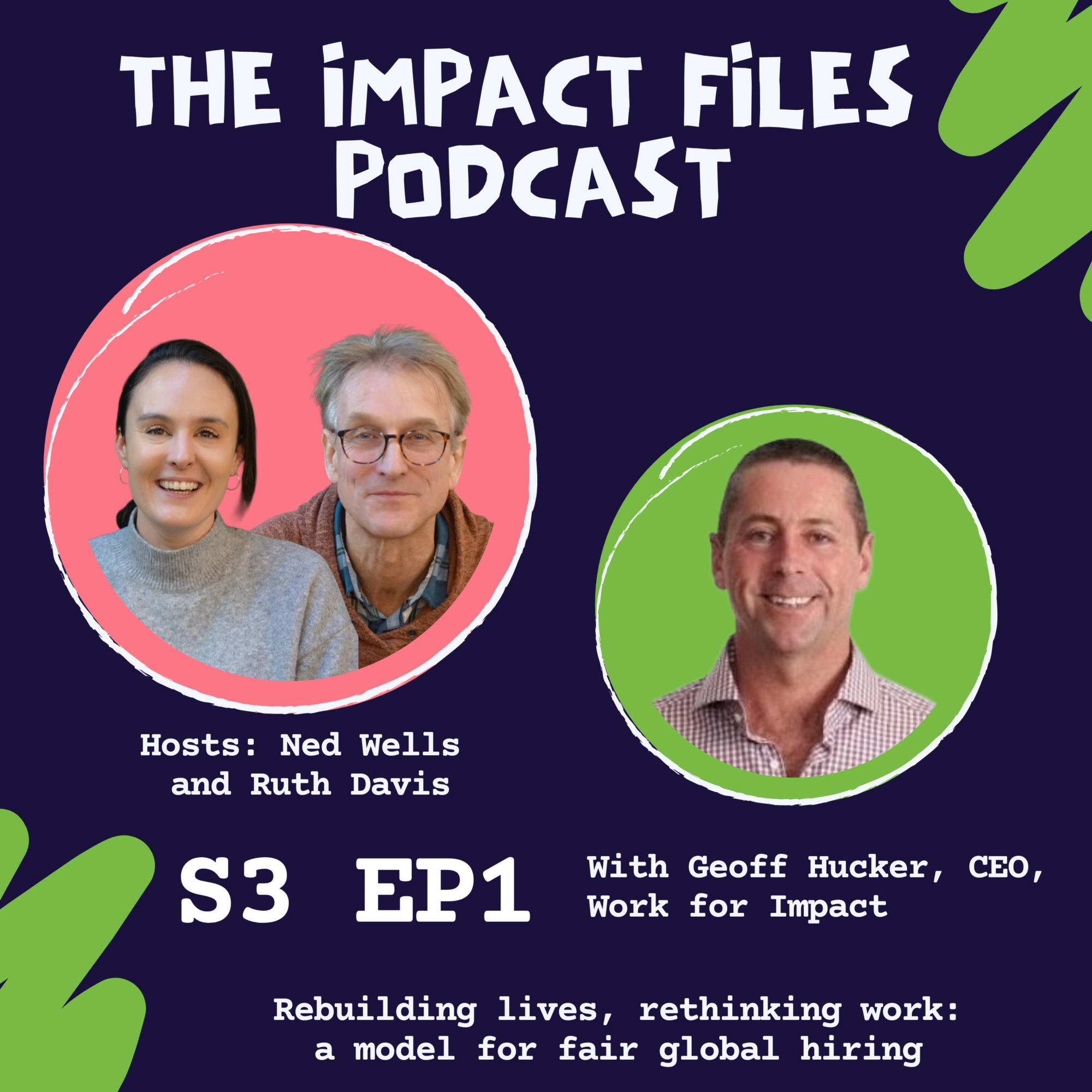
The Impact Files Podcast – Geoff Hucker, CEO and Founder, Work for Impact
Geoff: We did a study last year, our 2025 impact study. The average person who works for Work for Impact earns three times the local salary, which is incredible. And daily I meet these folks. It really changes their lives. All of a sudden, siblings are going to school, to college, grandma’s getting meds. And it really gives me the energy to keep going, doing the things that we do, seeing that. And on the other side, the clients – a lot of clients are maybe facing global headwinds, maybe facing challenges – get access to global talent that’s very capable, very clever. So really it’s a win-win.
Ned: Welcome to The Impact Files podcast. And in this episode, Ruth and I are delighted to be joined by Geoff Hucker, CEO and founder of Work for Impact.
Ruth: Welcome to the podcast, Geoff. Great to have you here.
Geoff: Thank you both. I’m really excited. I’ve been really looking forward to this for a while now, so it’s really good to be here. Thank you.
Ned: It’s really cool to have you here, Geoff. So could we start with a little introduction to yourself, your backstory, and your reasons for starting Work for Impact?
Geoff: Absolutely. So I’ve got a bit of a funny path. I was a pilot for many, many years, and in about 2000 I ended up in Dubai. Dubai in 2000 was not what it is like today. It was a relatively small sheikhdom, part of the United Arab Emirates. I was working for Emirates airline, and I was always very interested in Ethiopia and its history – King Solomon and the Queen of Sheba – and those terrible pictures we saw in the 80s of the famine. It was the first time I was really exposed to such poverty.
So, through a series of events, I went to Addis Ababa, the capital of Ethiopia, and through another series of events went to a small orphanage. It was in the foothills of a suburb called Kibana, and was run by Franciscan sisters. It was designed for about 50 kids, but at the time it was the height of the HIV/AIDS pandemic, and there were about 250 kids there.
And the kids were the same age as my son, Zach. He’s 31 now. So they were about five or six. I just hung out and played with the kids for a couple of days, and one of the kids made me promise to come back. Later I came back, and I said, “Where’s Ned, where’s Ruth, where’s Peter?” And a lot of the kids had passed away from AIDS. It absolutely broke my heart. This was the height of the HIV/AIDS pandemic, and antiretroviral drugs were available, but they couldn’t afford the $20 a month. And it was before PEPFAR. If you don’t know what PEPFAR is, it’s what the Bush administration brought in in 2003: free and subsidised drugs for low-income countries.
So what do you do? I started working with the orphanage. We put long-term funding in place, which is still there today. We renovated it. And this was over a period of many years. I would go on my days off and work there. And then, when I would leave at night, I’d walk the streets back to where I was staying. The kids living on the streets lived daily lives beyond one’s worst nightmare – the physical abuse, the trauma that they would go through on a daily basis. I just couldn’t imagine how they survived.
But I also learned some really important things: the power that we all have as individuals to fundamentally change someone’s life. More than just giving financial support or food – saying, “Ruth, you’ll be okay. I know it’s tough. You’ll be okay.”
And at this time, I was working with some really bright Americans that helped me build an alternative care, kinship care model. While the orphanage was very good, and back then orphanages were the model, I really saw the challenge of institutionalising kids, and how all the kids needed that individual attention. So in 2007, we launched an alternative care, kinship care model called Beyond the Orphanage, where we’d holistically look after children whose parents had unfortunately passed away from AIDS, or who were on the streets. If it was appropriate, we’d reunite them in a house, with a foster care or kinship care model, but then really look after that child and that household. We had a drop-in centre. The kids would come to the drop-in centre, and we’d work with them for years and years, so at the end of the programme, they had a chance of an independent life. Most would have degrees or vocations.
Fast forward many, many years: it’s been hugely successful, with thousands of kids in Nepal, Ethiopia and Kenya. But what we found at the end of the programme was these really, really bright young people, many with degrees, but with no work opportunities. If there were opportunities, they tended to be quite predatory: very poorly paid, poor conditions, et cetera.
And as we know, over the last decade, over three billion extra people have got access to the internet. Nearly 90% of the world has access to electricity. So the connectivity of the world has really changed the way we look at things. I wanted to provide opportunities for these young people to have ethical, transparent global employment. So that’s really why we launched Work for Impact: to address this problem, and to change this cycle of intergenerational poverty, not through handouts, but through opportunities – global opportunities. Does that give you a background of Work for Impact and why we…
Ned: It does. I mean, that sounds so interesting. I wanted to dig into that a bit more. So you said that when you started on this journey, you were working as an airline pilot?
Geoff: Yes.
Ned: So did you set up the orphanage work while you were still working full time? How did you do that alongside your day job?
Geoff: I kept working the whole time. I never took a salary from the charity. The most valuable thing that any of us has is our time, and I wanted to give my time to the kids. They deeply touched me, and still deeply touch me to this day. So I did both, but there were many, many great people around the world that helped me, and we worked together for that common good. I did the two in parallel till 2019, and then I started working on Work for Impact. So I was doing three things, but I wasn’t doing any of them very well. So I stopped flying, and focused on Beyond the Orphanage and Work for Impact, which is really where my heart is.
Ned: Which airline was it that you were working for?
Geoff: Emirates airline.
Ned: Okay. And did they give you the flexibility that you needed? I don’t know much about the life of an airline pilot, but I’m going to guess that it’s quite strict, and there’s a regime that you have to stick to. Whether you could go to a four-day week, or do this in your spare time, your family time, I don’t know. It’s really fascinating.
Geoff: There are two parts to that question. Emirates airline was hugely supportive. They have the Emirates Airline Foundation, which is still in place today. It’s a wonderful charitable organisation, chaired by Sir Tim Clark, and very supportive in low and very low-income countries. And the second part is that as a pilot, you tend to work in bursts. You do a long flight, and you’ll have three or four days off. With Ethiopia being only four hours from Dubai, with multiple daily flights, it was relatively easy for me to go on my days off or on leave. So I spent my time, my days off, there, and I loved it. I loved Ethiopia. It’s fascinating. And then, as the organisation grew, it was more managerial, not boots on the ground for me – working remotely.
Ned: Yeah, that’s great to hear that Emirates have that. That’s not something I knew about before, and that you had this flexibility in that way.
Geoff: Yeah, I was very fortunate, and very fortunate to have the support of the Emirates Airline Foundation.
Ned: Okay, so then you came to launch Work for Impact. Which year was that?
Geoff: We started the build in 2019. We spent a year on the foundation technology, and then we launched just before the start of the pandemic. Great time to launch a new business.
Ned: Well done. I hear that so often. Okay, so can we go into Work for Impact? Could you tell us a little bit about the business model, what you’re aiming to do with the business, and how it works?
Geoff: Work for Impact is really there to address the problem I talked about, the inequality of opportunities in low and very low-income countries, but also to provide opportunities for global organisations to work with talent in other countries. Low-income countries tend to have a lower cost of living, so the economics are very good for large organisations. But we do it in a very transparent and ethical way.
Outsourcing is a huge industry. By 2027, it’s forecast to be nearly a trillion dollars. But it also has a very bad reputation: very opaque, with large margins in the middle for organisations. So I wanted to build an organisation on a foundation of trust and transparency, that’s very good for the global client, but also very good for the independent contractor.
We did a study last year, our 2025 impact study. The average person who works for Work for Impact earns three times the local salary, which is incredible. And daily I meet these folks. It really changes their lives. All of a sudden, siblings are going to school, to college, grandma’s getting meds. And it really gives me the energy to keep going, doing the things that we do, seeing that. And on the other side, the clients – a lot of clients are maybe facing global headwinds, maybe facing challenges – get access to global talent that’s very capable, very clever. So really it’s a win-win on both sides. I sound like a salesman. I’m not, but it’s…
Ned: No, I absolutely love that. And the staff that you’re providing are making three times on average what they would otherwise. That’s brilliant to hear, because the social benefit and the opportunity that’s going to bring is just enormous, I would imagine.
Geoff: It is. And not only for them. The survey really looked at their communities as well. So not only their direct family and direct orbit, but also their wider community is impacted.
Ned: Yeah. And I’m going to guess that even at those rates, it’s still going to be good value for the hiring organisations as well.
Geoff: Absolutely. Most of our clients are in the US, UK and EU, and the traditional saving is around 60 to 70% compared with hiring locally. That’s combined with our low fees, and a lot of proprietary technology for the automation of what we do, so our operational costs are very low, which is why we can have such low margins. So it’s a win-win. The client is paying significantly less, and not only paying less, but getting access to talent that really wants to work and is very productive, in the level of work and the output you’re getting. And on the other hand, someone earning three times as much really sticks with the organisation. It’s a very important job for that person, that family, that community. So you basically don’t have turnover, and in some industries turnover can be quite high. So it’s a quite successful model in that way.
Ned: And could you share with us an idea of the scale of the business, in any metrics that you’re happy to share, just so our listeners can understand something about it?
Geoff: Yeah, of course. To date, we’ve done about 1.5 million hours. On the platform, we have about 140,000 people. At any one time, we have 100-plus active clients. Some would have 100 folks, some would have one or two. Year-on-year growth is around 30 to 40%, so quite significant. It’s a hard world, but organisations see the value that we have, the impact.
We work with global brands. Some of the big brands we work with: Outdoorsy – I don’t know if you know them, the largest RV rental firm in the world. We work with Outside Inc, 250 million users in the US. CuriosityStream – it’s like the Netflix of curiosity – a Nasdaq-listed company. So quite big companies, right down to smaller organisations. We have a lot of not-for-profits that work with us as well, for global talent solutions. So it’s a really good mix.
Ned: And those organisations you’ve mentioned are based in the United States. Is that where a large chunk of your market is at the moment?
Geoff: The US, EU, UK, Australia, New Zealand. The model is basically an organisation in a higher-income country working with folks in a lower-income country.
Ned: And in terms of the platform – you’ve mentioned it once or twice – could you give us a quick understanding of what the platform is and how it works?
Geoff: We go through a very extensive recruitment process. We have a lot of automation, a lot of artificial intelligence, and then we come in and do the recruiting at the end. And then the platform provides the legal structure and the compliance structure for you to work with global talent, and also the management: the time tracking, the transparency, global payments, global compliance and so on.
Ned: Brilliant. Okay, that’s so interesting, thank you. I’m going to hand over to Ruth.
Ruth: Geoff, you mentioned some really quite harrowing stories of the things you saw, and what people were experiencing at that time. So it’s really clear that that motivated you on the journey you’re on. And you said yourself just now that the ecosystem effects of Work for Impact give you the energy to keep going. I’m interested to know why you set up Work for Impact as a for-profit business, albeit a purpose-led for-profit, considering that you yourself had so much experience in the non-profit space. So it’d be good to hear a little bit more about that, and your thoughts when you were setting up Work for Impact.
Geoff: Such a good question. We did it purposely. Running a not-for-profit for 25 years was hugely challenging. I have so much respect for folks that run not-for-profits. We were dealing with children, and you’ve got to be really, really careful to plan strategically for a long period of time. You just can’t say, “Sorry, Ruth, the budget’s cut. You’ve got to go back on the street.” You rely on the generosity of others, on grant cycles, funding cycles.
It really came home in 2008. We had a couple of hundred kids under our care or in partner programmes, our direct responsibility, and funding basically stopped. Corporate, private, everyone just went. Luckily, we had the strategic mindset to have reserves for at least a year, but it was really challenging. So to plan years ahead, to be strategic, like you normally would with a business, is very challenging with a not-for-profit – or it was for us.
You’re always very limited by budgets for the administrative side. No one wants to spend money on admin. But to run a not-for-profit, the governance, especially in countries where corruption is a challenge, takes a lot of time and effort and expertise.
So when we were discussing the initial model, we talked about many things, but I really believe the future of organisations is the triple bottom line: to do good things for the world, good things for people, good things for the planet. But “profitable” is not a dirty word. Being profitable and purposeful makes strategic sense, so that you can plan the way you run a business: the governance, the economics of it. Having that foundation, that North Star – you’re doing good things for the world – helps you too. It’s really helped us grow, in the way that we strategise how we run our business.
Ruth: Wow, that’s so interesting. A few years back, I was working for a different organisation that did a lot of work with non-profits. And obviously, given the fairly recent situation with USAID funding and so on, I think it’s just a challenge that’s continually ongoing. I don’t think it’s going anywhere. So it’s really insightful. And I imagine there are probably quite a few charitable organisations that would be quite interested in your story, Geoff, in terms of how you’re finding these alternative funding streams. This is a completely random question, but do you do any consulting work with other charities or organisations in that respect? I feel that there are so many learnings for the sector as a whole from your experience.
Geoff: Anyone that’s doing good things for the world is a friend of mine, and I’ll make time for them.
Ruth: That’s amazing.
Geoff: And not charge, of course. I believe most people are really good people. I believe that we need to make concerted efforts to make the world a better place. And I’ve made many mistakes. If someone can learn from my mistakes and it helps them accelerate, great.
Ruth: Amazing. That’s such a nice message for a fairly gloomy Monday morning. Thank you, Geoff. So, going back a little bit, could you tell us slightly more about how the commercial and revenue model works for Work for Impact?
Geoff: Basically, and we continue to course correct a little bit, we take a margin on the hourly rate and charge the client. A typical organisation like us would charge 50 to 70% of the take rate. We charge 12% plus a 5% service fee. And we do this through proprietary technology, economies of scale, and not being greedy. So it’s really good for the clients – they pay less. And it’s really good for the contractors, who, as we say, tend to earn three times as much. And as for our margins in the middle, we spent years building the technology and the automation that allow us to work with many, many people. Without automation, and that mindset, we couldn’t do it.
Ruth: So what I’m hearing as an underlying message is the importance of balance. As you mentioned, profit isn’t a dirty word. Actually, it can be used for so many good things. So, like you say, don’t be greedy. There’s enough for everyone.
Geoff: And just be really, really efficient. Having a global footprint – our team is in, I think, 23 countries – makes us really efficient, really cost-effective. We wouldn’t have been able to be if we were stateside in the US, or even maybe in the UK, which is quite an expensive jurisdiction. We probably wouldn’t have been able to do it. And that mindset, global talent, is what we see in organisations as well. Organisations will come to us facing hardships, significant headwinds, and when they look at diversifying their talent base, all of a sudden they’re becoming more profitable. All of a sudden an organisation that was maybe failing is starting to show signs of growth. So it’s about having that mindset, that adaptability. And one of the many things that COVID taught us is that you can work remotely. Here’s you and Ned in the UK, and it’s very normal. We’re talking together, we work together.
Ned: Geoff, I wanted to dig down a bit into the business side of things. I think you said earlier that the business is growing at something like 30 to 40% a year. How many staff are there? How large is the organisation?
Geoff: We’ve got 23 people around the world, but it’s a bit of a hybrid model. We’ll have experts who aren’t a full-time equivalent, but a part-time equivalent. And one of the many great things about being a purpose-led organisation is the talent that you attract. People want to do good things for the world. Most people are really good people. Maybe they work for a larger company, but they feel disenfranchised, and they want to use their skills or expertise or intelligence or training to do good things for the world. So maybe someone works a day a week for us, or two or three days a week. We try and really keep our roster small, so that we can really work with automation. But, yeah, I think we’re 23, all around the world.
Ned: And in terms of the key metrics that you look at for the business, you mentioned the number of hours worked through the platform. Is that one of the key metrics that you look at? Are there some others as well?
Geoff: Yes. Revenue, of course, is important for us. Last year, I think our gross service value was about $5 million, growing at around 30 to 40%. So the numbers are still relatively small, but the economies of scale are coming in. We invested really heavily in technology, and it’s starting to come to fruition. Our platform and our structure are really starting to mature. Our technology is mature. We’ve very much doubled down on AI, like everyone else in the world, but ethical AI, with the glass box, so that we can use it for our efficiencies and automation – not to replace staff, but to complement our team and help them be more efficient.
Ned: Fantastic. We had a question about the people, the processes and the skills that you’ve put in place to support Work for Impact’s need to be both impactful and profitable. That’s a good question for businesses coming from a commercial route that are keen to work in the right way. But your route is so much about driving impact, and then needing to be commercially robust as well. That fills me with interest about how you’ve navigated that, in terms of the people and the processes that you’ve had to put in place.
Geoff: For the people, as I said before, when you’re doing good things for the world, people naturally gravitate towards your business. The roster that we have, some of the expertise that we have, is incredible. We’re not a great big payer. We just can’t afford huge salaries. But people want to do good things for the world, and when you combine that purpose with a business, it’s incredible what you can get done – that passion, that purpose for doing good things – and bringing in these key people that really believe in it.
So, taking your point from before about organisations: if they’re leaning more towards impacting the world, their staff will be very engaged. They’re really talking to their staff, and getting buy-in from their team: “This is what we want to do. We’re a traditional business. We don’t do bad things, but this is what we want to do. This is the change we want to have.” And then you’ll see the impact in their teams and their staff, the morale. When you can spend your day impacting others, making the world a better place, I don’t feel like I’m working. I get up at 4am to take calls from the US, but I’m really happy to do it. I think, “Wow, this is cool. Yeah, no problem.” It’s not just clocking in. You’re doing really good things for the world.
Ned: And you’re a registered B Corp, aren’t you?
Geoff: Yes, we were the first of our kind to become a B Corp. We’ve just gone through recertification, and I think it was a really good thing for us to do on many levels. We were voted Best for the World in the community category. Having that foundation, that framework, and that legal structure ensures it’s not just a wash. Our Articles of Association are very clear on the B Corp side. And going through the certification process – as anyone that’s done it knows – is quite difficult, and you’ve got to evidence everything that you do. So it really helped us as an organisation, and continues to help guide what we do and what we don’t do: the organisations we work with, and the organisations we won’t work with, for example.
Ned: Sure. Fantastic. Ruth, over to you.
Ruth: I’m really glad you mentioned that, Geoff, because my company became a B Corp at the end of last year, and that client framework is something that we’re still going through. It’s come up quite a lot in chats that Ned and I have been having with other podcast guests. So, in a slight deviation, I hope you don’t mind me asking: could you tell us a little bit more about your framework, and how you decide which clients you will and won’t work with?
Geoff: Really, really good question. When we first started, I was pretty militant. I would only work with not-for-profits, social enterprises and B Corps. For a young company that’s losing money, saying no to two out of three clients was pretty hard. And it was a real lesson to me in a lot of ways.
I remember specifically two lovely ladies in India. They had a woman-founded and -led organisation working with women in their communities, and doing lots of quite good things, but they weren’t a not-for-profit, they weren’t a social enterprise, and they weren’t a B Corp. I said, “Sorry, we won’t work with you.” And they gave me a real talking-to. They really had a go at me. They said, “How dare you?” And I said, “What do you mean?” She said, “Well, we’re a really good organisation. We do good things for the world. We really look after our folks. We’re not a big company, we’re not a social enterprise, we’re not a not-for-profit.” And I thought, fair cop. Really fair cop.
It was a lesson to me that there are a lot of organisations that are not bad organisations, but they’re on a bit of a path. And by the very fact they’re working with us, and employing someone in Ethiopia or in Tanzania, they’re having a significant impact. So we really changed. There are still organisations, under B Corp and under our own framework, that we just won’t work with. If you’re doing bad things for the world, it’s just a straight no. But there are a lot of organisations that are on a bit of a journey. They think, “Okay, we need to improve.” So why shouldn’t they get talent through Work for Impact, to bring in consultants or experts to help them? And by the very fact of employing through Work for Impact, they’re making a significant impact. So that was a real lesson for me. I was quite militant: “No, no, no.” Actually, no. And I’m thankful to those two beautiful ladies in India for giving me a good talking-to.
Ned: That’s such an interesting point that you make, Geoff. I did a course last year at the Cambridge Institute for Sustainability Leadership, and the course was in sustainable marketing. They categorise organisations as red, amber and green. Red being those organisations that, quite clearly, you shouldn’t work for. Green organisations being those that were set up to be purposeful in the first place: they’re a charity, they’re a social enterprise, they’re a B Corp, et cetera. And then in the middle, you’ve got the amber organisations, which were set up to do a thing – historically to sell a service or a product – but now they’re on a journey, and they’re trying to navigate the course to do the right thing.
And those, for me, are fascinating organisations, because there’s going to be tension on the board. Some of the people are going to be really focused on revenue and this quarter’s numbers, but others are going to be looking further out and asking, “Is this the right decision to make longer term, for people, for planet, or for whatever it is?” And I think there’s a very interesting world there to explore.
Geoff: Absolutely. I 100% agree. We work with many of those organisations now, around the world. As I said, there are a lot of organisations that are good organisations, but maybe they’re not having the impact that they want, and they’re trying to course correct or pivot. And we happily work with them.
Ruth: And why shouldn’t you help them, if they’re looking for support in that way? It’s something you can do to help them improve their positive impact as well. I think you can make positive change in lots of organisations. Obviously not, as you mentioned, Geoff, the absolute red flags, the absolute no-nos. But there are a lot of organisations in the middle, and I think there’s a lot that can be done with them, and they can probably have the biggest impact. They just maybe need more education and hand-holding.
So, thinking about the balance of long-term purpose and impact and your near-term financial goals, I was hoping you could share some successes you’ve had, but, equally importantly, maybe some of the challenges you’ve had, some of the things that haven’t gone quite so well. I’d be really interested to hear.
Geoff: Successes: seeing the impact that we have around the world, proving our model, and proving that you can do good things and be profitable at the same time. I think that’s a real success for us.
And things that haven’t gone so well… I joke – I don’t know if you can see how many grey hairs I’ve got. Everyone’s got a story. I think one of the things that didn’t go so well was being militant at the start about only working with not-for-profits, social enterprises and B Corps. In my paradigm, in my ideal world… that was maybe a bit of a fantasy. I thought everyone would immediately gravitate towards us.
It was really interesting, in some of those early days, I was in meetings with grey-haired men in grey suits, and I was so passionate about doing good things for the world. Not interested. You could just see you were losing them. But what I learned quite quickly is that if you’ve got option A and option B, and they’re net-net the same cost, the same sort of thing, and option A is ethical, most people will lean towards option A. If option B is cheaper, most people will lean towards that. So your value proposition has to be very strong. If you’re doing good things and you’re ethical, most people will lean that way. But just being purposeful, just being an organisation that’s doing good things, doesn’t mean it’ll naturally give you success on the commercial side. You have to be financially commercial. Most organisations are really driven by that bottom line.
Ned: That makes me wonder, Geoff, when you’re going out and recruiting employers to the platform, are you doing that in a targeted, proactive way, where you’re approaching organisations to say, “You need us”? Or does that work?
Geoff: It tends to be that organisations come to us, initially for the economics. And then, once they find out about all the impact side, they double down, double down, double down. But the initial conversation is normally around economics: solving a problem for the organisation. We’re offering global talent solutions, we’re a serious organisation, we have all the certifications, et cetera. And then they find out more and more about the impact that we have, our pathways programme, our studies and so on, and then they really double down with us. But the initial thing is the economics.
Ruth: So you’re almost saying that to get your foot in the door, you have to have a good financial proposition. Basically, it has to be economically viable for them.
Geoff: A and B: if B is cheaper, they’ll lean that way. If A and B are net-net, and A is ethical, A is doing good things for the world, most will lean that way. And it’s an interesting thing to understand. You’d just think, “Okay, someone’s doing good for the world, there’s a premium for it.” But in this global uncertainty that we have, the global headwinds, the turmoil we have in the world, that bottom line is very important for most organisations.
Ruth: Yeah, and I was just about to ask you whether you feel that will ever change. In some fantasy universe, many years into the future, people might make a decision because it’s better, even if they might have to pay slightly more.
Geoff: I hope so. I think in your generation… I’m the last of the baby boomers, the last year, and I don’t think we did a very good job. But seeing younger people come through – and still, at 61, I feel that I’m young – looking at the way they look at life, the way you look at impact, the way that you make choices, is very different to my generation. So it gives me great hope for the future, the different lenses you’re looking through. So hopefully your generation will think, “Okay, option A and B. Option A is doing good things for the world. It might be more expensive, but I’m going to lean that way.” I’m going to buy clothing… if I buy clothing, I’ll always go to Patagonia for that reason.
Ruth: Yeah, and I think you touched on it earlier as well, when you mentioned the importance of mission when it comes to employee retention. I think a lot of people who are just joining the workforce want motivation beyond just what compensation they can get for a job. They want to feel like they’re contributing to something. So I think that’s always quite a positive indicator as well.
Geoff: Absolutely.
Ruth: Great.
Ned: Geoff, I’d like to come on to a question around media, communications and marketing. We’ve got a couple of options we could look at. One question is: what is the big strategic role that media, communications and marketing can play in your sector, to drive purpose alongside profit? And our alternative question was: what is the role of communications and marketing in driving your business to be sustainable? Whichever of those feels more natural.
Geoff: I think they both come together, really, for me. The importance of communication and media for the organisation can never be underestimated: how you tell your story, how you connect with the right audience, how you motivate the right audience for your end goal. I think it’s really important, and by dealing with professionals, you can really drive the results you need, while being mindful of your return on investment. We all know that advertising can be hugely expensive. So it’s how you get the return on investment with the right audience, how you tell your story, the channels you tell your story through. What is the benefit of social media for you? This is your world, not mine, but I understand how complex it is now, and how complex it is with artificial intelligence. We’re bombarded day in, day out, whether it’s on social media or with cold emails and outreach. So how do you get past that noise? How do you get to the decision makers? It’s about being guided by professionals, professional organisations that really understand your market, and really understand how you can get the results that you need.
Ned: I guess one of the things that occurs to me is that the audiences you’re dealing with are, on the one hand, the hiring teams in big global organisations who are looking for talent solutions, and on the other hand, energised individuals in the Global South who are looking for work. In terms of marketing, there’s a distinct overlap in those two audiences, but they’re also potentially really different.
Geoff: For the independent contractors at Work for Impact, a lot of people want jobs. If you’re earning three times the local wage in a low-income country, there’s no shortage of applicants. The hard one is the clients: finding the clients that really believe in the mission, really believe in what you’re doing, and will try it. And how you get in front of them, how you get through all that noise that’s out there to find the decision maker, to find the right person, to set up that call, for them to open your email, or whatever it may be, to read your blog. It’s complicated.
Ned: And I’m guessing that there’s an awful lot of trust involved in winning those clients.
Geoff: There is. And the longer we do it, the more successful we are. Most of our work these days is inbound and referrals, which is great. Organisations, large organisations, listed companies that work with us will happily jump on a call and verify what we are, what it’s like working with us, which is great. It’s really rewarding for us.
Ned: That’s great to hear. Ruth, over to you.
Ruth: Thanks, Ned. We like to ask a question about how you see your organisation evolving over the next 12 months or so, but on reflection that maybe sounds a little dull. So I thought I’d reframe it and ask: what’s coming up with Work for Impact in the near future that’s really exciting for you?
Geoff: There are lots of things. We’ve doubled down on ethical artificial intelligence, to make us really, really efficient in our processes, in the way that we screen high volumes of candidates, and to ensure everything we do is ethical. But at the end of the day, the organisation wants to hire the best person. So in how we actually do that, we’re releasing some things in the next few months. We continue to improve all our processes. We very much have a kaizen mindset: always improving, always improving, to make it more efficient for the independent contractors and also for the clients.
I’m very excited about the years ahead, because we’re quite different in our model. I’d really like to disrupt the global outsourcing market with a more ethical, equitable approach, and get rid of the big fat companies in the middle that are not very nice to the world, not very nice to people. And then show organisations there’s a better way to do things, and it doesn’t have to cost you more. It can cost you less, and you can also have an impact on the planet, and on people as well. That’s my hope for the next period of time. Let’s see. See you next year. Give it a go.
Ruth: That’s great. From what you’ve said so far, I have no doubt that you can achieve those things, because it really sounds like you’ve set up something really incredible, really different. And as you said, it is quite disruptive. I’ve never heard of anything like it. So kudos to you and your team.
Geoff: Thank you. We’ve got a really good team. They’re very motivated. And again, like I said before, you meet independent contractors whose siblings are all of a sudden going to university, grandma’s got the meds, the community’s got something going on. It’s incredible. Wow. I don’t know if you’ve read our impact report, but you just see the numbers and think, “Wow, this is cool.”
Ned: What a feeling.
Geoff: It’s good, it’s really good. And it’s empowering someone. It’s not giving a handout. It’s really empowering them. They’re responsible for their own destiny. We’re just giving them the tools, the opportunities. Maybe facilitating is a better word for it.
Ned: And I think you’ve started to answer our next question, which was about where you hope your sector will be in maybe 10 years’ time. And I’m certainly hoping that it’s going to be you in there, really disrupting.
Geoff: I’ll be fighting. Like I said, it’s a trillion-dollar industry by 2027. It’s huge, and it’s dominated by some huge global players. But it’s about really changing it, really looking at the human side of it, looking at the people, using technology, doubling down on ethical AI for the facilitation, so organisations can get the benefits of global talent pools – but a win-win, not just one win. A win on both sides of the equation. And the connectivity means people can stay in their villages. They can stay in their language groups, they can stay in the safety of their communities, and not go to large regional centres, with all the socio-economic problems associated with that. These things are really important to us, and it’s working. We’ve just got to grow it, grow it and grow it.
Ned: When you say ethical AI, what do you mean by that?
Geoff: To me, a lot of AI is like, “How does it work?” We do an API call to ChatGPT or Gemini, and it’s just this black box. So, for you to really understand what we’re doing – what we’re doing with your data, what we collect, what we don’t collect. Do we look at intonation? No. All we’re doing is parsing your words. So we’re very transparent with it, using it as a tool for augmentation of what we already do. It’s like a glass box. You can really see inside. It’s not just this obscure thing that happens.
Ned: So a glass box rather than a black box. That’s a great expression. I’ve not heard it before.
Geoff: Yeah. I didn’t make it up, unfortunately, but you get the context – you can really look inside.
Ned: I love it, I love it. Okay, one piece of advice for businesses pursuing sustainability and financial objectives?
Geoff: Do it. Do good things for the world. Just do it. Crack on. Get up and do it. If you want to speak to me, I will willingly make time for you. I’ve made lots of mistakes. You can probably learn from my mistakes. But just do it. As I said, I’m so excited about working for Work for Impact. I get up and take calls. I work all day, and my wife’s going, “It’s midnight, sweetheart. You’ve got to go to bed.” But that energy, that enthusiasm…
Ned: Totally.
Geoff: For me, that drives me much more than any material possession I could ever own. We’re not poor, but we’re not wealthy, and I don’t really want to be. I want to do good things for the world. I want to have an impact. I want to hopefully leave the world a better place than when I came into it.
Ruth: You’re amazing.
Ned: That is a brilliant note to finish on. Thank you so much, Geoff. How can people find out more about you and Work for Impact?
Geoff: Workforimpact.com is the site. Have a look at it. And I’m contactable on LinkedIn. Direct message me. I’d love to speak to you, love to meet you, love to learn from you. And thank you both for your time, and thank you for doing the good work that you’re doing. It’s really inspiring.
Ned: Awesome. Geoff, that’s brilliant. Thank you so much. It’s been really lovely talking to you.
Ruth: Thanks, Geoff. So, so interesting.