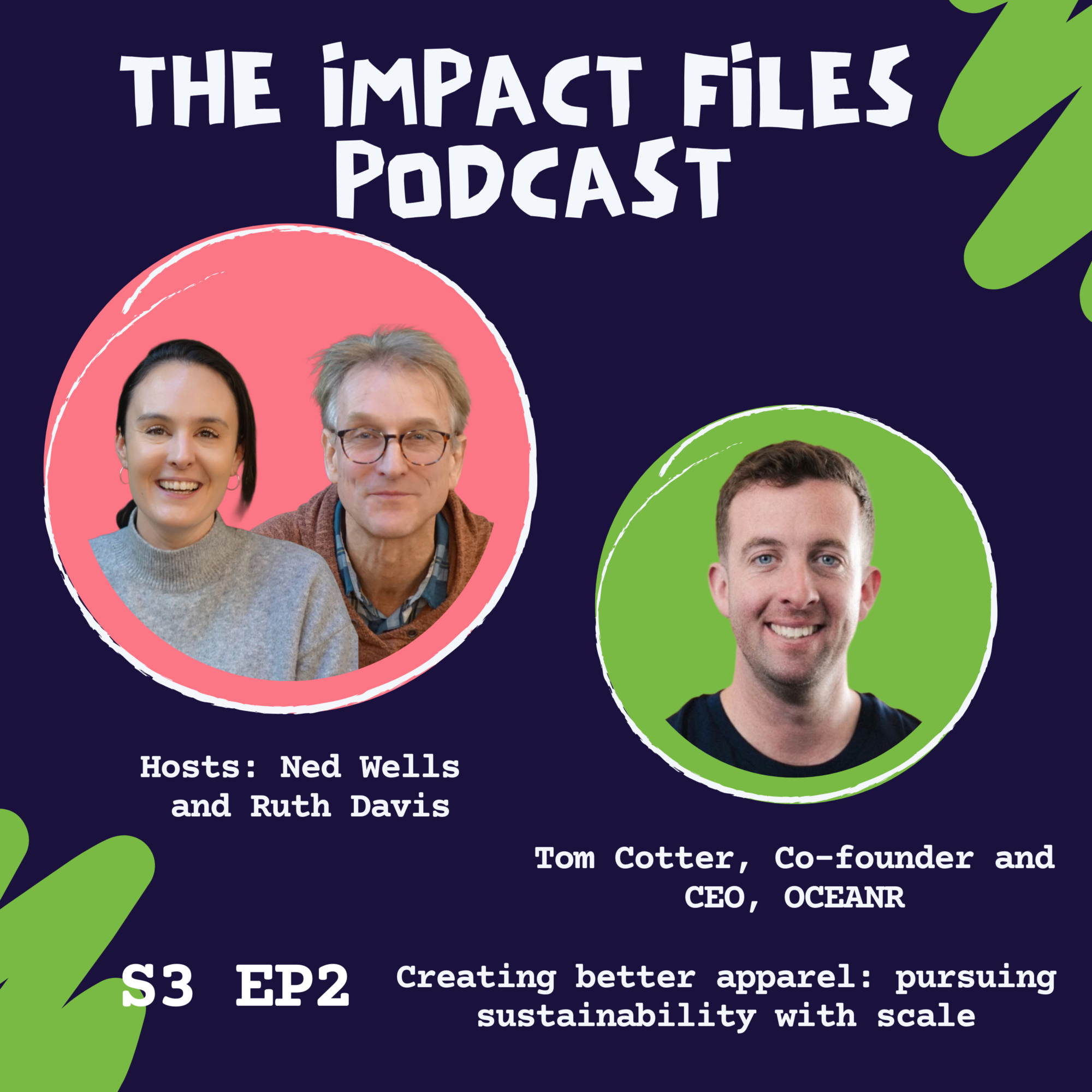
The Impact Files Podcast – Tom Cotter, Founder, OCEANR
Ned Wells: Welcome to the Impact Files podcast. This week, Ruth and I are excited to be joined by Tom Cotter, founder and CEO of sustainable B2B apparel brand OCEANR. Hi, Tom. Thanks for joining us.
Tom Cotter: Delighted. Hi Ruth, hi Ned, thanks for having me.
Ned Wells: Tom, it’s so nice to meet you. Let’s start with an introduction to you and to OCEANR and the work that you do.
Tom Cotter: As many of the listeners will understand from the accent, I’m an Irish fella from the south of Ireland, in a place called Cork. I’m not sure how far back we can go or how long we have, but I grew up in Ireland and holidayed quite extensively in one location in Greece, which happened to be a unique water sports hub in Europe. So a lot of windsurfing, a lot of sailing, a lot of diving. I’ve been going to the same location since I was about four or five. We did very little of that sort of activity in Ireland, but on holidays I did a huge amount of it over the years, and when I got older I wanted to stick with that industry. I was lucky enough to find a course where I could become a sailing instructor, a diving instructor and a windsurfing instructor, which took me from Ireland to Australia for about four or five years.
When I came back from Australia, there were no jobs really in the outdoor recreation space in Ireland. There are more in the UK, for sure, just because of the bigger population, but in Ireland you’re very limited, mainly due to weather. I really wanted to stay in the space, so I ended up creating a clothing company that combines my love of water sports, travel, ocean conservation and business.
Ned Wells: Very important questions. First of all, where was it in Greece that you used to go?
Tom Cotter: There’s a beautiful island between Corfu and Kefalonia called Lefkada. The little fishing village is called Vasiliki, and it has some mega windsurfing centres. It’s a home away from home now. I’m very lucky to have found it, or rather my mum and dad found it years and years ago.
Ned Wells: Cool. And where in Australia did you spend those four years?
Tom Cotter: So I’m 36. My wife, who was my girlfriend at the time, and I were 21 when the economy crashed in Ireland. We went off thinking we were going for three months, backpacking, and we landed in Melbourne. I’d gone from minimum wage in Ireland to going off with a sailing instructor credential and going to the local yacht club to see if I could get work. I was put on, I think, either $50 or $60 an hour. I remember getting my first paycheque and it was about $1,200 for the first week, and I was thinking, “I’ve just taught kids how to sail in paradise for a week and loved it, and you’re paying me crazy money.” We ended up staying for four and a half years.
Ned Wells: I was about to say, that story of going off to Australia and doing a bit of work in your early twenties will be familiar to lots of people, but that kind of money is definitely not familiar. That’s amazing.
Tom Cotter: I think that’s maybe just the affluence of the sailing sport. And I was very, very fortunate. People say you strike your own luck, but I was really fortunate that when I landed, the training centre manager of this really prestigious yacht club was moving job and had to recruit his replacement. I always say he didn’t really care who he replaced himself with, because he was going, and this cheeky Irish guy just landed in his lap.
I was hired as a sailing instructor, but very quickly the general manager came over and said, “Do you know Excel?” and I said, “No.” He said, “Here’s your marketing budget.” I was just supposed to be on a little RIB teaching kids how to sail. I ended up becoming the training centre manager, then got a couple of promotions, and we did quite well. I had no business experience, but the general manager was super to me and basically mentored me for the four years. I had to present at board meetings and run the marketing team, and I had a lot of instructors underneath me by the end. You basically learn every aspect of business without even realising it, with somebody quite substantial holding your hand.
Ned Wells: So you’re now running a business employing a fair number of people and specialising in sustainable B2B apparel. You left Australia and returned home to Ireland. Tell us about the idea. What was the seed of it, and how did it start?
Tom Cotter: I was about to say it was very linear, but not really. I still get to grips with being based in Ireland after Melbourne. I think Melbourne was voted the best city in the world to live in for the four years we were there. Then I came back to Cork. I have two friends, and the three of us were very interested in starting companies. Two of them had businesses already. We used to meet on a Wednesday evening for what we called a “pizza and a pint” and throw around ideas. One of them is a very good sailor, one is a very good surfer, and I’m a jack of all trades, master of none. If you take me to do any of the sports I can do them, but I’m not elite in any of them.
One day we went down to West Cork towards a beach, a bit of a road trip, to see if we could jump in the sea. We were getting dressed and getting into our wetsuits, and underneath the wetsuit you have a thing called a rash vest. We were all looking at them, the sailor, the surfer and me. At the time, which was about eight years ago, they were completely the forgotten product. All the wetsuit companies focused on the wetsuits and nobody focused on the rash vest. We thought maybe that was the idea to run with.
We did a bit of digging, and when you go to a bank, or to people you need to impress, we were just three crazy guys with a crazy idea. There was no market in Ireland, it was a strange product that hadn’t been done before. But all of the Google research we did, the keyword research in Google Analytics, said it was becoming a really searched topic online. Our local high-end fashion shop had a sun-protective top as well, but they were all done as an afterthought. So we decided to pursue it.
We started out most definitely as a consumer brand. We wanted to be an online consumer brand. Sadly, we all fell for the YouTube videos and social media clips that say if you put something online you’ll be a millionaire overnight. That didn’t happen. But we did build a credible audience. We sold a couple of thousand pieces a month for about six months, and what came from that was a huge amount of interest from organisations who wanted to collaborate with us.
It probably took another two or three years for the penny to drop that maybe we should stop pouring money into Facebook and Instagram ads to sell these rash vests, and instead sit down with organisations that want to be more sustainable. They want to work with a company that’s trying to do things the right way. We’re not perfect, but we try to do things the right way. We pivoted in and around the time of COVID.
Ned Wells: Could you share the scale of the organisation now: number of employees, profitability, all those sorts of things?
Tom Cotter: I keep saying to people that we’re in second gear. It’s been a very stop-start situation. Everybody’s dealt with it and people are sick of hearing about it, but COVID was really challenging. The majority of our business is in hospitality. We had a breakthrough moment, and your listeners will resonate with the name. We basically work with the top 20 private islands around the world. We go in and do their uniform and their retail merchandise, with their brand guidelines, their colours and their logos, but we’ll have our logo on it as well. If their stakeholders, whether guests or staff, want to see where it was made, they come to our website and see that it was done the right way. Everybody’s pushing them to be more sustainable.
The first deal we got was Necker Island, Richard Branson’s home in the BVI, in Q4 2019. Then Q1 2020 was COVID. We had this huge network of organisations in the hospitality space all ready to go, and all of a sudden countries and regions were shutting down. That paused the first two years. So we’ve really been at a standing start since about 2022. We came out of COVID, and we rebranded during COVID. From 2022 to now, we’ve grown the team to about 90 staff. We acquired a production facility in Latvia because we wanted to own our own production. We do R&D, design and everything in Riga, the capital. The main sales and marketing team is in Cork, about 20 people. There’s a team of 75 in the small production facility in Riga, and a couple of independent people scattered across the world.
Revenue is still quite low. We’re about 3.5 million and we’re still chasing profitability, which I think your listeners will appreciateI’ve sat down with some very reputable brands as mentors in the last number of months and said, “Listen, we’re scaling quite well, but we’re still not profitable.” I was always wondering whether it was the sustainability goals we had. All these big brands that have had really successful exits said the same thing: they didn’t hit profitability until they were at seven or ten million. It was lovely to hear. You have this realisation that you’re not on your own. We’re as lean as we possibly can be and we’re still not close to breaking even. We’re maybe 10 or 15 percent off. I was worried we were doing it the wrong way, and they all said no, they all took time. There’s a point where you need your CFO, your operations person, your sales team, your spend. You need the main structure in place. They said profitability came somewhere between six and ten million.
Ned Wells: What is it that makes your products more sustainable?
Tom Cotter: I could speak about that for two hours, because it’s how I discuss it with organisations when we go into them: what’s important to your organisation? Sustainability is the broadest topic around. If you do one thing, you seem to impact another. Do you want plastic-free packaging? Okay, we’ll do that, but then the lifespan of the product might be challenged. So it’s really challenging. We started the journey and came up against all of these issues, and we said, “That’s not right, let’s fix that.”
The simplest way I can describe it is that we have three pillars: people, product and planet. My argument, and I’m happy to be challenged on it, is that there’s no point making something with sustainable materials if the people making it are treated unethically. Depending on your personal preference, people have different answers about what’s most important. Some say carbon, some say something else. For me, it’s people. So number one, look after your people.
Number two, we only work with sustainable materials, whether that’s recycled polyester, hemp, organic cotton, or even seaweed T-shirts. We have an R&D section for fabric. The one I love is that in recent times we’ve added a full life cycle analysis on all of our garments. If you scan a QR code, you get the carbon consumption, the water consumption, the miles travelled and how many people were involved in the production. That’s become very important for the bigger organisations because they now need to report on their Scope 1, Scope 2 and Scope 3 emissions, and very few suppliers can give them the information that we give them. Then we have a take-back and repair service for some of our key accounts. It’s quite challenging because of the costs, so at this point we can’t offer it across all our clients.
The last bit is planet. We contribute to offsetting our carbon. That’s a very important phrase and I can go into it later. We plant about 300 mangroves a month in Kenya. Then our big one is ocean conservation. We’ve worked with probably four different organisations over the last five or six years to collect ocean plastic. At the moment our focus is a river collection system in Indonesia, which collects all the plastic coming down the river. There’s a team that we don’t employ, but the non-profit does, and they pull the plastic out of the river.
Ned Wells: Amazing. I think I’ve seen photos of that on your website, Ruth. Thank you, Tom. It sounds like you’re doing so much. Massive kudos for, like you say, putting your values ahead of everything else. I wanted to touch on that a little more. You mentioned Greece and Australia. I have family members who’ve been to Lefkada and I’ve seen photos, and it’s like island paradise, and Australia has the Great Barrier Reef. Was there a light-bulb moment when you were in these beautiful places, seeing the ocean, and you thought, “My god, I really need to do something about the problems these areas are facing”?
Tom Cotter: There were two things, which I’ll tell you in a minute. First, in Cork we’re not a farming background, but my grandmother was a farmer, and as I grew up we were very nature-focused. You’d spend your weekends at the beach, or go for walks in the woods close to our house. So for me it’s normal. I think everybody thinks this way. I’m definitely not a tree-hugger. I’m not forcing it on people. I’m very commercially minded at the same time, but I think it’s crazy not to try to do something if you can.
The two things that bothered me in Greece: before we went to Australia we did two seasons in Greece over the summer. I worked in a diving centre, diving every single day, and I was amazed at how few fish there were. There’s very little fish in Greece or the Med because it’s so overfished. The local fishermen don’t have the education to figure out that they need to repopulate, or the awareness that they need designated zones to let fish repopulate.
The other was that we stayed on later in the season, after all the tourists had gone home. One of the beaches, which you could only access by boat, had a big pile-up of rubbish. One day I did a five or six kilometre walk and got to the beach with the idea of going for a swim, and a dumper truck had been landed on the beach. All they were doing was digging a hole and burying all the rubbish left over from the whole summer. I was looking at it thinking, their whole economy is tourism, the tourists eating in the restaurants and the fishing, and you’re kind of going, this is crazy.
I wouldn’t say that at that point I said, “I’m going to start a business.” But I knew when I came back that if we were going to start a business, why not have an element of sustainability in it? It’s definitely a huge trend that everyone in the world is talking about.
Ned Wells: As you mentioned, a lot of your clients are smaller islands, which are arguably the ones that will be affected the most. It makes so much sense for them to have sustainability as one of their pillars, because if we continue the way we’re going, those islands might not be there. Linked to that, your business case for sustainability: you mentioned you’re not making tons of profit at the moment, but are you seeing a push from your clients? Do they want more sustainable options? Are you standing out in the marketplace in that respect?
Tom Cotter: One hundred percent. And again, it’s a really personal preference unless the organisation has really articulated what direction they’re going in. The way I opened this up was that sustainability is so broad. Everybody I talk to, and I mean everybody, wants to tear you down. If we manage to get a call with somebody, they’ll bring their sustainability person onto it, and their job is to be a gatekeeper and vet anybody they work with. You can kind of get the feeling that everyone’s sitting on the call waiting to tell us we’re wrong. So I just go through my people, product and planet. I say, “Listen, guys, we’re not perfect by any stretch, but if working with ethical companies in terms of people is important to you, work with us. If carbon reduction is important to you, I’ll tell you how much carbon is in your order and we can plant mangroves to offset that. At the very least I can give you a metric to say how much carbon went into that order, and you can offset it if you wish. If ocean clean-ups are important to you, we can work with our river system and you can say it’s amazing that you partnered with OCEANR.”
The more I go through this journey, the more I feel people are crying out for solutions. Once you’ve done the LED lights and maybe solar panels, people are scratching their heads about where to go. There are very few solutions being presented to these organisations. It’s a journey we’re on. I met a very famous person recently and asked his view on the sustainability journey, and he said, “Tom, it’s like an Arctic liner turning in the middle of the sea. It’s going to take such a long time to turn this around, but we have to start.” He said it’s going to get blown off course a few times, and I have loads of examples of us getting blown off course. But if you’re transparent, communicate with your audience and are open about it, I think people forgive you a lot. That’s the most important part. If you’re working with organisations that want to go on that journey together, there’s a lot more power in us all supporting each other. If they can work with me on improving me, and I can work with them on improving them, together we’re making a difference, whereas individually it’s a lot more difficult.
Ned Wells: Absolutely. You mentioned carbon and your three pillars quite a few times, and we know you’re a B Corp. In terms of reporting on your internal sustainability, you mentioned your life cycle assessments and you’re doing a lot of measurement. What’s the core thread running through that? Do you use the B Corp framework, which obviously includes your people as well, or are you more focused on those three pillars?
Tom Cotter: Two points to your question. When we started the B Corp process, it was just our Irish entity, a team of five or six. We said we’d go for it. I use it as a bit of a trump card. You go onto these calls and I go through people, product and planet, trying to warm people up and prove that you’re not greenwashing, that you’re authentic and trying to do it the right way. Then at the very end it’s lovely to say, “And we have a B Corp certificate that backs all of what we’re saying.” A lot of them take that really well. It’s not just me doing a sales pitch.
We started when we were eight people, but then we acquired the factory in Latvia and that put a whole different spot in the works. We went from a team of about eight to maybe 52, probably 60 when we did that. We became the first Latvian B Corp, and I think we were the 40th Irish company to become B Corp. But we only got that about 18 months ago, so we’ve gone right through the reporting they required. I have a call next Thursday with them to kick off what we need to reassess. You need to stay on top of it every year.
What I find interesting, and maybe a mistake we’ve made over the years: we started out planting trees. X number of trees would remove X amount of carbon, and it was all done on headcount. We were basically saying we were carbon neutral. We tracked the number of people in each facility and offset their personal lives and their work lives: the average carbon per person in Ireland multiplied by how many staff we had in Ireland, and the same approach for Riga. Every two months we figured out how much carbon the facilities had used, what travel we’d done, flights and so on, and offset that. Then the production of the garments: because we have the life cycle analysis, we can say it took X amount of carbon to make this fabric that we turned into a pair of shorts, multiplied by how many products we made. We put a 15 percent contingency on it. We were tracking that every month, and still are. We thought we were going above and beyond.
One day someone rightly pointed out that when someone clicks on your website it links with a server, and that server is burning carbon that you’re not offsetting. So you’re not carbon neutral. Now we don’t say we’re carbon neutral; we say we contribute to offsetting our carbon. I think you should rightly point out when people aren’t articulating it correctly, but when people are genuinely trying to do it the right way, you should definitely encourage it. It shouldn’t be a knock-down process. We haven’t actually had too many knock-downs apart from that one. So now I always tell the story: we contribute to offsetting our carbon.
Ned Wells: That’s so interesting. My agency does a lot of work in the digital sustainability space, and we understand it’s not top of the list of priorities. You yourself, and your organisation, are doing so many amazing things, and we’d never want to bash people with a stick because they’re not perfect. So it’s interesting that you brought that up. Tom, you told us you’re doing an awful lot in people, processes and skills to maintain and drive your sustainable approach alongside the revenue objectives. How do you decide what you’re going to do? Is this a conversation around the top team table monthly: how are we doing, what do we do next, are we overshooting, where are we with all these things?
Tom Cotter: Honestly, as we discussed off air, the hardest thing is that because you’re not printing money, or even breaking even, it’s hard to continually keep it at the front of your mind. To answer your question directly, with B Corp, one of the big things they want, rightly so, is for it to be the first topic you discuss at every meeting. At board level, my first report is our sustainability update. We have a 15 to 30 minute conversation with our investors: a couple of VCs, a couple of high-net-worth individuals and some family offices.
What’s lovely for me is to see these people, who probably never thought about sustainability at this level when they were driving their mega companies that exited for hundreds of millions, really engaged in that conversation. The hard part is that the next conversation is, “How are you doing financially and where are you going?” You need to run the company. And I’m saying, “Okay, guys, but we need to plant more, we said we were going to do it.”
I’ve learned one of the biggest mistakes we’ve made. One year our marketing claim was based off my forecast. Let’s say, three years ago, we wanted to do 2.5 million in revenue and give 2 percent of revenue, 50K, to the NGOs we work with. But we did 1.2 million in sales, so you’ve halved it. I’d said verbally that we were giving 50K, or the equivalent: we’re going to remove 50 tons of ocean plastic, which equals 50K of cash to do that. Our marketing message for the whole year was “50 tons, 50 tons, 50 tons”. Then you get to the board meeting and they say, “Tom, you’ve no money.” We issue a sustainability impact report at the end of every year and make sure that is right. But you learn not to commit to a certain amount at the start of the year, because it catches you out fairly quickly if you don’t make your sales.
Ned Wells: That’s really tough because, as you say, you’ve got the revenue and the sustainable vision, but you’re not making a profit, and sustainability in the sense of taking plastic out of the ocean and planting mangroves has a cost associated with it.
Tom Cotter: It’s the ongoing give and take. My latest reflection is that if anybody’s listening and starting a sustainable business, you need to take into account global gross margin levels. What does a retailer sell for? What does a distributor sell for? What do they all want to make? If you can’t fit into the global economy, it’s going to be incredibly difficult to scale. Say you produce in the UK, which is quite expensive, and you do your ocean conservation as well, and you tell a retailer what they’re going to make. They’re not going to let you in. They need to make 50 or 60 percent and your distributor needs 20 percent. You need to fund your team. So you need to sit down and work through the P&L and the structure of your costs. That’s really tough because you need a CFO, or somebody you pay a substantial salary to work through it with you. Your accountant will do it in your early years, but it’s definitely give and take.
We’ll even pivot, I think, from our solely owned production facility to working with a number of vetted outsourced partners. What’s getting really expensive for us is the war between Russia and Ukraine. The Latvian economy has been really heavily hit, so the cost of everything went substantially up. So you’re hitting the sustainability base with all these commitments, plus you’ve got a team of about 70 people in Riga and global economic impacts happening close to home. A lot of that is sacrificing the growth you could be investing in sales and marketing to take the company to the next level. But we’re very fortunate to have amazing investors who continue to support us and see where we’re going.
Ned Wells: Fantastic. Ruth?
Ruth Davis: Thanks, Ned. You’ve mentioned a few things, Tom, about challenges you’ve had, whether to do with partnerships or internally. Maybe you could tell us a little more about some of the things that have gone really well. And do you have any stories or learnings you’d like to share about things you’d absolutely not do again?
Tom Cotter: We’re very fortunate that we’ve taken a recipe. I always go in and talk to investors or banks and they ask, “What’s your IP?” and I say we really don’t have any IP, we just try to do everything the right way. That’s the IP at the moment. It’s quite difficult, because they always say there’s no barrier to entry. We make about 10 units at a time. If we sit down with the Four Seasons in the Maldives and they want to kit out their retail, they’re not going to do thousands and thousands of pieces. They’ll do 50 of this, 100 of this, 75 of that. So we have a very low minimum quantity. We’ve taken the recipe of people, product and planet and fallen into the most lovely niche you could find.
We’re talking to like-minded people. If you jump on a call and it’s a hard-nosed procurement person, you’re looking and thinking, this is probably not the play. If you’re going to beat me down on price… what I really want is for you to be happy to spend maybe 20 percent more than you are with your current supplier for something sustainable, customised to you, made in Europe, with all the bells and whistles. A lot of people get that. We’ve now gone into six different industries. We take the same recipe, people, product and planet, and diversify in terms of product.
Our biggest deal to date is with an Arctic expedition company. They go up to the North Pole or the South Pole and take thousands of people on their boat We do an Arctic jacket for them, and their guests get a jacket where they scan the QR code and get all the information I spoke about earlier. We’ve gone into healthcare: we’ve just done a line of scrubs for one of the leading private hospitals in Dublin. We’ve gone into superyachts. We’ve gone into hospitality, like I said. If you can think of the sport, we’ve probably done something with it: golf, tennis, loads in there. I’m quite happy with where we’ve got to over a four- or five-year period, and now we’re focused on increasing sales, which I love. When you’re talking to like-minded people who are excited about the potential to collaborate, it’s lovely to see.
If I was starting again, and this is removing the sustainability conversation and looking at it purely from a business point of view, I think I jumped into it a bit too early. I could have stayed in the bedroom a bit longer. Where we’ve ended up is still quite good, but if anybody listening is trying to get into a space, I’d get my product finalised and get everything ready to launch while still in another job. When you have your product, your website and everything ready to go, you do need to go at it at 200 miles an hour. But jumping and removing that comfort blanket of a salary too early can really impede your growth in the future, because all of a sudden you have life challenges: mortgages, families, eating out, normal stuff. That becomes tricky when you don’t have a salary and you think you’re going to take off, but it takes longer than you think.
Ned Wells: Excellent advice. I think a lot of people think a start-up is: you have the idea, you do it, and then you make money. Actually there’s quite a bit in between.
Ruth Davis: That’s true.
Ned Wells: Tom, I wanted to ask you about the strategic role that media, communications and marketing play in your sector, because there’s clearly a fascinating, difficult line to navigate between greenwashing and greenhushing. But what other significant roles do media and communications play for you?
Tom Cotter: I did a photo shoot in Greece when I was on holiday one year, and I don’t think I’d have a company if I hadn’t. It cost me about 400 euro. I gave all these sailing instructors the free gear, and I paid a photographer about 400 euro to give us a day or two. It cemented the visual for everybody. It’s very hard to articulate; we’re talking for an hour, but if you send people to our website they’ll get it in two seconds. Until you have that website and that visual, it’s incredibly difficult.
You take that right through. I have very few skills; like I said, I’m a jack of all trades, master of none in business as well. But what I’m quite good at, I feel, is packaging it. People, product, planet didn’t come in one day. It came from telling the story for three years and realising people weren’t following. One second we were talking about carbon, then made in Europe, then something else. One day it was six pillars, and once you got to the third pillar you could see people reaching for the exit.
With media, it’s obviously a vital point. We go to trade shows and I’ll sit down on the first day with all the media outlets we know. Some of them are probably sick of me telling the same story, so we don’t sit down with them too often. But nine times out of ten you’re sitting down for a 45-minute conversation, and if they like it, they’ll release an article about you. If you’re all over the place trying to figure out your story, and it comes across like you’re potentially greenwashing, you don’t have a chance. I take the exact same story I’ve told you here to an editor, and they all leave saying the same thing: it’s an incredible story, it’s just you guys trying to do the right thing. And it’s practical. Instead of being paralysed because there are so many elements to sustainability and doing nothing, it’s, “Let’s just start and improve as we go.” I think people resonate with that.
Ned Wells: It’s so interesting, as you say, to keep the story simple and be transparent that you’re on a journey and not completely perfect. Brilliant.
Ruth Davis: I love “just start”. There’s so much out there and it can be so overcomplicated, but if you just start and you’re open about where you are, I think that’s the best thing anyone can do. Looking a bit more to the future: is there anything exciting coming up for OCEANR over the next six to twelve months?
Tom Cotter: I had a meeting last week where I said I want to meet our top 30 clients. It’s the stereotypical reference that your top 20 clients give you 80 percent of your revenue. I wouldn’t say “abandoned” is the right word, but we’ve got these incredible clients and they’ve been so supportive. Richard Branson’s team, for example: we did that deal when we were a consumer brand, about seven years ago, and they’ve worked with us for seven years. I was there about 18 months ago. Those people are so supportive of what we’ve done. I only met Richard for a five-minute meet and greet. I said I wanted to thank him, because when he gave me the deal I had two staff and we now have 90 or whatever it is. He’s obviously very supportive of start-ups and business owners in the UK and across the globe. He didn’t even know who I was, but that resonated with him. He said, “You’re doing our uniform?” and I said yes, and the retail and everything. I was trying to say thank you.
There are a lot of businesses out there that have given us a shot. Our goal this year is less about crazy growth. Even our investors are saying, “Just stabilise the business, get it to break even or profitable.” One of the best ways I can do that is to visit them. Ninety percent of our contact is video calls like this, or phone calls. If we could land somewhere for maybe a week and visit 10 or 15 of our clients in that area, that’s going to be the focus for the remainder of 2026.
Ned Wells: I love that. It’s so important to cultivate those relationships, and, as you say, people taking a chance is so important.
Tom Cotter: Absolutely. It’s very difficult to speak to someone over the phone who’s got a hundred things going on in their world. If you could sit down in someone’s office, show them product, and a lot of them default to thinking they buy three products off us. Some customers might buy hats, another might buy T-shirts, and they’ve never thought about the rest. To name-drop Necker Island again: Richard’s so into cycling, and I said we have a whole cycling collection, so you could have a Necker Island cycling jersey for the guests when they come. I think it would go really well, but they’re in uniform and swimwear and all that. So it’s important to go and, like you said, cultivate those relationships.
Ned Wells: We like to end by asking where you hope your sector will be in ten years’ time. I’m slightly struggling to know what sector we’re talking about, because you said you’re in six really different markets. So the question is, where would you like things to be from your perspective in ten years’ time?
Tom Cotter: It depends what day you ask me. I go from really pessimistic to quite optimistic. All of the global changes that are happening at the moment have definitely set us back. You hate to put a timeline on it, but it felt like there was real progress in the early days, and I’m sure there will still be organisations, and people within them, with a huge appetite to do the right thing. At a global level, I think the importance and priority of sustainability has slipped a number of bases in the last 24 months, which is disappointing. On the pessimistic version, you’d love to see that in ten years we’ve gone through this global change and it’s back as a main topic for discussion. It was probably top of everybody’s agenda for the 36 to 48 months before; for the last 12 months there have been a few other things. In terms of sector, I see us just as an eco apparel producer. We span a number of industries; if we went into space, making astronaut soup, we’d just be trying to do it the right way.
We were really optimistic about the new directive from the European Union, which includes the UK. They’ve just issued a rule that you can’t destroy unsold stock anymore. That was released this week. That’s a huge issue in the apparel space. You’re going to have to buy it in 2027, and you’ll have to have all those metrics I’m talking about, the carbon, and monitor that. Hopefully it gets implemented, because as we all know these bureaucratic situations tend to roll over for a couple of years. It would be great to see the apparel world change because it’s a horrific sector. It’s one of the top three most damaging sectors in the world. We’d love to see some serious change, starting with monitoring all the metrics. You can’t make real change until you know how much damage you’re doing. Then it’s about how you improve those metrics going forward. Maybe that might happen in the near future, and hopefully in ten years’ time people are improving on it.
Ned Wells: One of the challenges, as you say, is that it’s a sector that contributes a lot of damage, and people say there are already enough clothes in the world to last generations.
Tom Cotter: It’s horrific, and I think people overlook it. I’ve sat on podcasts similar to this where the question is whether sustainability is a luxury, and you kind of have to agree. That’s not to blanket everybody who isn’t in that luxury section. But if you’re trying to make ends meet and feed a family of four, your priority is your family. You’re not saying, “I want to do organic cottons.” That’s not everybody. I’m sure a huge proportion of people, including myself, find it very challenging in today’s economy to prioritise sustainable apparel when you’re trying to put food on the table.
I rub shoulders with a lot of people who get very frustrated with that. I also think people aren’t bad. Can you name one bad person you know? Their priorities may just not align with yours. I might talk to someone in my friend group about eco apparel and organic cottons and it’s not twigging with him, but he’s donating hand over fist to cancer research and homelessness and other causes. People have their own priorities. This is just one of the many problems the world faces on a day-to-day basis. If people aren’t bought into your way of thinking, it’s not that they’re not contributing in some shape or form.
Ned Wells: Indeed. Tom, I wanted to finish by asking if you could give us one piece of advice for businesses that are pursuing sustainability and financial objectives.
Tom Cotter: I’ve probably mentioned it already, but the transparency piece is something I always default to, and I’ll give you a practical example. When we started the business we were working with a third-party producer, and it was just me wearing all the hats. All we were focused on was making sure the product was made from eco materials, certified, with everything done. I was sitting on a panel one day in the south of France at a boat show talking about sustainability, and a woman put up her hand in the audience during the Q&A. She said she was so happy she’d come, because everything I’d explained made her think I was the real deal, but she’d got one of our early products and it came in a poly bag.
This was in front of the whole audience, and I nearly… no. She said, “You did reply. I emailed you giving you grief, and you did reply, and I was content with your response at the time.” The reality was that the third-party producer had focused on the product, but we’d completely forgotten about the bag. We then moved quite quickly to a new cornstarch bag that biodegrades, with all the bells and whistles. We still use that type, although we’ve changed supplier since. But the next problem came 12 months later when one of our Four Seasons customers received their product. It turned out the cornstarch bag has a lifespan, the inside of it had started to deteriorate, and there was loads of white residue on their product. We had to get the product back, wash it, iron it all out and repack it. So then we had to change again.
I stay in touch with that lady, actually; she even tried to be a sales rep of ours later on. Back to your question about advice: be transparent on the journey. For the first mistake, people will forgive you. For the second mistake, people will forgive you. But if you’re burying your head in the sand, not telling anybody about it or not trying to improve it, that’s when you get in trouble. People will resonate with the journey. So just start. If you go in the wrong direction, someone will point you back in the right direction fairly quickly, and then explain to them why you started on that journey in the first place.
Ned Wells: So it’s all about trying to do the right thing, but also communicating that you’re at least making an effort. That is fantastic, Tom. Finally, how can people find out more about you and the business?
Tom Cotter: I’m quite active on LinkedIn, so you can find me there: Tom Cotter at OCEANR. And for the website, if you need any information about the company, it’s oceanr.co. Somebody will come back to you.
Ned Wells: Fantastic. That was brilliant. Thank you so much, Tom.
Tom Cotter: Lovely discussion. Thanks, guys. Thanks, Ruth.
Ned Wells: Thank you.