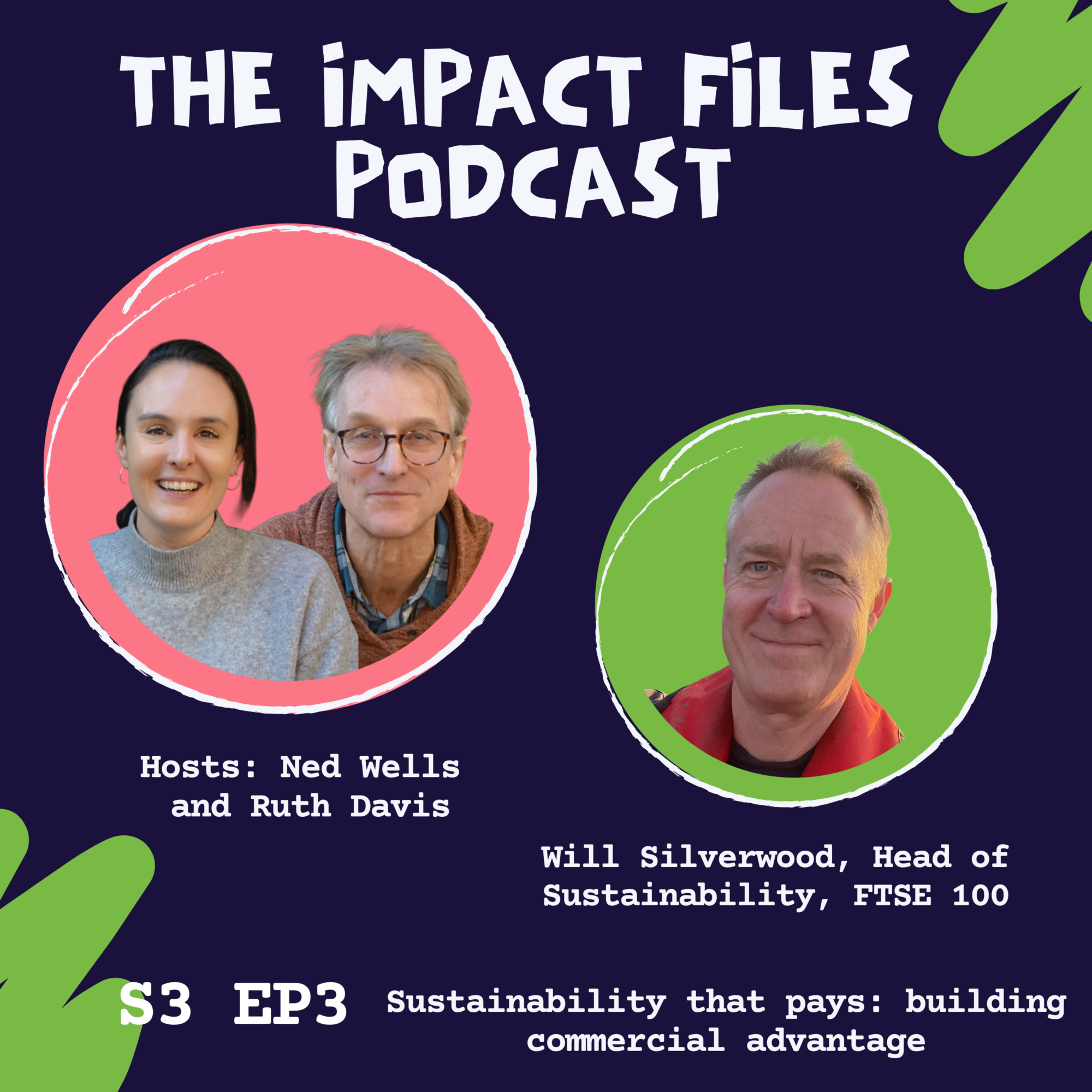
The Impact Files Podcast – Will Silverwood, FTSE 100
Ned Wells: Welcome to the Impact Files podcast. And this week, Ruth and I are delighted to be joined by Will Silverwood, who until recently was heading up sustainability at Whitbread PLC. Welcome to the podcast, Will. Really lovely to have you here.
Will Silverwood: Good to be here. Hello Ned. Hi Ruth.
Ned Wells: Well, really nice to have you here. Let’s start with an introduction to yourself and to the work you do, and perhaps begin with your personal story, your motivations for doing the sort of work you do.
Will Silverwood: Okay, so I guess my career has been fairly scenic. While I’m sitting firmly in the world of sustainability today, chapter one for me was nothing to do with sustainability. It was working with big organizations, quite diverse organizations, like the Trainline, like Gala Coral, like Siemens Communications, helping them develop capabilities and propositions that they didn’t have before. And that was all well and good. I spent 10 years in a brilliant consultancy called Iris Concise, where I was number seven in the door. We were bought by a big agency and we spent about eight or nine years helping the clients I’ve just talked about, those big, complex organizations, to develop and implement a commercial strategy. And in about 2017, I thought to myself, I’ve got to do something new. Sustainability had always been a deep passion of mine, although it clearly didn’t manifest itself as cool as a child enjoyed nature. And my hypothesis was that all of the stuff I knew I was quite good at, which is the front-end bit, getting stuff done, still needed to be done to enable a sustainability outcome that I’m passionate about. So I jumped into the void like Flash Gordon. And here I am, I guess four or five different roles into sustainability, really trying to make an impact.
Ned Wells: So let me rewind a bit. I’d be fascinated to know what happened towards the start of your career. Did you go to university? What did you study? And then how did that turn into working for Iris on those big clients like the Trainline?
Will Silverwood: So I’d like to think it was a well-planned route and that I knew what I was doing. I actually studied geography at Manchester in the early 90s. Now, I think, based on the fact my two kids are at university now, that they do a lot more work than we did back then. I spent quite a lot of my time at university not studying too hard, which was a fantastic few years. But when I came out the end, I didn’t really know what I was going to do. And really by chance, I landed in a small scale-up business that was, I guess, a bit like the Betamax of videos. It was voice messaging before emails came along, but it was technology and it was projects and it was operating in enterprise solutions. But that’s where I met a lot of friends who I still see today, including my wife. So it was a good first step, but really more luck than judgment. And that moved me through the idea of delivering projects and then more strategic front-office projects into strategy.
Ned Wells: I see, that makes sense. Okay. So then it was Iris, and then you did this little sideways move.
Will Silverwood: Yes. And that was an interesting transition because, when you want to make a mid-career change, the first thing you’re asked is, well, what do you know about this new world you want to get into? The honest answer has to be very little, which doesn’t equip you brilliantly for an effective mid-level, senior-level role. I was quite lucky. I picked up a role with an organization called QA. They’re a private equity-backed national apprenticeship business, and the brief was to digitize their business to create a much more profitable operation, which I succeeded in doing. And it was something I knew how to do. But one of the side effects, or one of the secondary outcomes, of that project was that we almost completely decarbonized the business. Their emissions come from driving around the country meeting apprentices. That’s really where all the big scope three came from, all the big emissions, and we pretty well removed all of those. So I guess it’s illustrative of how sustainability means different things for different businesses. In that case the key area was really to digitize it. But the outcome meant that I could talk effectively about knowing how to devise and implement a strategic decarbonization, which equipped me to jump into subsequent sustainability roles. Again, a little bit more luck than judgment, or maybe a bit of both. Anyway, that’s how I found my way in.
Ned Wells: Fascinating. Now that all slots into place. So you were with Whitbread for a few years. I’m sure a lot of our listeners will have heard of Whitbread, but could you give us a brief introduction to the business, the scale of the business, the key brands? That kind of thing would be fascinating.
Will Silverwood: Yeah, I mean, Whitbread, I guess, is one of the UK’s best-known brands. In testing, it comes up right up there as a trusted, authentic and well-known brand, but it really is an investor brand, Whitbread PLC. They don’t brew any beer anymore. They bought and sold Costa. They sold Costa in 2019. They are really Premier Inn and a few hundred-plus branded restaurants like Beefeater. Part of the business is consolidating to some extent, reflecting how the market’s evolving around mid-scale restaurants. A real part of that business is Premier Inn, and that is 850-plus Premier Inns across the UK. And in Germany, it’s the fastest-growing hotel operator. So a relatively new entrant. Germany is a very different market, more operators competing, I guess, and a really good opportunity to get in there and become, you know, brand number one. They’re fast growing over there. So that’s really Whitbread. There’s about 35,000 of them operating in the hotels, with a support centre in the middle.
Ned Wells: Mm-hmm. What sort of revenue is it?
Will Silverwood: Over three billion. A sizeable organization, trading well, well established, a really tight operational business and really a great place to work.
Ned Wells: Brilliant. And how long were you there for?
Will Silverwood: Two and a half years.
Ned Wells: Okay, so that’s quite a slice of time to work on the project. We’re going to come onto that in a minute, that’s interesting. Ruth.
Ruth Davis: Thanks, Ned, and thanks, Will. I really enjoyed hearing about how it was almost very organic, your journey into sustainability. It’s quite nice, actually, that a job can become about sustainability. I think eventually, hopefully with time, all jobs will be like that and everyone will take their own piece of responsibility. So, talking a bit about the business case for sustainability and how you used to measure it, could you tell us a little bit more about how you took these decisions to the board, how those decisions drove business results, if they did, or if not, and maybe how it was reflected in the reporting as well?
Will Silverwood: Yeah, I mean, I think just coming back to the Whitbread brand, it’s so trusted and so established in the commercial landscape. It’s a given that as a business there is responsibility that’s considered central to what goes on. So that’s the foundation expectation, but it’s also a big, commercially driven organization. So sustainability really sits as a supporting imperative in that business, below the surface, I guess. And from a business case perspective, there’s obviously the climate side, there are emissions, there’s pollution, there’s waste, and we’ll come on to a bit more detail about that in a minute. That’s a real responsibility. There’s also a business case element about resilience for the future. So this is thinking about how, with a changing supply chain, we are going to operate, but also, as the energy transition happens, how we are going to think about operating in that future world. And last but by no means least, the business case sits around people. Customers ultimately choose big, networked, budget, value-brand hotels based on price and location. It’s not the sustainability message. However, the expectation is that the right things are also done by the operator. So “Rest Easy is a phrase that’s used in our brand narrative. That means that as you have a sleep, you can do what you do and we’ll do the heavy lifting and you can relax, with the understanding that we’re doing the right things for you. So from a leisure perspective, and from a guest perspective, it’s not necessarily seen as a determinant of choice. From a business perspective, it’s more and more. This is where regulation, to some extent, is tying things together. Because of the scope three reporting of a lot of our corporate customers, 50% of our guests were business guests, and about half of those were booked by a contract or some kind of arrangement. And during that transaction, or the preparation for that transaction, the questions are, how sustainable are you as an operator? Some of that booking is done kind of direct through a booking platform. Some of it’s done through aggregated platforms like HRS, for example, and we need to exist on those platforms, providing qualitative data around what we’re doing: renewable energy, recycling, train options et cetera. There are a bunch of criteria, but also, importantly, quantitative information. So we provide a hotel carbon intensity per room on that platform. By providing data, you move from a basic to an advanced level, which accesses more bookings. So there’s a revenue element in this case. So from a financial perspective, you’ve got leisure, you’ve got business, and then you’ve obviously got an investor dimension. Whatever the narrative globally around investor sentiment in the US in some areas, we don’t have exposure directly to the US, but there is obviously transference, big organizations invested in businesses across the pond, and we’ve not been affected by some of that headwind in the US. Investors still see it as very important. So there’s a business case around that. Just coming back to some of the really core elements of the business case, the easiest to understand are that we can save significant cost by using less energy, using less water, wasting less, and that cuts directly through to the bottom line. And that’s something that we could prove in fairly quick turnaround, and have done over the last few years. So the business case there is quite clear. The last point is supply chain. That’s about protecting business value for the future.
Ned Wells: Well, I just wanted to jump in on something you said earlier. You were talking about one of the platforms and saying that by demonstrating some quantitative data around sustainability, that opened up some more opportunities within the platform. Is that right?
Will Silverwood: That’s correct. Yeah. In this particular case, HRS is a big hotel reservation system. A lot of operators will sit on there. It’s kind of an aggregator, but they have three levels: basic, advanced and pro. To become advanced, you need to provide them with a checklist of X number of characteristics about how you operate, but also, critically, provide them actual emissions data per room. So it’s not per individual room, but an average for that hotel. And that can tap into a different stream of sized bookings So it raises you up the algorithm, as it were.
Ned Wells: I mean, that’s so interesting, because in thinking about the theme of this podcast, where we’re looking at the balance between business economic metrics and sustainability metrics, the fact that HRS have decided to put sustainability at the heart of their business model and encourage their customers in quite a focused way to motivate them to behave more sustainably, that’s really interesting.
Will Silverwood: Yeah, I mean, they’re an enabler in a way, because any large organization like Whitbread also has a responsibility, in whatever jurisdiction they exist, to disclose their environmental credentials. So that means reporting. They need data from us about where their staff are staying, because they need to report on it as part of their scope three. So HRS are an enabler. In the same way, Booking.com used to have three green leaves. They’ve actually taken them away now and replaced them with an obligation on operators to have their own certification. So in Germany, for example, it’s really important to have a certification, because it does affect things. If you look at the left-hand side of the booking screen on Booking.com, you can filter out those that don’t have any leaves, or you can filter to prioritize those that are more environmentally friendly. So there’s definitely an opportunity that’s bigger, I guess, to affect choice with business guests.
Ned Wells: And that is driven by regulation rather than an internal drive?
Will Silverwood: A little bit of both, I think. Yeah. But ultimately, these large organizations, we are part of their emissions supply chain, I guess.
Ned Wells: It’s so interesting, because only the other day I was looking at booking a hotel for a wedding and I noticed, I think it’s Booking.com, has the sustainable option, and I always love seeing that. It’s really interesting. I guess, linking to something that we mentioned in the briefing call, from the individual or user, however you might call them in the hotel industry, you mentioned, Will, these customer nudges, and it was a concept that we really found interesting. So maybe you could talk a little bit about how you use those throughout your properties.
Will Silverwood: Sure. So I guess the booking-choice nudging we’ve talked about, and I think in the booking flow, surfacing any kind of environmental credentials can be done through the infrastructure, the web pages, I guess. But if you do it through any kind of language, it’s got to be really authentic, simple and brand-aligned. We know from research and speaking to customers that things that sustainability geeks might think are exciting and interesting mean nothing. Don’t talk about targets, talk about progress. Talk about actual activities we’ve done or are doing. We were looking at surfacing just icons that might suggest that we’ve got EV charging on that site, or that renewable energy is in all of our hotels. So that’s the booking flow. When it comes to nudging customers while they’re staying with us, that’s a really interesting area, because while the heavy lifting has to be done by us as an operator, we’re investing hugely in infrastructure to lower the flow of the taps, which at individual room level sounds fairly small, but as it aggregates up, you can save huge amounts of water. The next step, having done that, is, can you nudge customers to have shorter showers? Now, this is quite a contentious area, and not one that, I don’t think anyone’s properly resolved, and we were looking into it. But any changes we’d make in the estate had to be meticulously tested prior to any kind of adoption. So you’d start with a very small set of rooms. You have guest surveys across the whole estate all the time. This is used for lots of other things, so you test it and see if there’s any negative around guest scores, not just from a sort of built-in perspective, but from a data perspective. Do you see any nudging downwards? We tested messages. We did this before we moved to lower-flow showers. And actually, we didn’t see any negative. The brilliant thing around the shower design now is that when you aerate the water, it comes out and feels just as high pressure. Less is coming through the tap. Nudging beyond that, as in use shorter showers, is a touchy, difficult subject. There have been some trials. Accor have published some trials that they did, where they put a sticker on the wall and they put some messaging, and they proved that they could reduce the length of showers by using messages like “average shower time is five minutes 42, can you go less than that?” I’m making that number up, but it’s broadly right. The challenge there is that, you know, the infrastructure of buying that kit in every shower, you then have to think about the business case of paying it back, of maintaining it. Is it going to last? Does it need washing? So I think nudging at room level is an interesting idea. Water usage is one that potentially could make people feel guilty. Recycling in rooms is definitely something that we’ve done. So this is about, before you put that in the bin, have a think about it and put it here if not. And then things like energy, a big operational estate of 89,000 rooms, you really need to control that. While there are some fans, the approach that we take much more is around controlling air conditioning across the estate by hotel, as opposed to giving individuals the ability to affect it. So the other area is food waste. Food waste is a huge area of opportunity to waste less, drive down emissions, drive margin. And that’s about experience design. It’s been proven that if you put out more food at a buffet, people will take more food. If you put nothing there, it looks really mean. So there’s a balance there. Can you look at planning the amount cooked based on the number of guests coming through? Can you look at plate size, et cetera, et cetera. But nudging guests, if you can get it right, as lots of hotels have done around reusing towels, you can save tens of thousands of tons a year by one less towel a week.
Ned Wells: Can I just interrupt? It’s such an interesting piece of psychology though, Will, because what I’m reflecting on is that you want to attract people to come and stay in the hotel because it’s going to be a positive and enjoyable experience and they’ll recommend it to their friends and their colleagues. And so many of the environmental and sustainability messages that one gets fed day to day are kind of negative and off-putting, about eating less of this and traveling less in your preferred way and doing this less and less and less. So the balance for an organization like Whitbread, of nudging people in the direction of using less water and thinking about what they’re throwing away and eating less and so forth, is a very interesting psychological seesaw. And I guess I’m wondering, in the role that you had as head of sustainability, tell us just a little bit about how this thinking played out. Somebody comes up with an idea to save water. How would that idea be generated, in what forum, and who would you have to take it to in order to actually implement it?
Will Silverwood: Yeah, so the big gains we made on water were definitely done by our property team. These are people who understand the tanks and systems and basins and baths and shower heads, and understand what gain you can make. Ultimately, a shower is measured in liters per minute. So you know that if you move from a higher to a lower, you’re going to use less. So for that kind of project, the flow-through is, well, can we prove that we can reduce without affecting guest experience scores? And if you can, then you look at the business case. The brilliant thing about using less water in showers is that if you use less water, you heat less water. So you’re using less water, but you’re also using less gas, or obviously less electricity when you’ve electrified the hotel. That’s the science of the property team. And then it raises its head through a commercial discussion with whatever sustainability or infrastructure steering groups there are. This is the business case, this is the experience. When it comes to things like in-room recycling, again, as with all trade-offs, for every minute you add to a housekeeper’s routine, you’re adding significant cost, and time, to the operation, all scaling up to 89,000, however many, rooms. So these decisions are made by lots of different teams, and to some extent the head of sustainability is trying to be a catalyst in some of those discussions, just trying to keep them on the agenda. But those decisions have to be made by big groups of people with input from guest experience and property and maintenance. And then it’ll surface up to the sustainability or the property steerco, who will go, right, let’s check the metrics. What are the savings? What’s the impact on guests? A considered decision will be made. Each decision has a different set of decision-makers.
Ned Wells: Yeah, yeah, interesting. Okay, so you were at Whitbread for two and a half years. I’d be fascinated to know, over that time, the environment that you came into, what your mission was, and the changes that you were able to put in place over that time.
Will Silverwood: Yeah, I think sustainability in a business is a bit like a forever-running race. You’re taking a baton from the previous person in the relay race and you’re running with it. And at different stages of the race, there might be a different speed. There might be different hurdles. I arrived in the business when we had put in place a lot of the typically early-stage things around energy efficiency. We had set up some of the people infrastructure around governance and we’d started to look at water savings, and we were starting to do some very early trials and some of the degasification and electrification of hotels. But actually, in order to move from the lower capital-intensive projects to some of the bigger, longer-term, heavy-lifting capital projects required a different level of governance and a kind of evolution of some of the different levels we put in place. And one of the things that we evolved was the steering committees, which had to be represented by different people, typically more senior, as the capital investment decisions expanded. So if I use an example: we are 800-plus hotels, you have to take out gas boilers, and to get to net zero you have to create a trajectory to remove gas. We’re doing that for new hotels, the ones that are opening now. Swindon was a hero hotel a couple of years ago, completely electric, no connection to a gas supply. All our conversions that are now going on, when we’re moving restaurants to hotel extensions, are electric where possible. But then there’s this retrofit idea. And in order to bring together the right papers, submitted to the right groups to sign off that kind of longer-term capital expenditure, we set up newly represented working groups to approve them and sign them off. So I think that’s illustrative of the journey we were on. So, you know, up through sustainability meant, I guess, expanding the reach and the representation of senior people in the business.
Ned Wells: And one thing I haven’t asked you, actually, you mentioned net zero, we haven’t discussed it. Does Whitbread have a net zero target, a kind of 10-year plan?
Will Silverwood: It does. It has scope one and two targets and scope three targets. Scope one, one being obviously getting rid of gas. That’s in kitchens, which we’re phasing out significantly. The technology development around electrification of kitchens has changed hugely in the last five or so years. I worked for the Restaurant Group before I worked for Whitbread, and even in that time, the discussions around what can’t be cooked on electric have shrunk significantly, and all of our kitchens are moving that way. And then it’s a case of getting rid of boilers. It’s a huge task. These hotels have five, eight big gas boilers each, each the size of a small car. And those are being replaced by big air-source heat pumps, which require planning permission, et cetera. So that’s kind of scope one. And there’s also F-gas that sits in refrigeration systems, et cetera. Then there’s the renewable energy we buy across the estate. Renewable energy certificates, REGOs, and in Germany, cover our renewable energy scope one and two. And scope three is the big longer-term target. And that’s, as everyone in the sector is facing into now, a really big cross-business question around what we use, what we buy, how we buy it.
Ned Wells: Okay, okay. I think the final thing I wanted to ask you is just to get a sense of the scale of the team that you were working with.
Will Silverwood: So I think one of the things, probably building on your question from earlier around what we’ve been doing over the last couple of years, is that while the team that has the word sustainability in their title is small, four or five people, [the people who sit within the business and work on different initiatives, in procurement and property and the people team and operations and finance, number in the hundreds. And that’s, I think, the reflection when I look back on the progress we made, and I think about the number of people who were involved in all the different working groups, the different projects. I sort of think the sustainability team’s role, to some extent, is to light the fires with the right people, and then get them to sit around, and feed them and roast their marshmallows, and then the sustainability team, to some extent, take a step back. Some of these things are very specialist. So our role, I think, is a kind of fire starter and holder to account: you know, this thing’s coming, we’ve got to deal with it. So the whole team, lots of people, democratizing sustainability.
Ned Wells: Fascinating, because you’re the fire starter, you’re also the lobbyist. I imagine there was an awful lot of having to persuade people, talk to people, bring folks on board. And then the hard numbers side of it, at least starting off with the business case and then seeing that through.
Will Silverwood: I think so. I mean, it’s change management. The different layers that you’d think about: you’ve got senior-level sanctioning of strategy, you’ve got an absolute requirement to get sign-off and approval for things you’re going to do, but nothing will happen unless you’ve lobbied, you’ve built relationships with the people who are going to be doing it, you’ve got their input into the design of some of these strategic proposals, so that when we come along and propose them to the steering committees and ExCo, these are things that are endorsed and don’t come from the head of sustainability, they come from the head of procurement or they come from property. So I think the relationship between chapter one of my career, which is change management and transformation, and this is completely linked. It doesn’t happen unless you build the relationships. I think a huge part of being head of sustainability is walking around the business, buying cups of tea, having conversations, getting people on board, engaging people.
Ned Wells: So interesting. Ruth.
Ruth Davis: Thanks. Yeah, I mean, I can’t quite even comprehend how multifaceted it was. Thank you for sharing so much with us, Will. You mentioned a lot of compromises, and we all know that there are so many that are inherent with sustainability: balancing guest experience with financial needs, and realistic changes to operations and supply chains. I was wondering if maybe you could share some more of the challenges, and maybe some things that didn’t go quite so well, as we’ve already heard of so many great initiatives that you implemented.
Will Silverwood: Yeah, I mean, essentially, we’ve only really talked about the environment and climate side of sustainability, and I’m not going to go into it now, but it should be remembered that a hugely important part of it is the people side. And not only was there a good program that we were working on with a really strong community engagement element, but also it’s really important to think about our teams and how inclusive they need to feel in a big operational business, because it really links through to happiness, tenure, delivery of guest experience. I’ve been reflecting on your question about what didn’t go so well, and about compromises. Compromises are about making sure that you don’t go after everything, and you work out where you can win and where you can create tangible benefits for the business with the commercial context in mind. So the head of sustainability has to be commercial, has to come to the table recognizing what the broader trading environment is, what the regulatory or political situation is. Hospitality has had quite a kicking over the last few years, with very significant increases around NI and business rates more recently. The head of sustainability has to come to the table with proposals that recognize that. So compromise, yes, but reflective, I think, of the commercial character of the business, because ultimately we have to trade, and we have to trade publicly. So some of the things I’d bring to the business would be, okay, we’d love to do this, but on the basis that we’re probably not going to be able to do that, let’s do this. Managing that from a compromise perspective, the commercial element, there are no daisy chains to be made. Sustainability has got to be tough, commercial outcomes. As far as answering your question about what didn’t go so well, I’ll probably answer that in a slightly different way. An area that is hugely challenging, not just for the hospitality sector or the food sector but for all sectors with complex supply chains, is our scope three. So this is category one, this is what we buy. And ultimately, as long as we buy and sell food, there’s going to be a footprint. And as long as we build hotels, there’s going to be a footprint. We have to kit out the hotels. So we’ve got three categories: production materials and build; goods not for resale, fixtures and fittings; and then food and drink. And where do you start? I think the realization, as we tried to navigate to a starting line on this, was that you start by establishing a shared set of principles across the many, many people who are involved in designing the proposition and buying the necessary products to deliver that. We split into those three areas, very different people from a procurement level and a property level. This is about how we get them all in one room, metaphorically, to understand this is the shared challenge, which is targets. This is what we need to do for the business. Quite often targets are probably not the headline you lead with. It’s more what’s right for the business. This is coming. This is why we need to adapt to it. And then it’s a shared task that each of these groups of specialists goes out and thinks about. So from a food perspective, what’s our opportunity here? What are the big areas of emissions? What are the things we can do, with which suppliers, to effect change? On the basis that you’ve got hundreds of suppliers, the realization over the last few years is that you’re not going to be able to do it all. So let’s try and work out a strategy that is very tactical. And that means, in food, maybe let’s talk to just these 10 suppliers and work out how we can work with them to deliver, do things more sustainably, perhaps look at product. And I think I could go on, but just to wrap up that answer, this is really hard. And the way to do it is to ensure you’ve got ownership within the business. This isn’t sustainability doing it to the supply chain and proposition teams And it’s also important to reflect and respect the business cycle, which is an annual cycle of looking ahead, people planning tasks, and you need to get well ahead of that, long before you head into the next year, to make sure you’ve done that work and you’ve got people on board and they’re starting to think about objectives and potentially KPIs and resourcing, so that as you head into the next year, it’s in train.
Ned Wells: I suppose the question that’s occurring to me, with your perspective of having recently left the business, so you can look in perhaps with a bit more reflection: as you were talking, I was thinking, gosh, all the people you were dealing with have got endless other priorities that they have to be dealing with. So where would you say sustainability sits with all these people? I imagine it’s never going to be the number one priority. Neither is it going to be right at the bottom of the list. How would you put it?
Will Silverwood: So I think it comes back to the business case, in a way. It’s completely different for every conversation. It’s a chameleonic business case. It’s a different answer to the same question. For our head of food, the things that they’re facing into around sustainability are very different to those for our head of property. But for food, the conversation is about resilience. It’s about access to quality. It’s provenance. It’s about de-risking the future. In property, I’m not saying it’s completely different, but there’s a lot of regulatory and planning stuff that’s coming down the line. So it’s not always an obvious conversation about cost or margin. It might be something that’s slightly different. And the priority either needs to be convinced at that level, or it needs to be supported by effective levels of governance. We had a steerco that was very well represented by our senior ExCo and then reported into the ExCo, which a lot of them were on, but also into the PLC. So you had to get sort of top-down approval for some of the heavy lifting, but you also had to get people understanding why it was important and how it could add value. And then they made it a priority.
Ned Wells: So you’re framing your sustainability need in terms that will be meaningful to the individual, the department or the team.
Will Silverwood: Exactly, the chameleonic element.
Ned Wells: Yeah, fascinating. I’d like to come on to the strategic role of media, communications and marketing in driving this long-term sustainability agenda. Where did that sit for you?
Will Silverwood: I think that for every organization, the answer to that question is going to be very different. Premier Inn is not an eco lodge. So the proposition is always going to be value, comfort, a good night’s sleep, and the process of leveraging marketing has to be thought of very much through that lens. It’s slowly, slowly from a consumer perspective. It has to be led by brand. It has to feel authentic, it has to be simple. You’ll see, by looking at any of our consumer-facing marketing, that it doesn’t surface loud. There are references to sustainability on our website. Through our customer feedback, , we’re beginning to think about how that lands, but it will never be a headline. We might go large on a story around Swindon or, you know, something we’re really proud of, but also you need to be really careful that you might reference a kind of case study of something you’re trialing. You don’t want to go out and shout too loud about something that’s in three hotels when you’ve got 850, because it isn’t authentic. So I think from a brand and media perspective, that’s not really going to surface very loud. Again, back to the business side, I think the opportunity there is that all of our business teams are briefed around all of the things we’re doing. And those messages from a marketing perspective are much louder and land much better with the audiences they’re talking to. That might be very different for an eco lodge on a lovely island somewhere, an independent, but for Premier Inn, it’s different.
Ned Wells: You mentioned, when we were talking earlier, shareholder communications, and how that plays into the whole thing.
Will Silverwood: Yeah, shareholders, it’s really interesting, because the maturity of conversation with shareholders is changing rapidly. If you rewound five years, shareholders would be asking more simple, one-dimensional questions around carbon and emissions. Now, a lot of these funds and a lot of these investors have a much broader appetite for companies to do things across the board. So this isn’t just about taking gas out anymore. This is about biodiversity. This is about plastics. This is about provenance in your supply chain. This is about human rights, animal welfare, all of which is critically important for us. In our supply chain, we have to vet and validate. When suppliers come on board, they go through a process around risk assessment. That’s super important for investors. And we’ll jump on a call with them, typically requested by them, and they might ask us a series of questions around, what are you doing to prevent human rights abuses in your supply chain? What are you doing to ensure that animal welfare meets a certain standard? And that’s a constant balancing act. Animal welfare is a great example, because you’ve probably seen the articles in the news recently about the Better Chicken Commitment from some of the major fast-food operations. On the one hand, shareholders want profit. Higher-welfare chicken will cost a lot more, and there will also be higher emissions. So it’s a kind of, you know, cost, quality, time, in the sort of change triangle. You’ve got welfare, you’ve got cost, you’ve got emissions, and you constantly have to balance all of those. With shareholders, you have to be really clear about what your priorities are. You have to, to some extent, not be swayed by their demands. You’ve got to say, this is why we chose to do it, and that’s how we played it.
Ned Wells: But it sounds like, even in the time that you were there, that the scrutiny from shareholders has become a lot more detailed, a lot more sophisticated.
Will Silverwood: I think the analysts and the people you’re on calls with seem to know a lot more about what they want. But then sometimes their portfolio companies will have very different propositions. So for us, for example, we’d sometimes be asked questions that we have limited control over, because we’re not a direct manufacturer, for example. And in that case, we’d have to think about how we can get visibility or respond to it, or just simply park it and say, our priority is somewhere else for now.
Ned Wells: So interesting. So, we’re wrapping up shortly, and I wanted to ask you where you think the sector could be in maybe 10 years.
Will Silverwood: Ten years, it feels like a long time. It’s going to take us to within a few years of our net zero target. Obviously, the country’s committed to be net zero in 2050. We’ve got to make a lot of progress in that time. I would love to think that, supported by a strong and well thought-through regulatory environment, the hotel sector has moved a long way to decarbonize its operations. Probably a more encouraging transition environment, perhaps more financial incentives to invest in electrification. Obviously, energy prices at the moment are fluctuating massively. Gas prices, as in the last few weeks, have changed hugely, but there hasn’t been a massive opportunity to recognize operational costs by moving to electric. Well, that would be great. I think from a regulatory perspective, it levels the playing field if there’s clear regulation around packaging or around investment in lower-carbon. Anything that, in a competitive environment, means that you’re a pioneer, or you’re putting yourself out there and potentially compromising your bottom-line contribution, is always going to be harder than when a government is saying, right, everybody, we need to do this. I’m a big fan of well thought-through regulation. I’d like to think that in 10 years’ time we’ve pretty well decarbonized our hotel operations, and we’ve made really big inroads into working with suppliers to decarbonize their operations, and probably also buy more of the things that are lower emissions and less of the things that have higher emissions. But I think that will happen. What happens out in the broader consumer world will happen in hotels as well, because it will reflect, I guess, the changing consumer sentiment.
Ned Wells: I’m also mindful of the considerable task ahead of the UK, needing to change its electricity infrastructure so it can handle this move to electrification. That’s quite a large job. Cool. Finally, one piece of advice for businesses that are pursuing sustainability objectives alongside their financial objectives.
Will Silverwood: I think do fewer things, as in go at some bigger things in a more ambitious way. As sustainability teams and commercial delivery teams, we are always hugely passionate about what we do and want to do everything. But sometimes you probably bite off more than you can chew. Go for the areas you can win and focus on them. I know that sounds easy to say, but.
Ned Wells: Well, I don’t think it sounds easy. I mean, we ask this question to all our guests, and it’s interesting how one might expect something really blindingly insightful, but actually it’s often those good, simple things, like just do less, do fewer things but do them well. You go, actually, that makes a lot of sense. Will, thank you. That’s been so good. How can people find out more about you?
Will Silverwood: Well, LinkedIn, I think that’s the only place I kind of exist. And yeah, I’m always happy to chat. So if anyone wants to drop me a line, just do it through LinkedIn.
Ned Wells: Fantastic. Well, that’s brilliant. Thank you so much. Really enjoyed that.
Will Silverwood: Great, did too. Thanks Ruth, thanks Ned.