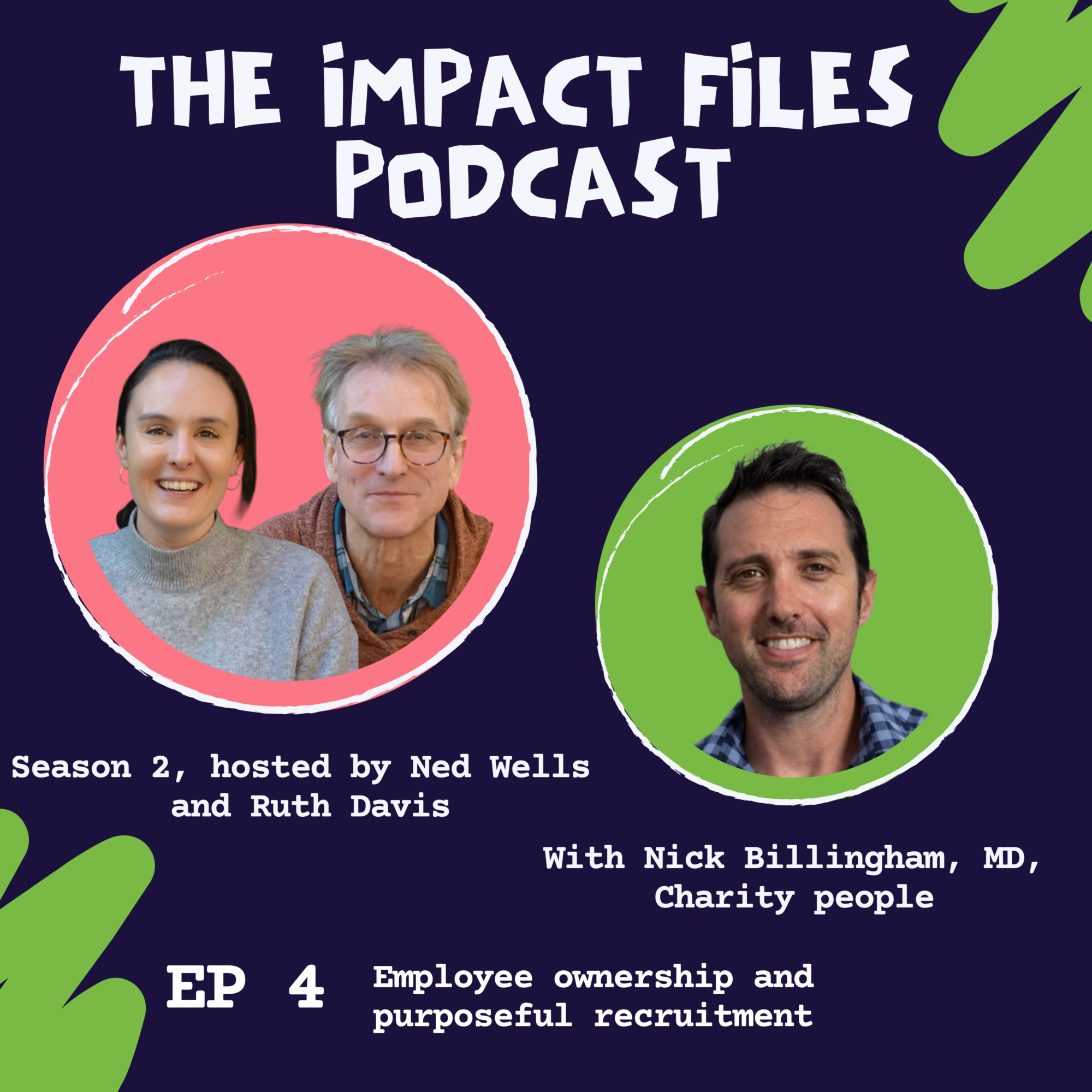
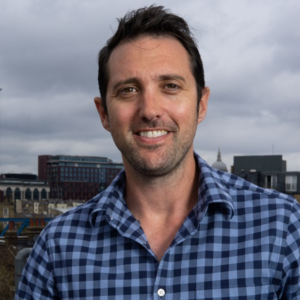
The Impact Files Podcast – Nick Billingham, Managing Director, Charity People
Ned: Welcome to another episode of The Impact Files podcast. In this episode, Ruth and I are delighted to be joined by Nick Billingham, Managing Director of Charity People. Nick, welcome to the podcast.
Nick: Hello, thanks, Ned.
Ned: So, Nick, let’s start with an introduction to yourself, your story, and to Charity People and the work that you do.
Nick: Yes, great, thank you. My name’s Nick Billingham, and I’m the Managing Director at Charity People. Charity People is a specialist recruitment organisation that serves the non-profit world. We work with a real range of organisations, from quite large ones that lots of people will have heard of – historically, places like Cancer Research UK or the University of Oxford – to much smaller organisations, some of which hardly anyone will have heard of. But the central theme is that non-profit space of the market. We’re a B Corp, and we’re wholly employee-owned, both of which I suspect we’ll talk a little bit about today.
Ned: Oh, nice one. What’s your story, Nick? How did you find your way into Charity People, and how did you start your career?
Nick: Well, funnily enough, today, the day that we’re recording this, is my 10-year anniversary at Charity People. I hadn’t realised, or I’d forgotten this morning, and a colleague of mine did a nice little post and reminded me and told the world – so that was incidental in terms of recording this.
Like many people, I fell into recruitment. I left university and didn’t really know what I was going to do. A couple of weeks before graduating, I thought, I should probably think about that, and I found myself working in a recruitment role about a week after graduating. That was in the engineering, pharmaceutical and medical device industries. I did that for coming up to two years, and I didn’t love it, I think it’s fair to say.
I went travelling with my then-girlfriend, now wife, and came back determined not to go back into recruitment. But that was 2009, and the economy wasn’t in a great place at that point, so I ended up in a recruitment role. The key change at that point was that I fell into charity recruitment, and didn’t really look back. I loved it. It was a complete contrast to what I’d done before, in that people weren’t desperate to hang up on me and avoid me at all costs, which seemed to be the case in the previous company I worked for. It was quite consultative, and that really suited how I wanted to work.
So I was there for seven or eight years, did a short stint working within a charity, went back to recruitment fairly quickly with my tail between my legs, and then joined Charity People shortly after that. So roll on 10 years – I’ve had a few different roles here, and five years ago I took over the day-to-day running of the organisation, after the retirement of our last managing director.
Ned: You’ve mentioned some fantastic brand names that you work with, but give our listeners a sense of the scale of Charity People – numbers of staff, or whatever metrics you’re happy to share.
Nick: Sure. We’re about 25 people. We have, right now, probably between 30 and 40 temporary workers working across the charity sector as well, which does inflate the employee total officially, but it’s 25 or so. That’s split into three different divisions: our core London team, which serves organisations in London and the South East; a regional team, focused on place-based recruitment in different geographies; and our board and leadership team, who work on chief exec and trustee roles within the sector.
Ruth: Thanks, Nick, for that really interesting overview. You mentioned that you’re a B Corp, and within the B Corp framework, you would be termed as having a minor environmental footprint. So it’d be really interesting to hear a bit more about what impact means to Charity People – in terms of being employee-owned and looking after your staff, but also some of the external impacts that you have, because I know a big part of your mission is helping the sector that you work in.
Nick: We talk a lot internally, and to some extent externally, about being impact-led recruiters. What we mean by that at Charity People is trying to be far removed from the stereotypical view of what recruiters are – the quick win, make a quick buck, get out of there and find someone else to do the same. We don’t want to do that. What we really want to do is find people who make a massive difference to the organisations that they work within.
When we think about our impact, there are three central bits. There’s internal impact, for which we’re thinking about our staff – how we support people within Charity People, things like wellbeing, flexible working, all of that stuff that impacts on the life of someone who works for Charity People.
Then we think about external impact as a separate pillar. It does sound quite trite, but what we try to recognise is that someone changing job is a massive part of their life, so we have a really key part to play in that, and it’s really important that we get it right. It’s quite a big responsibility – to organisations, but also to individuals, who are going through quite a big transition point in their life when they’re engaging with us. That also includes things like volunteering and pro bono support that we might provide to parts of the sector.
And then latterly there’s the environmental point. It’s something that’s really important to me as a leader, that we consider that and think about it. But we’re quite fortunate in that we have quite a limited supply chain, so it’s quite easy for us to be focused on ensuring that our environmental impact is as minimal as possible – and I realise it’s much more complex in other industries and other organisations, with far greater challenges.
So when we think about impact, those are the three ways we break it down. When we went through the B Corp assessment, I think there were five different pillars that we were measured on – I can’t remember the names of them all off the top of my head – but we’ve simplified that a little when we’re talking internally about what we mean by it. And as I said at the start, it’s becoming more and more important since we became employee-owned, which was two years ago last week.
Ruth: You’ve been at Charity People for 10 years now. Has it always been like that? In terms of your mission of helping the sector, it’s probably always been there, but those internal bits – is that something you’ve seen from the very beginning, or did something happen that made it more of a core focus?
Nick: To a point, I definitely think it has been woven into the fabric of Charity People. I joined an organisation that was quite mindful of its impact. They used to use a term which I really disliked, but which did encapsulate the thinking: “changing the world one hire at a time”. It was just too glib for me to get behind, but that strapline was in place when I joined. So I suppose that suggests it was always important, for the 25 years or so before I joined – Charity People was set up in 1990. But what’s really accelerated it for us is the move to employee ownership.
To expand on that, we were founded in 1990 by David Lale, and he wanted to exit the business. So in 2021 or 2022, he and I started talking about what that exit might mean, and what the options might be if he were to leave Charity People. He’d already been quite removed from the day-to-day running of it, and had given me quite a lot of responsibility to manage the day-to-day operations of the business. So I think he was starting to feel it would make sense for him to exit and move on.
That was when we started exploring what our options were. Are there merger options? Is there a management buyout option? The one that felt most suited to us and our environment was for the shares of Charity People to be bought by an employee ownership trust, and that’s now the ownership model – the governance model of our business.
Essentially, that trust exists purely to distribute the profits, if there are surplus profits, to the beneficiaries. The beneficiaries are the staff – the current staff, and all future employees of Charity People. So what we’ve got now is a model where everyone has a part to play. Every decision, every action has a part to play in determining the success, and subsequently the impact, of the business on our external environment. I think that’s what really accelerated why it’s become more of a topical discussion point internally over the last couple of years.
Ruth: It sounds great. I’m especially interested in EOTs, and I know it’s quite a complex process to go through. It sounds great on paper and in theory, so why isn’t every organisation employee-owned? Maybe you could shed some light on what you found were some of the big challenges, or why many other organisations struggle to take this route?
Nick: I love the concept. I think it’s brilliant, and I really do think that for a lot of businesses, it’s the future. There should be a lot of organisations considering this. I think it’s a much more equitable approach to running and owning a business, and I think younger generations than me will care more about ensuring that businesses are run in a way that feels more equitable. So in some ways, organisations should be really considering whether this could be an option for them.
However, like anything, there are obviously challenges that come with it. We’re two years in, and we were told it would probably take a couple of years before we got to grips – both as a leadership team and as a board of the trust – with what this means, what the differences are between being a privately owned business and an employee-owned business, and how that translates day-to-day. We’re still learning that. It’s hard, for all the reasons you would imagine. How do you balance the equal opportunity to have your say across the staff with the need sometimes to make quick decisions and respond to opportunity? The balance between those two things is at times really difficult, and it’s something we’re learning as we go.
The second thing organisations considering it should think about is that, at the moment, access to funding is a little more difficult as an employee-owned business. Because it’s quite a new concept, a lot of lenders are quite hesitant to explore funding opportunities with you, and that in itself has created quite a technical challenge for us in terms of access to capital.
Ruth: That’s really interesting. As a segue, because an EOT means your employees are really bought into your business, how do you make sure the Charity People team is brought in when it comes to initiatives – B Corp, any other partnerships you have, both with clients and internal initiatives?
Nick: That’s a good question. I recognise I’m completely biased when I say this, but my view as a leader of a business is that recruiting the right people is the most important thing that you do. I’ve learnt that over the last few years, really, and it strengthens the need to work with a recruitment partner, if you’re going to go down that road, who really understands you as an organisation and wants to get under the skin of the types of people who are going to thrive in your environment, and how to find those people to ensure that you fulfil your mission.
So, to answer your question, a key part of that is ensuring that we’re hiring people who actually share the values of what the organisation has been set up to achieve. If you can get that bit right, you’re halfway there to ensuring that they’re actually going to buy into whatever it is we’re focused on – whether that’s B Corp, a partnership proposition across the sector, a free mentoring programme, or any other bits of work we’ve undertaken over the last couple of years. If we’ve hired the right people, that makes a huge change.
Ned: It’s so interesting that we’re talking about this today, Nick, because I read an article earlier today by Tom Greenwood, the founder of Wholegrain Digital – I’ll include a link to it in the show notes. His article is about whether or not people really want workplace democracy, and I guess that’s connected with what you’re talking about. His view is that some people really want it, enjoy it, suit it, understand it. Others, if you’re introducing it to an existing business, just want to turn up at work, do their job and leave, and not necessarily be involved in decisions in the business.
The other point he made, which was interesting – and he was talking about workplace democracy, which isn’t necessarily the same at all – is that it can introduce a vacuum, like a political system, where the people who want to be making decisions are, but they’re not necessarily the right ones. So it’s very interesting. What you’ve said is that it’s not simple, but clearly you’ve found that so far it’s been really worth it.
Nick: I would agree with the concept you’ve introduced there, and that has been our experience. Regardless of whether an employee stands to benefit from the success of the business or not, some people really want to contribute to decision-making, and some people don’t. They want to focus on what they’ve been hired to do, and that’s okay.
We still have a management team with responsibility for running the business. We also have what we call internally employee engagement forums, which are opportunities once a quarter to come together as a staff team and talk about some of the issues or challenges, and some of the decisions that might have been made, and have an opportunity to voice those and share those. But I think it’s absolutely right that you shouldn’t assume every single employee is desperate to have a say.
One by-product of this move is that we do a lot of internal surveys. It does almost feel like death by SurveyMonkey at times, but we’d prefer to ask and have people not contribute than not ask and assume. That’s probably been quite a big learning over the last couple of years as well.
Ned: That’s so interesting.
Ruth: Sorry, I feel like we could talk about employee ownership for so long, but I’d also love to ask you about the flip side. You’re balancing purpose and profit, and a lot of your internal work fits into the purpose. In terms of the profit side and the work you do with your clients, I know you do a lot to help the sector hire more inclusively. When we talk about sustainability, a lot of people immediately think environment, but that inclusivity, accessibility and diversity side is also really important – it’s becoming even more important in the B Corp framework. I’d be really interested to hear how you challenge your clients in those ways. If they come to the table with a job description, I know your consultants must do a lot of consultative work – how the job description is written, non-biased hiring, anonymous job applications. How do you challenge your clients, while also understanding that they’re your clients and they’re paying you to do a service?
Nick: Definitely. You’re right that when we think about sustainability, it’s not just the environment. For us, the sustainability of the sector we serve is really, really important, and day-to-day, I think that feeds a lot of our work on EDI – ensuring that the sector we work in, and the clients we work with within it, are representative of the communities they serve. I think it’s critically important that non-profit organisations take that really seriously and avoid hiring the same types of people for the same types of roles. So it’s a really big component of the work that we do.
But there’s also something to give a nod to, in that the charity and non-profit sector in the UK is under a huge amount of pressure in terms of funding. It’s incredibly difficult to fundraise from the public, and incredibly difficult to generate income from historical sources like trusts and statutory funders. At the same time, demand is increasing in many different areas of the non-profit world.
So, coming to how we challenge clients – we do challenge them. We want to question: are you hiring for culture fit or culture add? Are you aware of how representative your staff population is compared with the communities you’re serving? Are you measuring that? But the move to make hiring more equitable and staff teams more diverse is a long-term investment, and we’re also mindful of the acute challenges non-profit organisations are facing at the moment. Sometimes you have long-term goals and short-term need, and we often need to find a way of bridging the gap between those two things.
EDI – equity, diversity and inclusion – is something we talk an awful lot about, and something we really care about. Regardless of the noise that’s been coming from the US over the last few months, we’re seeing that individuals still care quite a lot about it. As employees, people still want to know: is the organisation I work for inclusive and still invested in the need for diverse teams and inclusive work environments? It’s a really big topic, and I wouldn’t claim in any way that we have all the answers. But we’ve made a lot of progress in ensuring our service is fit for purpose, to work with organisations to fulfil that need, whatever it might be – and that will change depending on where different people are on their own EDI journey.
Ned: One of the themes really coming out of this for me, from a communications point of view, is the bravery of people and organisations being able to say, as you just have, that we don’t claim to be the experts. We’re on a journey. We’ve made a start. We’re not perfect, we know where we’d like to get to, we’re en route, learning from our mistakes. That’s a much more interesting, much more honest, and actually much more helpful approach than claiming to be somewhere you’re not, and potentially falling foul of that.
Nick: Yes, definitely. As an organisation, we’re a service provider, but looking at us internally, as an employer, there are things we’ve got wrong. It’s not been one straight line of progress, certainly since I took on this role and since we started investing in our EDI work and talking a lot about being an inclusive employer and building a diverse team. There are absolutely mistakes that we could share and talk about, and I think that’s okay.
This is a topic that people are sometimes a little scared to talk about, for fear of saying the wrong thing, or getting it wrong, or being seen to do the wrong thing. But as long as you’re taking a learning mindset – we’re going to try to keep improving, we are going to make mistakes along the way, and we’re going to reflect on those mistakes and try to do better next time – then I think that’s all you can ask for. If more organisations did that, I think progress would be quicker.
Ned: That’s a fantastic segue, because on our list of things to talk about today, we were going to go into the processes you’ve put in place to support your need to be purposeful and profitable. We’ve covered a lot of those, so are you all right if we move on to some of the successes, some of the things that haven’t gone so well, what you’ve learned from them and how you’ve overcome them?
Nick: Yes, definitely. Where would you like to start?
Ruth: Success is a nice place to start.
Nick: In terms of measuring our impact, we have a yearly impact report, which we release both internally – for people to look at and think, crikey, we’ve done a lot, we’ve made some progress in certain areas – and for our client base, to see how we’re progressing and what we’ve been focused on. We completed last year’s impact report just a couple of weeks ago, and some of the key bits that jump out for me: 100% of staff have trust in the leadership of Charity People. That’s something I’m really proud of, and I think it’s testament to the way we’ve tried to ensure that we’re working on the right things, being accountable, but also empowering all of our staff to feed into how the business is run. That trust piece is really, really important.
Ned: Can I just jump in there? I hope this is okay as a question – do you remember what that trust percentage was last year? I’m wondering whether it’s a huge leap up from something very low, or incremental on the year before.
Nick: I don’t know the specific number, but I know, A, it wasn’t 100%, and B, I don’t think it would have been really low, because we’ve always tended to score quite highly on these internal measures. But it’s certainly never been 100% before.
Ned: And 100% is a real thing to celebrate. Fantastic.
Nick: Yes, absolutely – I’m particularly pleased and proud of that. And 95% of our clients would recommend us. It was 96% the year before, but to stay consistently at 95% plus over the last couple of years, I’m absolutely delighted with. And it’s okay that there are a few in there who wouldn’t necessarily recommend us, because that gives us an opportunity to learn and do better. Sometimes you do end up working with an organisation where there just isn’t alignment between how we want to impact and work, and what they want from a partner. So I don’t think that number would ever necessarily be 100%, and I’m okay with that. But that’s another factor to really celebrate.
But I shouldn’t gloss over the fact that there have been some real challenges over the last few years. I took over the running of Charity People in March 2020. We had planned a nice, long, six-month handover with the previous MD, and obviously Covid happened. One of the first things I had to do was furlough him, and I was on my own. So that was a challenge.
Since then, we’ve had an incredibly busy, buoyant recruitment market. Then last year, with the 2024 Budget, we saw a real slowdown – a huge slowdown in market conditions and need within our space. That created a really acute challenge, and we were pretty close to running out of money. That’s not something many organisations would want to shout about, but it was a reflection of the fact that we’d been through this corporate transaction the year before. Following on from that, we budgeted on the assumption that market conditions would remain at a certain level, and when they changed pretty drastically – a big change in demand for a short period – it was really challenging for the business.
And the additional context, as I mentioned earlier, is that if your governance model is one that lenders are quite fearful of, because they don’t really understand or know much about it, that was incredibly challenging and difficult. This time last year, we were talking internally a lot about how to get all our costs down, and that was a really tricky few months. I’m really pleased to be able to look back on it and think, yes, we navigated that, and I think we did an okay job, all things considered. But the fact that we were in that place at that point was obviously not great, and there are learnings to take from why that was, if I were ever working for an organisation going through a corporate transaction.
Ned: That’s a really scary place to find yourself. Are there some key things you did to move forward out of that very challenging position that you feel able to share?
Nick: I remember grappling with the balance between how transparent you should be about some of those challenges with the staff team, versus protecting them from the stress of what that means. If you’re an employee-owned business, you’ve got to take the rough with the smooth, and if the rough is a really challenging position like that, that does come with the territory of that model.
Looking back now, I think we probably did better for being incredibly open and transparent with everyone: this is the financial position, this is what we need. And we saw a lot of people – I think everyone, actually – really pull together and focus on their part of the business to ensure that we rode out that challenge. In some ways, those really difficult moments are quite unifying. The vast majority of people who went through what I sometimes call that “winter of discontent” period are still with us, and I think we’re probably better for it as a group and as a team. Reflecting back on it, the learning of being incredibly open probably served us quite well.
Ruth: Closely linked to that, I heard a quote recently that I really loved: when times get tough, the values are tested. If you had one piece of advice for any business on this journey that finds itself in a less than ideal financial situation – it can be so easy for the values to be the first thing to go, because you really just have to stabilise the business – what one tip would you have to keep those values and your integrity in place?
Nick: That’s a great question. I could completely empathise with someone being in that position, and it’s taken me a few years to learn that it’s very easy to look at a spreadsheet and make decisions, but life doesn’t play out on spreadsheets. The successes or failures of a business are not defined by what happens on that spreadsheet. So I think you do need to have a lot of faith in the value set of the organisation, and draw upon that.
Whether that answers your question or not, I don’t know. I would completely get it that if you’re running a business and you’re in a really difficult financial position, it can be really hard to keep those values in mind. But I do think in the long run, if you can do that, you’ll be an awful lot better for it.
Ned: So interesting, Nick. Thank you – some really powerful reflections there. I wanted to move on to look at communications, media and marketing. We’ve talked a little about communications and the importance of it, but in a business where purpose is clearly really important to you, we’re also in a capitalist, commercial world, whether we like it or not, and those two things need to be balanced. Clearly you’ve got a lot of communications happening internally, but externally, how are you seeing marketing as a tool to help you balance purpose and profit?
Nick: Sometimes to my detriment, I love marketing and comms – detrimental in the sense that I’m probably always keen to try something new and then move on to the next thing, and that’s not necessarily always the best approach. So we try lots of different strategies that fit our overarching marketing plan.
I think authenticity is just so important here. If you’re thinking about how you communicate your impact and your purpose, it has to come from a really authentic place. All of my experience, and everything I’ve talked about, comes from the context of being an employee-owned business, so it’s quite simple and straightforward for us to talk about purpose and impact as a result, because the success of what we do or don’t do is shared. It’s not one or a couple of people’s game.
So maybe that’s something for organisations to think about. If you’re working on your marketing plan and want to communicate how purposeful and impact-driven you are, are you also looking at the governance and structure of your organisation? I feel quite fortunate that everything we communicate is authentic. It comes from a place of wanting to serve the sector in order to see the sector do better, which in turn feeds a successful business, which in turn is shared among the people I work with day to day. That authenticity is a really important part of it.
And again, a bit like the environmental element, I realise I’m quite fortunate in that it’s quite simple and straightforward for us as a smallish business, with an employee-owned structure, serving a sector that is undoubtedly doing amazing things. There’s a lot to draw upon that feeds that impact.
Ned: I think you’re being very British about that. You’re saying it’s very simple for us, but actually, yes, it is simple, but it’s simple because you’ve set up some very careful structures, and you’ve been very thoughtful about who you are, why you are and what you do. So I really like what you said, but let’s not underestimate the planning and thinking that had to go into the fact that it is now, to a degree, simple.
Nick: Yes.
Ned: Over to you, Ruth.
Ruth: I’m biased, because we’ve worked with Charity People for years, and I think you’re an amazing business. So I just wanted to say thank you, Nick, for being so transparent. I think you embody Charity People’s value of transparency amazingly, and it’s so important in communications, but also in being an impact-led business. You’ve done so much over the past few years – your employee ownership, your B Corp, growing the business. So, quickly, do you have any plans for the next 12 months? Where do you see Charity People going next?
Nick: In the short term, we have our first Employee Ownership Day, which is happening in March. It’s an opportunity for all our staff team to come together and talk about the medium- to long-term vision for where we take this business as a group. At the moment, we’re in an 18-month strategic plan which is quite dull – it’s around consolidation and stabilising after the financial difficulties I mentioned from about a year ago. But as we work through that and come out the other side, there’s an opportunity for us to think about our trajectory and what part we have to play. I suppose that’s very much sitting on the fence in response to your question.
But in the shorter term, one of the things I’m excited to see us do more of: we’ve just partnered with Oxford HR on a research project looking to assess EDI within the non-profit sector in the UK and Europe. I hope that’s the first of more work from us – both thought leadership and analysis that can support the sector to do things better and see improvement. I could foresee us playing a bigger role in some of those conversations over the next couple of years.
Ruth: That’s really exciting. We’ll definitely pop the link to the research up – I think it will be out by the time we launch this episode, so I’m sure people will be interested to see it.
Nick: Yes, great.
Ned: Fantastic. Nick, as we wrap up this episode, which has been really fascinating, where do you hope your sector will be in 10 years’ time? By sector, I mean recruitment for the charity and not-for-profit sector.
Nick: Most weeks, I’m thinking about AI and what the impact is for our sector in the context of that changeable landscape. But regardless of the progress AI makes or doesn’t make, human interaction will still be a really important component of recruitment. As I touched on earlier, recruitment is just so important for any leader – you have to get it right. That’s where my confidence comes from that humans will continue to be heavily involved in ensuring recruitment is done well, and that the right matches are made between organisation and individual.
I hope we continue to see progress in the expectations placed on recruiters, and the role they have for organisations in delivering key hires. In our sector, we’ve seen a lot of progress on that front in the last five or six years. It’s no longer just “chuck some CVs our way and we’ll pay you a fee if one of them happens to land”. It’s becoming much more consultative, with much more involvement in understanding an organisation’s need, and going out and identifying and engaging with talent that fulfils that need. I think that will just continue to happen, and I’m here for it. I think that’s the right trajectory for recruitment in general.
Ned: And I imagine there’s a whole other podcast episode that could be done on the issues of AI and bias in recruiting.
Nick: How long have we got? We’ll do that next time.
Ned: We’ll do that next time, exactly. Okay – one piece of advice for businesses pursuing a purpose-led approach, twinned with those financial objectives?
Nick: As we touched on earlier, if you’re genuinely seeking to run a purpose-led organisation, and that’s what you’re going to communicate, I think it’s really important that you have strongly considered your ownership and how your governance will impact on that. Even if going down the employee-owned route isn’t deemed to be the right solution – and it absolutely won’t be right for every organisation – I think it’s really important, for that authenticity piece, that you’ve considered: is our current structure fit for purpose, if this is the route we’re going down? So my main piece of advice is really to start from that perspective.
And B Corp, which we haven’t talked about quite as much – if you go through and achieve B Corp accreditation, you are literally changing the terms on which the company is founded. You are legally stating that you will consider people and planet as well as profit, and I think that’s a really important part of the process that is perhaps often overlooked once you’ve got your badge and you’re a certified B Corp. That’s what I love about the B Corp movement: you’re seeing organisations that have committed to altering their governance to ensure they’re not solely focused on profit. So that would be my starting point, and that’s probably my main piece of advice.
Ned: I think that has been such an interesting episode, Nick. I’ve learned a lot more than I was expecting about employee ownership, and the significance, importance, value and relevance of it. So thank you so much. How can people find out more about you?
Nick: Charity People is simply charitypeople.co.uk. If people want to connect with me, LinkedIn is the main medium to do that, and I’m sure you can get my profile into the notes. But Charity People and Nick Billingham – you can’t go too wrong with that.
Ned: We’ll make sure everything is there in the show notes. Nick, that’s fantastic. Thank you so much. Really lovely to talk to you.
Nick: Likewise. All right, thanks, Ned. Thanks, Ruth.