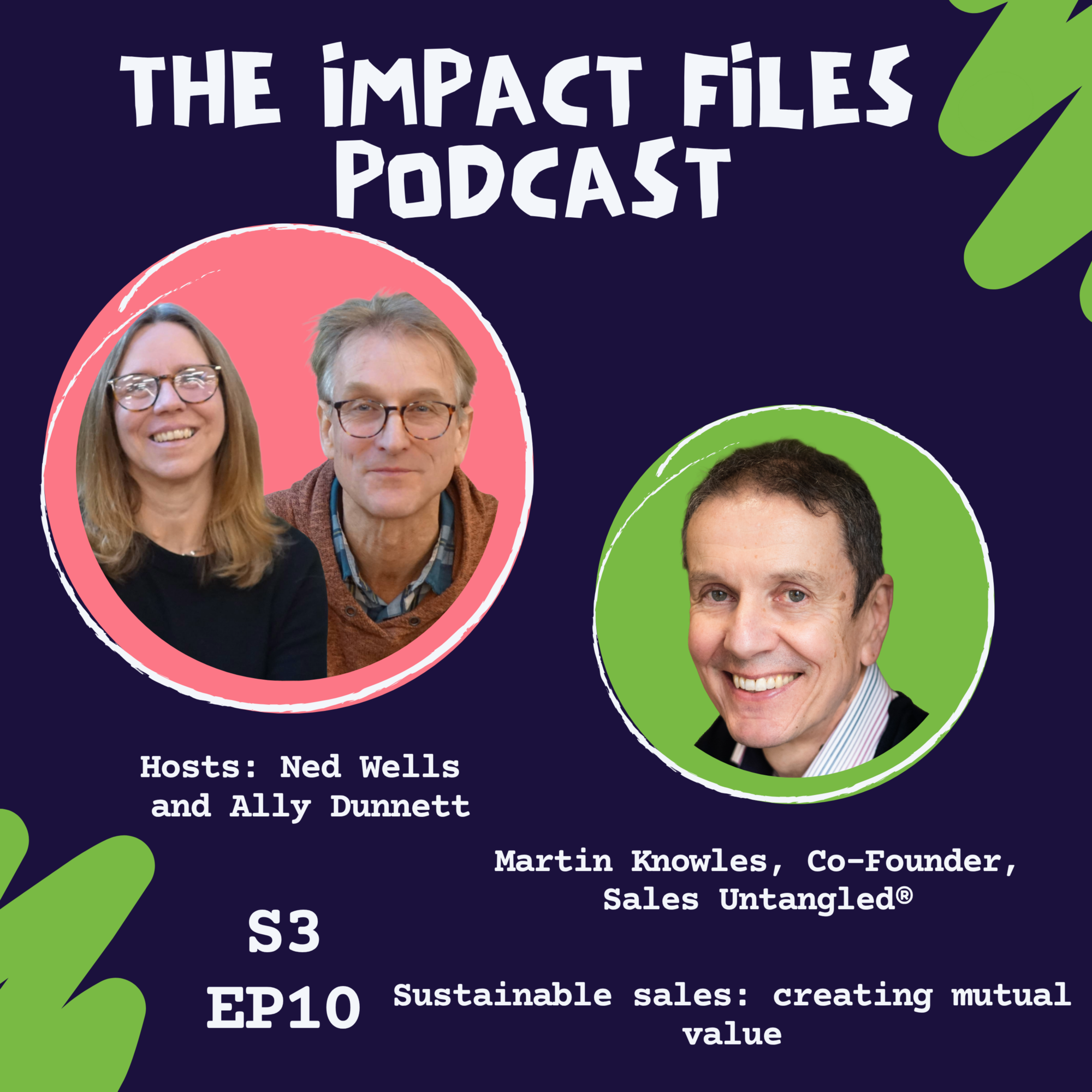
The Impact Files Podcast – Martin Knowles, Co-founder, Sales Untangled
Ned Wells: Welcome to The Impact Files podcast. This week, Ally and I are joined by Martin Knowles, co-founder at Sales Untangled. Martin, welcome to the podcast.
Martin Knowles: Thank you very much. Very nice to be here.
Ally Dunnett: Hi Martin, really good to meet you.
Martin Knowles: Hello.
Ned Wells: So, Martin, let’s start, if we can, with an introduction to yourself, to Sales Untangled and the work that you do.
Martin Knowles: Okay, great. Sales Untangled is a business founded and run by my wife and myself, and we are a sales consultancy. What we do is a mix of training, consulting and coaching. Really, the sweet spot is helping businesses scale up by professionalising – building some structure and some process into the way that they manage the sales side of their business.
Ned Wells: And what sort of clients do you work for?
Martin Knowles: It is a really wide mix. I probably ought to answer that I’ve got this really tight niche, but it’s wider, partly because a lot of what we’ve got is through introductions and referrals, and people we’ve met who have moved to other places.
Typically, I would say most of our clients are organisations that probably haven’t got to the scale where they’ve got a really professional sales director in situ. So there’s a gap there, where the owners or the directors know that sales is important, but maybe don’t have the experience themselves of personally having run the sales side of an organisation. And it leaves this gap around sales coaching, sales training, and sometimes even the basics, like writing a job description, interviewing people, and knowing how to recruit the right salespeople.
So it’s everything from that right up to having a sales strategy, or a customer strategy, that brings together your whole organisation. It’s not just a sales team. It’s about everybody being part of that customer experience. So it’s that whole thing for us. We help organisations develop whatever aspect of it they need – developing those sorts of skills and capabilities.
Ned Wells: So does that mean you work with organisations of all sizes, from start-ups to scale-ups? Because I think when we’ve talked in the past, you’ve mentioned some quite substantial organisations that you’re working with.
Martin Knowles: We have got some big organisations we work with, though often they have started as small businesses, or we’ve got in through a small team or a local team. So I would say the organisations we start working with are probably at the smaller end – small to medium – but they sometimes do then get bigger as we grow with them, which is always nice.
Ned Wells: Hmm. So what’s your background, then? Where did you start, and how did you find yourself where you are now?
Martin Knowles: Well, if you wind right back to everybody’s first job, when you’re leaving school, I worked quite hard to avoid sales jobs. And I think it’s a thread that runs right through to where we are today, and the challenges we see for lots of business owners and senior people in business. There’s this uncomfortable aspect about selling for lots of people. That was all I’d experienced before I started work: the discomfort caused for my parents when somebody knocked on the door, or when they thought somebody was coming back to try and take an order for something they maybe couldn’t afford or didn’t want.
So I worked quite hard to avoid sales jobs, and joined a brewery in my first job, which is very appropriate for a 20-year-old. I joined as what I thought was a management trainee. Then they announced, “You know you’ve got to do a sales job before you can get anywhere near management.” And hence I ended up in sales, and figured out, eventually, that I did really well at it. Maybe it came as a surprise to them. It certainly came as a surprise to me. But it went really well, and from there I’ve spent most of my career in sales jobs of one type or another.
Ned Wells: Fantastic. Martin, that’s great. I’d like to hand over to Ally now.
Ally Dunnett: Thanks, Ned. Following on from the introduction you’ve given us, Martin, about how you got into sales and your evolution there, I’d like to probe what you think of when you think of sustainable sales, and what that means in the sales environment. And then, once we’ve talked through a little of what sustainable sales may mean, perhaps you could tell us about the business case for sustainability in sales, as you see it.
Martin Knowles: Sure. It’s quite a challenging question, and we’ve unpicked different layers of it at different times. If you were really purist about sustainability, you might get into the whole discussion about whether it’s even right to sell stuff when the world is full of stuff, and people have got more stuff than is probably good for the planet. Is it right to be selling and marketing even more of that stuff? You can go down a rabbit hole with that. It’s not a discussion I would take people through, or even try to win, but it does come up from time to time.
For us, we keep it more pragmatic and more real. How do you sell in a way that gives you relationships that are sustainable? How do you do business in a way that means your clients don’t just buy from you once, think, “Well, maybe I would, maybe I wouldn’t,” and then don’t come back to you? How do you build sustainable relationships with your clients, and deal with them in a way that means they want to deal with you on a repeat basis, come back to you, and indeed refer you to other people, which is always lovely?
And from a people point of view, how do you build relationships with your internal teams? How do you build relationships with your supply chain? So it’s the people you’re working with holistically, right around you as a business – 360 degrees. How are you building those sustainable relationships? For me, it’s probably more about that than the ethics of whether we should just stop selling stuff altogether, which I think is a more difficult argument to get into.
Ally Dunnett: I think that’s really interesting – the focus on the people. It seems to come back to that initial point you made about discovering, sort of accidentally, that you’re good at sales. You’re good at sales because you enjoy listening to the customer, building the relationships and solving their problems, I guess. It comes back to that people-centred approach.
That’s great, thank you. And in terms of your own organisation, Sales Untangled, how do you rate yourselves in terms of sustainability? What are your credentials, Martin? Tell us a little about that.
Martin Knowles: I suppose there are two different answers, really. One is that we always measure the proportion of our business that comes from repeat clients. We set ourselves a target of 80%, in recognition that sometimes you do a piece of work that’s a one-off, and you know it’s a one-off. You maybe deliberately take on a piece of business that’s a one-off. So I don’t think 100% is realistic. I think it becomes self-defeating, almost. But we do measure every year what proportion of our business has come from repeat clients – somebody who’s bought from us before – and that’s usually running in the high 90s for us, which is great, and something we’re really proud of. So that’s how we treat sustainability in terms of relationships.
And then, in terms of the more traditional discussion of sustainability, we are a B Corp. We’ve been a B Corp since 2020, so it’s over six years now. We recertified the first time in 2023, and we’re now coming up to recertification for the second time, on the new standards. That really is the whole framework that we operate in, in terms of running a sustainable business. The B Corp framework is what we work to – everything from the community stuff and the supply chain stuff we’ve just spoken about, right through, of course, to the emissions piece, and how we manage all that side of things.
Ally Dunnett: That’s interesting. Ned, do come in.
Ned Wells: I’ve met you several times through the B Corp community, Martin. I know you’re very active, and that you run various events locally. I guess my question is: are there instances where you’ve had to say no to potential opportunities, or perhaps even potential clients, because of the B Corp framework that you work to?
Martin Knowles: I don’t think it’s quite as black and white as saying no to things, but I think it probably becomes self-fulfilling. We’ve worked with a number of B Corp clients who I’m sure we wouldn’t have worked with if we weren’t a B Corp ourselves. The connections have come through the B Corp community. And I think people have probably found us, and maybe filtered us in ahead of other organisations with a similar offering, because of that. So we tend to attract, disproportionately, people who have a similar approach and a similar mindset.
We have documented whether there are sectors we wouldn’t work in. But we’ve never really had to have a conversation about whether we should work with a particular business or not. We don’t get approached by the typical industries that come up in those conversations, like tobacco, or armaments, or big gas, or whatever it might be. We don’t really come across clients of that nature. So it’s very rare that we say no. I’d say it’s more of a nudge than a no, probably.
Ally Dunnett: Following on from that, I was curious about when prospective clients come to you and they’re not part of the B Corp sphere at this stage. In terms of their own sustainability journey, they’re perhaps what we refer to as an amber-type business rather than a green one. They’re on the road. What sort of conversations do you have with them? The conversations you have are primarily about equipping them for sales, but are you also underpinning them with advice, guidance and suggestions on how they can be more sustainable?
Martin Knowles: Not overtly, unless the specific case suggests it should be. It goes back a little to your earlier question about how you navigate sustainable selling. People buy from us primarily because they want help with sales. That’s what they’re buying. And we have to be good at it to help them. We have to be able to help them fix whatever aspect of it they think they want fixing. That’s the be-all and end-all. If we couldn’t do that, they wouldn’t buy from us. It’s like people say about food: if food doesn’t taste good, you can put any credentials you like on it – it’s got to taste good.
Ned Wells: That’s great.
Martin Knowles: So the entry point is that we have to be good at sales. And, as an aside, we have never invoiced anybody a penny for sustainability work, even though we advise people, we help people and we pull communities together. We just do it because we think it’s the right way of doing business, not because we’re making money from it. So it’s not that we’re stopping anything; it’s just encouraging conversations in the way we’d like them to move.
Some clients, obviously, are more interested than others. With some, you get a sense that if you said, “Oh, and by the way, we’re a B Corp,” that’s going to really make a difference. With others, you’re just going to get a lengthy conversation about “What’s one of those, then?” And that doesn’t really add value. Of course, it’s in our materials. If we send a proposal to somebody, it will say, “By the way, we’re a B Corp, and these are our governance standards.” But I think it’s more about specific cases that are relevant to the client. It brings you back to selling what people want to buy, or what problem they’re trying to fix, or what pain points they’ve got. So if they’re interested in the sustainability piece, we can help them.
As an example, we quite often find, when we’re advising people on fixing organisational problems around sales and selling, that we’ll advise them to look at part-time roles. They don’t necessarily default to that, but part-time is a great fix for a small business in terms of giving balance to a team. It also opens doors for people who maybe need flexible working, because they’ve got other difficulties or challenges in their lives. It gives them an open door to find some work, get into work and generate income. Maybe 20 hours a week, flexibly, is more appropriate than having to do a full-time job. So that would be an example where I think we’re nudging people towards a sustainable way of working, but it’s because it works for both parties. It’s not just dropping our beliefs onto organisations, which I think could be the wrong approach.
Ally Dunnett: That makes so much sense. As you say, people are likely to be a lot more receptive if, first of all, they’ve come to you to ask for suggestions. And you don’t have to instantly think about being a B Corp, to come back to that example. You could say, “If you’re interested in this sustainability stuff, which we do, here are some baby steps.” I know when you and Ned chatted about this earlier, you mentioned the Good Business Charter, which I’m familiar with, and I thought that was interesting. It gets people into the mindset, and starts them thinking about what works for their business, without suddenly going, “Whoa, we need a 30-page sustainability policy, and we need to jump through the B Corp hoops” – the very necessary, stringent process there.
Martin Knowles: I think so. I don’t know what you two think, but I think there are examples where people have got so passionate about sustainability – and I understand the reasons why – that it’s become almost like a dogma, and it’s polarising and putting people off, rather than nudging and encouraging. It feels a bit like that to me. I don’t know if you see it the same way.
Ally Dunnett: I’ve certainly seen it, yeah. Ned, what do you think?
Ned Wells: I think so. What I think I’m spotting in you, Martin, is a very refined and sensible approach. You are delivering your professional expertise as a sales expert, sales consultant and sales director. But we all know that once you start thinking about sustainability, people can get very passionate about it, and it doesn’t take much to trigger somebody to want to talk an awful lot about sustainability. If that’s not your client’s thing, it’s just going to be annoying and potentially a waste of time. Whereas if you can subtly trigger and nudge them into that thinking, whilst principally delivering your sales expertise, that’s much more what they want, and what I think will be effective.
Martin Knowles: The easy examples are where it’s a win, aren’t they? People like to go back to, “Well, if you can save money on electricity and gas” – which is even more pertinent at the moment, again – “then you’re sustainable, and you’re saving money. Why wouldn’t you do it?” So I think it’s picking your battles, rather than telling everybody the planet’s burning and you’ve got to act right now, which, for most people, isn’t an agenda they’ll be motivated by.
Ally Dunnett: Yeah, that makes total sense. Thank you. I’ll hand back to you, Ned.
Ned Wells: I wanted to come on to the role of communications, media and marketing, and how that happens in your world, Martin – particularly, perhaps, around the negativity around sales, and pricing and so forth.
Martin Knowles: Yeah, we have nudged into that already, haven’t we, around communications? By our own internal measure, we reckon that upwards of 90% of the business owners we talk to are not trained in selling. And there’s good reason for that, because probably 90% are not trained in finance or supply chain or whatever. People have their own expertise, so there’s a high proportion of people who are not experts in it.
Unusually, most people recognise it’s really important to them. And then you’ve got this third level, which I think really only applies to sales, compared with other functions: a lot of people feel really uncomfortable. It just feels awkward. They don’t want to be seen as pushy, they don’t want to be told no – the whole interpersonal thing that people feel really uncomfortable with.
So I’m on a mission to try and tackle all of that, because that combination of not being good at it, knowing it’s important, feeling really awkward, and hoping somebody else will fix it for you holds people back. It holds businesses back, it holds back growth, and it prevents people from achieving what they really could achieve with their businesses or in their teams. So I’m really passionate about trying to help people flip their mindsets from, “I’ve got a pitch, I’ve got to pitch and get a deal,” to, “Okay, how do I help the person who’s in front of me? How do I find a way of seeking mutual value that works for both of us?” Rather than it just being me selling and you buying, which becomes a bit confrontational and unlocks all those problems people feel about selling.
Ned Wells: It’s all about the psychology, isn’t it?
Martin Knowles: It’s a big piece of it – and often the seller’s psychology more than the buyer’s. If you give the buyer what they want in some format, then they’re likely to come with you. Often it’s changing what’s in the head of the seller, rather than the buyer.
Ned Wells: And I think my question is: how do you do that? What are two or three examples of little ways that you can help a managing director or a founder who, as you say, knows that sales is really important, but isn’t very confident doing it? You need to be that supportive mentor, I guess, to help them see that they do have what it takes, and to be brave. Is that where you fit in?
Martin Knowles: I think “brave” is a really interesting word. Traditionally, if you weren’t in selling, you would think the way to achieve more by selling is by pushing harder: being a bit more aggressive, making more calls, banging the phone harder, sending out more emails, pitching – all those cold emails we all get swamped with in our inboxes. If you weren’t skilled in selling, you might think it’s more of that that’s needed, and that you’ve only got to push harder or run faster.
And actually, the being brave bit is almost about challenging that, and being able to stand back and ask, “What is it that’s going to motivate the customer to act differently?” That’s about playing to their agenda: what are their problems, and what’s going on in their world? It’s quite brave, in many ways, to ask questions of a potential client in a meeting, rather than pitching – to hold off pitching for 20 or 30 minutes, find out what they need, co-create solutions, and come back to selling that way. I think you need to be quite brave to hold your nerve and treat people that way, rather than just pitching and trying to get the deal fast, which is what most people will instinctively try to do.
Ally Dunnett: That is interesting.
Ned Wells: Indeed. I’m thinking back to the few things I’ve read and studied about selling, and how tempting it is, as the person selling the product or service, to rush towards the deal, rather than travelling at the speed the person you’re working with needs to.
Martin Knowles: It can be. And it’s probably more pronounced with founders, because you get that level of passion about the service or product they’ve created and lovingly polished, quite possibly giving up a very good salary to create it. There’s a lot of personal investment in founder businesses, especially. And it isn’t necessarily natural for people to stop early on and go out and ask people, “I’m thinking of doing this – what’s your response?” It’s more natural to polish it, and polish it, and love it, and cherish it, and then go out and try to find somebody to sell it to. By which point you’ve given up your salary, the bank’s putting pressure on you, you think you’ve got to find money, and you’ve got to find targets. It can become just a bit too pushy too soon, and that can repel people in those conversations.
Ned Wells: That can be really awful, yeah.
Martin Knowles: There’s another angle on it, and this is interesting for you as a marketer as well. I’m a big believer in targeting. Targeting at a macro level, from a marketing point of view, and being able to identify your niche – there’s a lot of value in talking to the right audience. But then there’s targeting when you’re selling. Say you walk into a networking meeting, and you think there are one or two people in the room who are potential customers, and you target them at a sales level. That changes the tone of the conversation, what you say to them, and how you walk up to them. It feels a lot more uncomfortable, doesn’t it? So targeting’s great, but targeting when you’re selling, with an individual, maybe feels a bit more awkward.
Ned Wells: Yes, I can imagine that if you march into a networking situation and introduce yourself as a sales consultant or sales director, people are going to start putting up their barriers quite quickly, I suspect. But I guess that’s where you can start to talk about the B Corp world and your sustainability interests, and start to build and develop a relationship.
Ally Dunnett: Yes, I’m just piecing together the various points that have come up in this conversation. It’s really interesting, and I’ll reflect on it some more. As you say, rather than doing the pitch, you can share those insights – they can almost be asides. It’s about building the relationship, isn’t it? You’re listening to the people talking to you, but you’re also letting them in, somewhat, to your business, to Sales Untangled, and actually to you as a person. And that’s what breaks down the barriers.
I do want to reflect more on this idea, because I have it in my head that sales is about push, and you’re saying it’s not necessarily about pull, but about waiting, or gently bringing results towards you, rather than pushing for results. A similar scenario came up when Ned and I were talking to someone for whom Ned may be able to provide a service. Ned, you said to me afterwards that you didn’t want to go into the pitch too fast – that it was very important to curb that instinct, step back and listen, which is what you did. But it sort of goes against the grain, doesn’t it? Or it’s a real skill.
Martin Knowles: It can feel quite unnatural, can’t it? If you’ve got really passionate about something you want to share with people, then human nature, for most of us, is to be quite gregarious and want to share it. And, again, to use your word, Ned, it’s a bit brave to hold back and ask, “Yes, but are they ready to listen to it?” It’s about getting the right thing at the right time, isn’t it?
Ned Wells: Ally, over to you.
Ally Dunnett: Okay, with a slight change of tack, we’d be interested to hear whether there are any particular developments coming up at Sales Untangled – any new ways of doing things, or things which feature large on your agenda over the next 12 months or so.
Martin Knowles: I don’t want this to sound like a cliché, but – surprise, surprise – AI is on our list.
Ally Dunnett: Yeah.
Martin Knowles: We’re quite cautious in adopting things that are new, and we’re big believers in figuring out why something is going to be valuable before you jump at the latest shiny thing. So I wouldn’t say we were quick adopters. But what we’ve come across with AI is that the initial adoption we’re seeing in lots of businesses is at a relatively low level: “We can get it to write some LinkedIn posts for us,” or, “We can simplify some customer research,” and that sort of stuff. There are efficiencies there, which are great if you can take them out, but I don’t think the prize in sales is in the efficiency. That’s a relatively small prize.
The prize in selling is figuring out how it drives a different competitive positioning for you, and what your competition are doing differently. I think it’s around how you engage differently with your clients, and how you free up more selling time for your best salespeople. It changes your sales process and your customer interaction, and I think we’re in the foothills of it. It’ll continue to evolve, but we’ve got involved a lot more in that, and started to help clients think more about the strategic implications of AI developments in sales and customer management – less so about the operational savings, which are effectively meat and drink.
And one of the really interesting aspects of it – this is unofficial, it’s my own perspective – is that it feels like enterprises have got the resources to drive it fast, and they’re driving real efficiency and effectiveness out of their sales teams, at a pace that smaller businesses don’t have the expertise or confidence to keep up with. We don’t really operate with enterprises, but probably at the level below. So for us, it’s a really interesting area. Can we help our clients work things out for themselves around AI, in a way that helps them keep up with the big competitors they might be up against?
Ally Dunnett: So it could be a real inflection point for businesses of that size, as you say. Interesting, thank you.
Ned Wells: And do you see AI as a threat to the sales function, in terms of eating up graduate-level or entry-level jobs at all?
Martin Knowles: At a really low level, possibly. But I would say more not, and I hope not, because I really am a believer in human connection. I don’t think people want to sell any way other than as humans, and I don’t think people want to buy any way other than as humans.
Ned Wells: Hmm.
Martin Knowles: Think of call centres, which we’ve talked about quite a bit in the UK, and how they are often entry-level jobs for people. You’re literally on the phones all day, you’re quite tightly supervised, you’re expected to make a certain number of calls, get a certain number of results and operate at a certain frequency. AI already means you don’t necessarily need somebody standing over that team, supervising them, advising and coaching them: “What do you say here? What do you say there?” You can get live prompts, for example. So the way you would train and coach people like that probably is already changing, and that completely changes the dynamics of those teams. So at that level, maybe there are some changes.
And there’s a whole different, interesting question about how people best learn. Is it through having a personal line manager as a coach, or through having an AI coach? Some early evidence is that it may be a bit of both. But if you think about bigger, more high-value customer relationships, what companies are doing is taking off some of the admin and the grunt work that those teams often have to do, and freeing them up so they spend a higher proportion of their time doing the stuff they’re passionate about: dealing with customers and closing deals. So there’s some evidence that AI is helping businesses get bigger deals faster, rather than it being about cutting jobs at the periphery, at entry level.
Ned Wells: Interesting. And that brings us on to the ending questions we like to ask all our guests. First of all, where do you hope your sector – and I’m thinking of sales consultancy – will be in 10 years’ time? I guess that ties into your point about AI and differentiating at a more strategic level.
Martin Knowles: I think so. I really hope – and so many people I speak with say this – that we don’t lose the personal side of doing business. I’m not convinced it will disappear. I think there are great efficiencies and ways of driving effectiveness out of AI, but at the same time, I’m almost expecting that the genericism it brings – just the predictability and the boringness of it – will help people value personal relationships, connection, trust and honesty, all the stuff you get from humans, more. That would be quite a nice outcome, really: yes, we can drive efficiencies and take off some of the burden of admin and the low-level stuff, but that then helps people spend more time on relationships and being human. That’s where I hope it will go. I’m not holding the reins, unfortunately, but that would be nice.
Ned Wells: I think that’s a very interesting perception, though. As you say, content, material and answers produced by AI can come out in a very generic, rather boring style. And if that encourages people to remember the uniqueness, interest, quirkiness and flawed but more interesting nature of communications from a person, that would be all to the positive.
Martin Knowles: You’d think so. And maybe, from a marketing point of view, it emphasises the importance of storytelling and connection, rather than just being able to get 100 words out of AI to post on LinkedIn.
Ned Wells: Yeah, exactly. Okay, one piece of advice for businesses pursuing sustainability and financial objectives?
Martin Knowles: If you’re pulling the two together, there is significant evidence that businesses that are committed to a clear purpose, effectively as part of their operating model – how they work – are getting better results. And that’s results across the board: financial results, and things like access to investment.
A really strong theme is that they’re attracting people differently. I was at a B Corp event just a couple of weeks ago, before the bank holiday, with a professional services business, and they were saying it’s really noticeable at interview. When they’re interviewing young 20-year-olds to join them, they’re asking about it. They really want to know about them being a B Corp. So I think there are a number of measures or metrics by which you can say that sustainability is working out for businesses, and that it is driving better financial results. It’s not just a fluffy nice-to-have.
For smaller businesses, I would just say: dip your toe in the water. Don’t overthink it. Try to do something simple. You might have a different perspective, but for me, you could start with a carbon calculation for your business, and just figure out where the big chunks of emissions are. Is it driving to clients? Is it heating your office? Whatever it might be.
Once you start to understand it, open up conversations with customers, suppliers or other people you meet. Ask, “Where does it look like the waste is? Where does it look like the opportunities are?” Because we don’t have perfect solutions, people welcome the conversation. Everybody knows it would be nice to do it, but – “Unless you can make it easy for me, I won’t.” So don’t overthink it. Start simple, but start. And then chat to the people around you about what it tells you, and what questions it provokes.
Ned Wells: And I think “waste” is a very interesting word there, because waste is something that, operationally and financially, businesses have always wanted to minimise – why wouldn’t you? But shining that spotlight of waste onto the sustainability, energy and carbon world is an interesting one. It’s almost a familiar, safe word to apply to an angle that people might not have thought about quite as much.
Martin Knowles: I think so. One of the nicest expressions I heard was from somebody who said, “It doesn’t feel right, that.” We were having a conversation, and he’d introduced himself with, “I’m not really into sustainability, it’s not my thing.” But as we chatted, he said, “Yeah, but I know there’s this big pile of waste. I’ve got this warehouse with all this stuff stocked, and it’s just taking up space, and we’re heating the warehouse. It doesn’t feel right, that.”
And once we get people to look at their industries or their operating models and say, “It’s the way we’ve always done it, but it doesn’t feel right,” and they start to have conversations with other people in the industry – “Is it immovable? Or, if it doesn’t feel right, is it something we can start to think differently about?” – then those conversations start, don’t they? We don’t know the answers, but if you’re asking the questions, then “It doesn’t feel right, does it?” is a good place to start.
Ned Wells: You’re making a really good start, yeah. Martin, that’s brilliant. Thank you so much. How can people find out more about you?
Martin Knowles: Well, not surprisingly, you would expect a sales consultancy to have a website, so people can go to salesuntangled.co.uk. Or you can look me up on LinkedIn, as Martin Knowles.
Ned Wells: That’s brilliant. Martin, thank you. That was absolutely great.
Martin Knowles: Thank you both very much.
Ally Dunnett: Thank you.