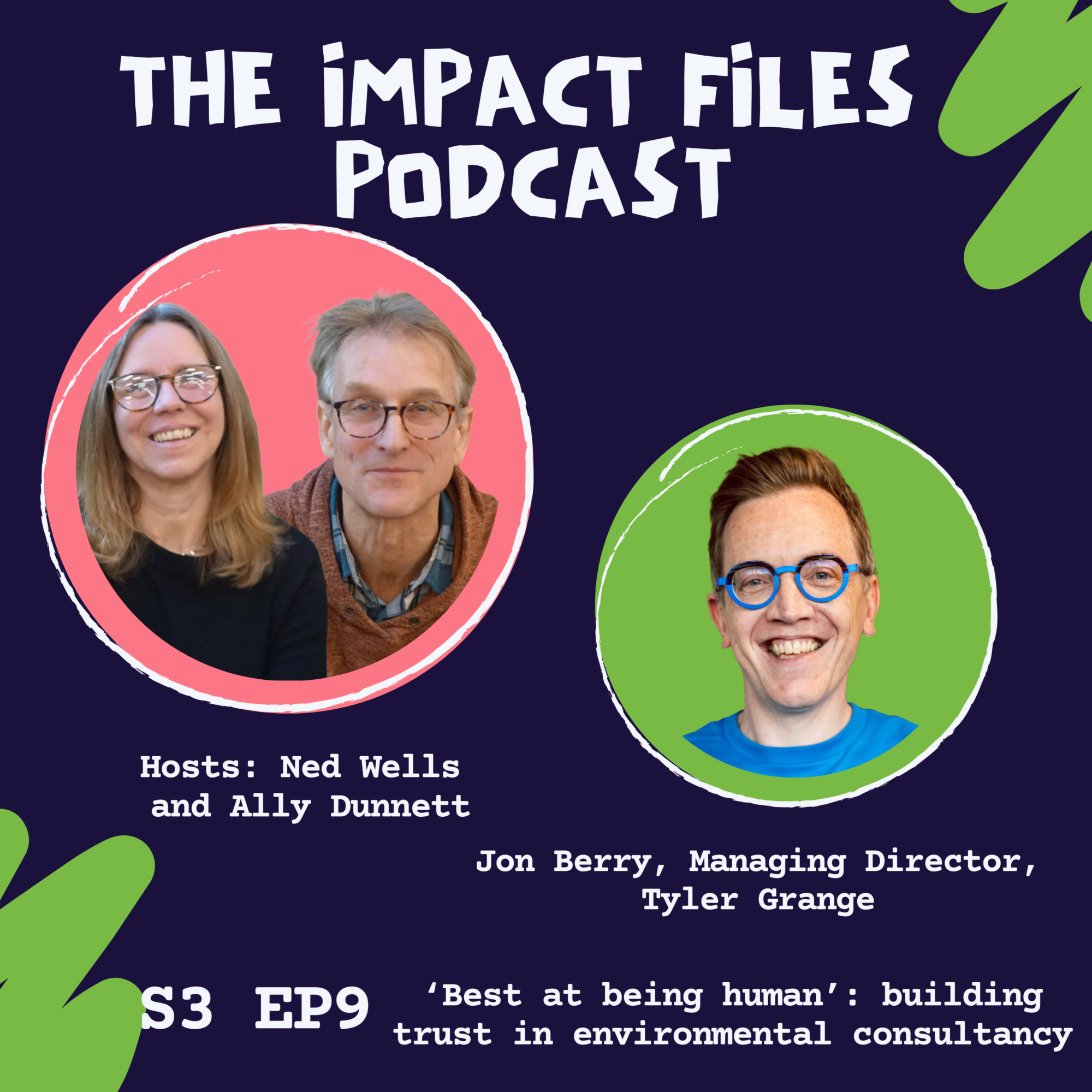
The Impact Files Podcast – Jon Berry, Managing Director, Tyler Grange
Ned Wells: Welcome to The Impact Files podcast. And this week, Ally and I are joined by Jon Berry, Managing Director at Tyler Grange. Jon, welcome to the podcast!
Jon Berry: Thanks for having me. Really looking forward to it.
Ally Dunnett: Great to have you here.
Ned Wells: Jon, let’s start with a little introduction to yourself, to Tyler Grange and the work that you do.
Jon Berry: Yeah, I’m Jon Berry, I’m Managing Director of Tyler Grange, and it’s an environmental consultancy, started 15 years ago. The focus of it is helping people through the planning system with ecology, arboriculture, landscape planning and green infrastructure.
Four of us have managed to somehow turn that consultancy into a 130-strong business, now across the UK. And it was very much founded on wanting to enjoy work again. Myself and the founders came out of a larger PLC business that had kind of lost its way. The recession had hit, and, frankly, we weren’t enjoying it. We got together and said, “You know what? Shall we found a business that means we can fall back in love with work? And can we be back central to the community around us?” Not just working in silos, but getting back really at one with our clients, our collaborators, even our competitors, and giving something back. So from day one of founding Tyler Grange, it was about creating something that feels a bit different to work in and to work for. And that’s how the business was created.
Ned Wells: And how old is the business?
Jon Berry: We’re 15 years old. We celebrated last year with a big party at the Botanical Gardens in Birmingham.
Ned Wells: Oh.
Jon Berry: A celebration of how far we’d come. It feels like the blink of an eye, but we really have evolved in 15 years, and that’s the main thing in our story, really: it’s very much about change and action. We’ve found that’s the way you can really innovate as a business. As soon as you think the business is great and performing well, it’s probably showing signs that you need to change something, from my experience.
Ned Wells: So what sort of organisations do you work for? Who are your clients?
Jon Berry: It’s really varied, actually, and it’s changed as we’ve got bigger as a business. It can be anybody that’s seeking planning permission and change, whether that’s new housing, social housing or energy infrastructure. But then also things like the leisure sector, with its growing demands – things like artificial surf reefs we’ve worked on in former industrial sites – right through to rewilding and nature restoration projects, where people are buying land for the sole purpose of improving it for nature and biodiversity. Our team will be able to give their expert advice in relation to whatever the ultimate land use is.
And the importance we’ve always put on it is that anybody can perhaps do surveys, but we want to add that experience. You want to build a rapport with your client, you want to give them the best advice, and work with consultees and local authorities in a really enjoyable way. And that can sometimes mean telling clients that they haven’t got the right site, or they haven’t got the right proposal in mind.
Ned Wells: I’m intrigued by that, Jon, because the things you’re saying aren’t unusual. They’re kind of common sense. But you’ve grown in 15 years to 130 staff. That’s amazing. And I’m wondering, if you stand back and reflect, how did that happen? There are lots of other business leaders who’ve been running lovely organisations for 15 years and tried to do things the right way, but they haven’t grown anything like that. What’s the secret sauce, Jon?
Jon Berry: I sometimes wake up asking the same question: how did we get to 130 people? We had our quarterly team day in Birmingham yesterday, actually, and it’s always a great moment for me to step back and think, “Wow, we’ve created a really great culture.” In all honesty, that’s what helped us grow. We’ve always had quite a flat structure. For us, whoever’s speaking in the room, whether they be a graduate or one of the founders, has probably got an important point to make, so listen to them. It’s quite a lateral leadership, so you support and get influence from everybody around you.
When we started, I remember there’s a great book called The Second Mountain by David Brooks, and there’s a quote in that book: never underestimate the power of the environment you work in to gradually transform who you are. And that really stuck with me when we created Tyler Grange. We’ve got a real responsibility to create an environment where people can thrive.
So we created values, we created the ability to let people be their authentic selves within the business, and to trust them. And that meant that people started to join us, sometimes in regions where we hadn’t got an office at the time, and we were like, “Well, they’re good, there’s a really great character fit, let’s just give them an opportunity.” That freedom and trust really helped us grow, and is still at the core of the business today. It’s harder at times to manage as a bigger organisation, but we’ve put some things in place that really help us to maintain that culture as we grow.
Ned Wells: How interesting. I’d love to dig down a little bit more into your personal story. You mentioned that you were working for a larger PLC that had perhaps lost its soul a bit. But rewind a bit further. How did you start? Did you go to university? What happened?
Jon Berry: I was lucky, actually. I thoroughly enjoyed my time at school. I was born in the Midlands, and at my secondary school I had an incredibly passionate, enthusiastic geography teacher, but I also really enjoyed the creativity of our art lessons. Putting those together – I went to school in the days when you went to see the careers officer, they got a book out, went along the top and up from the bottom, and it came up with two options: “Do you want to be a landscape architect, or do you want to be a veterinary surgeon?”
Ned Wells: Okay.
Jon Berry: I’d never heard of landscape architecture, but when I started to look, something about this interaction between humans and the environment, and how we’ve always had an interest in shaping it, really captured me. And it was that passion from my geography teacher, who was the sort of teacher that got the whole class in the minibus to go and look at a geological feature in the countryside. That sparked a sort of interest in it.
That took me to landscape architecture, and I ended up studying for four years in Cheltenham. Again, I was really lucky. That was a time when universities were so interactive. We had a studio space for the four full years of my degree and postgraduate diploma, and it was all about interaction and learning. Lots of other disciplines came into our course. We had artists, we had performing and theatre experts, we had planners, we had arborists.
Ned Wells: Mmm.
Jon Berry: A really all-encompassing course, which set me up for a career in it.
I finished university in 1998 and started to look for a job, and I think that was the point when I realised I probably needed to stand out. I always knew I wasn’t academically the brightest. For what I put in in effort and work ethic, I perhaps sometimes lacked in my studious ability to just perform. One of my lecturers said, “Just sell that. Sell your character. Be the person that stands out.” So I hand-built a CV – I made a small model – and I made 10 of them, and I drove around the UK in my Renault 5. I can still remember the thing just about falling to pieces.
Ned Wells: Ha ha ha!
Jon Berry: I drove to 10 practices that I knew I wanted to work at, literally did a road trip, and hand-delivered my model CVs. I didn’t get an offer from all of them. I got two on-the-spot interviews, and I got offered roles in six of those practices. But I got a letter back from all of them, saying thanks for making the effort to show up in a different way. And I think that has stayed with me in life. You might not be the best at something, but if people remember you, or they can see the effort you’ve put in, that’s probably going to get you somewhere.
That’s where my career started, in a small, rural agricultural practice in the Cotswolds.
Ned Wells: Hmm.
Ally Dunnett: How interesting. It sounds like you could take your pick, then, if you had multiple offers. So why did you go for that one?
Jon Berry: I’m a great believer, still, in gut feeling. It was a bit like how I selected Cheltenham as my university. It wasn’t the course that got the best reviews, but I got a feeling when I went to the open day, and it was the same for that visit. There was something about the environment of the practice, and how they made me feel from the moment I arrived, that I thought, “This is right.” I think we sometimes value that intuition a bit little. I still say to the team, “Use your technical ability, but also, what’s your gut feel instantly on this site, or this project, or this person that we’re going to work with? Does it feel right?” And that employer just felt right.
Ally Dunnett: That’s so interesting. I think as we talk more, we’ll hear more from you about the culture you’ve instilled at Tyler Grange and your various interconnected offshoot projects. But it sounds like the principles and criteria you used in those early-stage decisions form the basis of the values you carry through.
Jon Berry: Yeah, definitely. I think it’s really important. It’s not to say that that employer then turned out to be the best. But having the luxury of a choice of where to work came from that pure effort of, “I want to do this differently. This is me, with all my flaws, but also this is my creativity.” And there’s a lot to be said for that, and that’s what we look for today. When we recruit at Tyler Grange, my strapline is, “Ditch the CV, recruit a human.” We ask everybody to bring five photos into Tyler Grange and talk about their life. And for me, it’s life-changing, because you have the luxury of hearing somebody’s story for an hour during every interview.
Ned Wells: Yeah, yeah, yeah.
Jon Berry: Love it.
Ned Wells: And actually, what we’re finding on this podcast is that just taking a bit of time at the start to ask, “Who are you? What’s your thing? What’s your story?” is a really interesting way of setting the context. You run a business, but how does your personality show up, what are the things you care about, and how are you managing to bring your own personal values into what you’re doing in the commercial world?
Jon Berry: Yeah, and I really love to have that connection with people. For me, personally, I was born in 1975, 11 weeks prematurely, and given less than a 20% chance of survival. My mum had a condition called rhesus disease, where the baby’s blood and the mother’s blood interact, and the immune system creates antibodies that attack the baby’s red blood cells. That was happening to me, so I was born early. But I was saved through the skill and care of somebody that drove six hours across the UK to operate a new incubator. And I think that’s always instilled in me this sense of, “I’m lucky to be here. I’ve got to give something back.”
Ned Wells: Hmm.
Jon Berry: And I think everybody’s got a story like that, which somehow links to the way they live, or how they choose to work. I’ve only recently started to tell that story again myself, because it didn’t feel important. But looking back now, I can see why I’m very much a people pleaser, because I feel like I need to be.
Ally Dunnett: That’s what I thought when I saw your story, I think on the Tyler Grange website, or somewhere you’d referenced it. I thought that truly gives meaning to the perhaps overused phrase “origin story”, because you’re saying, “Those were my beginnings, and those were the people who helped my beginnings. How do I carry that through?” I think it’s amazing.
Jon Berry: Yeah, I guess it’s the beauty of the story. We’ve now got a storyteller in residence at Tyler Grange. Clare Murphy is a world-class storyteller by trade, and she’s helping the founders and all of the team get better at telling their stories. Because it’s great for you to understand your story, and it’s great for the people around you to understand it. It’s also incredibly powerful in sales and business development. If people remember you for your story, they’re going to trust you more, and they’re going to want to work with you more.
It’s also really important for people to be able to tell their own history of Tyler Grange. They may have joined five years ago, and see Tyler Grange in a different way, linked to their life, than I see it as a founder. She’s helping us document that at the moment, and training us and facilitating for us to tell that story collectively, which I’m really excited about.
Ned Wells: So cool, Jon. And you mentioned that you’re joining us from Cornwall.
Jon Berry: Yeah.
Ned Wells: And that’s related to what I think you called your side project, the Kindness Forecast. I’d love to hear about that.
Jon Berry: The Kindness Forecast came out of my recognition of my start in life. The beauty of us being a four-day week business, which I can talk about later, is that Friday gives space for side projects, which we’ve always encouraged the team to do. It’s great for the mind and great for wellbeing. Mine was to create a self-funded social experiment, and now soon-to-be foundation, called the Kindness Forecast. It’s all about playing with acts of kindness to people and planet.
And I love it. It gives me space to experiment. I started the project with a really simple experiment where I funded a free cup of coffee somewhere in the UK every day for a year. It was anonymous. The people were selected at random by the people behind the counter, and they were given a little token. They could choose to accept a free coffee in exchange for a short story, or just a response to how it made them feel. Or they could pass it on in the line and gift it to the next person.
That first experiment blew me away. First of all, there was silence. I didn’t hear anything for a few weeks, and I thought, “This hasn’t landed at all.” But then these anonymous emails started to come through the system I’d created, with short stories: “This changed my day”, or “Nobody does this any longer.” Other people had self-reflection that they’d had good careers but had never given back. One individual messaged me to say it was a moment that turned him to volunteering and funding a local food bank, after a 35-year career in the City. He’d never given back. For me, that’s the perfect initiative to show that kindness creates these ripples.
And I can also align it with my day job. I’m now working with some big rewilding schemes in the UK. I’m supporting Tir Natur in Wales, a huge, community-funded rewilding site. And in Cornwall, where I was last night, there was the launch of an initiative by Carl Rowlinson, who runs Plant One Cornwall. I’m kindly sitting in his cabin on the edge of the Helford River. He plants trees for a living, and is really fascinated by creating woodland and restoring the habitats and landscape of Cornwall.
Last night was the launch of a short film and a new campaign called No Trees No Seas. It’s about that rediscovered, inextricable link between woodland creation, water quality and fish stocks. So it’s another excuse for me to get involved in something. I try to spend my life around other experts and other passionate people, because it’s so motivating. They’ve probably got the intelligence to do it, whereas I’ve got the enthusiasm to support them.
Ned Wells: It sounds like you’ve organised a really nice life for yourself, and for the people that work for you.
Jon Berry: Yeah, that’s the aim. I’ve experienced really poor management and leadership in my life as well. I’ve had bosses that had a very different relationship with their workforce, so I’ve seen it done really badly, and experienced significant stress and burnout. I blacked out at work.
That was a moment for me. I’d been asked to start a new office in Manchester, which was a brilliant opportunity, but I underestimated the pressure of not being given much support and suddenly changing my social network. I was isolated in a big city, and I put everything into work. And I threw exercise at it, because I thought my tiredness and fatigue were something that could be fixed with exercise.
Ned Wells: Oh, no.
Jon Berry: It was the worst thing I could have done. That moment of darkness, and six months spent at home not being able to work, gave me the chance to ask whether I was really happy and enjoying the career I’d been so passionate about. And, being true to myself, I wasn’t enjoying it. So I thought, “If I’m not enjoying it, perhaps I can create a place where I could be me.” And that’s really how we started the business.
Ally Dunnett: I think that’s so interesting. When you were describing earlier how, in group gatherings of whatever size, whoever is speaking is speaking because they have something of value to say, for me that taps into the idea of psychological safety at work. I was thinking about that as you were referencing the less positive leadership and management experiences you’ve had. I think psychological safety counts for so much. And so does the idea of storytelling within the organisation – that everyone’s story is worth hearing. Because if people feel listened to, they feel valued, and people who feel valued give more back. It’s a virtuous circle, isn’t it? So, building on the not-always-positive experiences, you’ve clearly got a really great model in place.
Jon Berry: Yeah, and it’s meant that we’ve put wellbeing right at the centre of our organisation. People will say to me, “That costs money, it’s difficult, the market’s tough.” And I’m like, “Absence through sick leave costs the UK billions per annum.” It’s a figure that nobody ever considers.
Some of my fellow founders had also had health issues, so from day one we started to put a structure in place of external support and a non-exec team, sometimes paid very little. We’d be like, “Can we just bung you 500 quid a month to help us with this?” And we got everyone from ex-England rugby coaches to clinical psychologists to mindfulness coaches, who now work with and in the business to keep us healthy and happy. And you have to give people a range of ways to access that, because everybody wants it in a slightly different way.
Ned Wells: Hmm.
Jon Berry: For us, a resilient business is much more likely to be a healthier and profitable business. I think we’ve grown and turned a good profit over the last 15 years because people want to be there, and when they don’t feel well enough to be there, they know that we’ll support them to get back. And it is hard work. Consultancy is really hard work. We never try to create this panacea of “It’s all wonderful.” Consultancy is deadline-driven, demanding, challenging work. We basically say it’s high demand, but it’s high support at the same time.
I guess that’s the sporting analogy. Russell Earnshaw – Rusty – comes from a rugby background and runs a brilliant organisation called the Magic Academy. He gets people re-enjoying sport. He says sport is about enjoyment, fundamentally, not competition.
Ned Wells: Hmm.
Jon Berry: But he came in and said, “Let’s look at your business collectively. How do you perform on the pitch? How do you have difficult conversations as you walk off the pitch, to make you better the next time?” It’s been a great way of us realising that you’ve got to work with the team in a different way to get that performance up. And it doesn’t always work. We’ve also trialled things that don’t work. With Rusty’s encouragement, we livestreamed our board meetings for a while, to be ultra-transparent and inclusive, but they were so boring that nobody tuned in.
Ned Wells: That’s brilliant. Jon, we’re going to come on to some of the things that went well and less well in a moment, but I’d love to move on to the B Corp side of what you’re doing, and hand over to Ally to dig into that.
Ally Dunnett: Thanks, Ned. I’ll go straight in with our central theme in the conversations we’ve been having as part of The Impact Files. That theme is the balance between commitments to people and planet – sustainability, we could say, is our umbrella term – and hitting the commercial targets. And in relation to B Corp, I know Tyler Grange has just recently recertified. How has being a B Corp, and delivering to B Corp standards, impacted on your bottom line?
Jon Berry: For us, it’s all been positive. There is a cost to it, and it’s a challenging process. But I guess for us, it was also reassuringly difficult to get B Corp certification, and indeed it’s getting harder still.
When I discovered B Corp – and I probably discovered it, in all honesty, drinking an innocent smoothie or something, and thinking, “I’m going to look at this logo and explore it a bit more” – I thought, “This is great, because I want Tyler Grange to be held to account, and actually judged for its performance.” I knew there were ISO standards, but that felt a little bit corporate for Tyler Grange at the time. It didn’t feel quite right. So I thought, “Let’s look at B Corp.”
I started to discover a very encouraging network of people that were already B Corps, which then sold it to me. As soon as I said, “I think we’re considering becoming a B Corp,” these people in the network just found us. It was like this metaphorical hug of, “We’re going to take you through it with us. It’s great, you’ll meet other people, you’ll be supported, you’ll learn how to improve.” And that was it, really. We thought, “This is a great way to see, firstly, if we’re as good as we think we are, and where we’re not, it gives us a framework to see how we can improve over time.”
Ally Dunnett: That’s great. And did you have to sell the B Corp message, as it were, and require something different of your own suppliers and supply chain? Did you have to switch some suppliers? What sort of impact did it have there?
Jon Berry: That was a really interesting one, because, like all businesses, when you’re eight to ten years in, most of your suppliers are kind of accidental. You use someone because they were there at the time you needed them, or somebody said, “Have you tried X or Y?” And we suddenly realised we’d never really looked at our supply chain. It was a wake-up call. We were using Amazon next-day delivery, and once we looked at the impact of that, that was stopped pretty much immediately.
With other suppliers – we use a coffee roaster, a local coffee shop near our Manchester office – as a small ethical business, we had to give them the confidence and reassurance that we weren’t suddenly going to walk away from them because they weren’t a B Corp. Our responsibility is to help them get better. We might be able to write their environmental policy for them, because we’ve got the capacity to do it, whereas they’re so focused, as a small team, on just roasting coffee and sourcing the beans sustainably.
Ally Dunnett: True.
Jon Berry: If they’ve got to fill in a supplier questionnaire, it’s going to totally overwhelm them, so we’ve had to help them. But we’ve transformed our supply chain. It’s now over 50 other B Corps. Our hand soap comes from a refugee-led community group in the Orkney Isles, and gets delivered to our offices with a story of how the soap is made, what botanicals they use, and how they use the manufacturing and processing of that soap to train people to then move beyond that charity and get jobs in the UK. Every supplier has a story, which makes people think.
We’d got too used to convenience, whereas now it’s like, “Think ahead, plan, work with people that have got shared values.” And we saved money. One of the biggest lessons I had was moving away from a high street mobile phone provider for our team to Honest Mobile, another brilliant B Corp. We saved over £35,000 overnight by switching contracts to a more responsible service provider. So that was a great example.
Ned Wells: Wow. I’ve just moved to Honest Mobile this week.
Jon Berry: Oh, brilliant.
Ned Wells: It’ll be very interesting to see how it goes.
Jon Berry: And you do have to convince people. I go and speak to other boards, business owners and founders, who’ll say, “It’s just going to cost me money, Jon, isn’t it, if I’m a responsible business?” And I’m like, “Well, yes, it might in some areas, but in other areas you may well save. And it’s not about what you save in the first six months. It’s about the impact over five years, ten years.”
Ally Dunnett: A long game, yeah. I think that’s such an important message for people to hear. This is the topic we’re drilling into as part of the podcast, and I understand the fears, particularly if you’ve got very tight margins, that you’re going to have that short-term impact on your bottom line. But, as you say, you have to work out what you’re there for and what matters most.
Jon Berry: Yeah, and also create a relationship with your suppliers. Know who they are and what motivates them. It’s great, because you’ll understand why they started their business.
Ally Dunnett: Yeah.
Jon Berry: Also, when things get difficult, if you’ve built that relationship, it’s much easier to say to them, “Something isn’t right,” or, “That was great.” Feedback is really important both ways, so we encourage our suppliers to tell us in what ways they like working with us, and what frustrates them. Inevitably, as we’ve got bigger, there have been a few more processes put in place, and a supplier of the last 10 years might now think, “They’re not quite as quick at paying us.” And we’ll have to say, “Well, we’ve had to put a few things in place.” We might once have had 15 credit cards scattered across the business, just paying everything instantly, whereas now we’ve actually got an accounts team.
Ned Wells: I wanted to dig into that a little bit more, if I might, Jon. You’re running a consultancy business. We’re in a cost-of-living crisis, and budgets are lower than you’d like. I imagine that commercially things are as tough out there for you as they are for everybody else. You need to make a profit to cover all the costs and everything else. But you also have this desire to operate your business in a sustainable way. You’re clearly very plugged into what’s going on in the business, but how does the team work? What are the structures, people and processes you’ve implemented to manage the balance between near-term economic results and longer-term sustainability?
Jon Berry: It’s a great question, Ned. A flat structure can be a chaotic and intimidating structure, so there is now structure within the business. What we did was look at people’s true skills again, and direct them towards technical, operations or sales leadership. So there were three core strands there.
Some people are naturally great at speaking to people, generating work and communicating with clients, and they became the natural people to be pushed towards our sales team. Before I was MD, I was very much a sales director as one of the founders. Our previous MD, Simon Ursell, helped us create the business. He was great because he was a non-consultant, whereas most businesses are born out of experts that try to run a business while balancing their day-to-day project work. Simon could just ensure we started our business and take care of finance, operations and sales.
Simon was an incredible mentor and coach to me and others, and he was creating the next layer of people that could lead Tyler Grange as it grew. That meant we got people that were naturally salespeople, like me, who led a sales team. We’d got some people who loved systems and operations: once a project gets instructed at Tyler Grange, what happens? How does it get done? That was really important. And then, technically, we knew we’d got people who really didn’t like any of that stuff. They like people, but what they really love is standing in the field doing the survey work, wanting to improve and share survey techniques, and industry progression.
That’s what we did, really. We started to build the structure around those key themes, and then we built up team leads under that, so each of our disciplines has a lead, and then there’s a central administration team. We actually call the administration team the Hub, because in most businesses that’s actually the most important part of the business. If you have no central administration team, you have no business.
Ned Wells: Hmm.
Jon Berry: And it’s like, remember who you are. Egos don’t really land well at Tyler Grange. You’re as good as the next person that supports you to get your job done. That’s how the business is structured.
Ally Dunnett: Sorry to interrupt you, Jon. I really like the use of that term, the Hub, because it sounds to me like some of those roles might be what certain organisations – the more old-fashioned ones, I might say – refer to as the back office. I’ve always thought “back office” instantly relegates people. It literally says, “You’re not at the front, you’re back there somewhere.” I’m from an operations background – that’s my career path – so the nuts and bolts, all that good stuff, as you say, in the Hub. I think that’s a great bit of recognition of how important they are.
Jon Berry: And they can often be the face of the organisation. Angelina has worked with us for a long time, and when she’s having to call clients about aged debts, she has an amazing manner with them. I always say to the team, if you know where our suppliers and clients are going on holiday, or where they’ve just come back from, and you can talk to them like a human, it’s going to be a much easier conversation saying, “Oh, and by the way, you might be about three months late paying us.” She can make a joke of it.
Ned Wells: Yeah, lovely.
Jon Berry: But it really does work.
Ally Dunnett: Love it.
Ned Wells: So that paints the picture of how you’re running the business from a commercial point of view. How does decision-making happen when it comes to doing it in the right way – doing all the interesting things you’ve talked about around social and environmental sustainability?
Jon Berry: Firstly, as we said, B Corp provides some framework for that as a business. And we’ve always operated on a triple balance sheet, where the whole team will be aware that we’re balancing responsibility for people in the business and their wellbeing, as well as the wellbeing of their families and our suppliers. We’ve got our financial performance, which, again, I’ll be really honest and open about in our strategy. And then we’ve got our environmental and social performance, linked to B Corp.
All of that is in a strategy. We tend to work on an overall business strategy, and then a five-year strategy that is presented really transparently to everybody: “This is where we want to go, and why.” Then everybody’s role will have an indication of how they can deliver their part of that strategy. Communication, expectation and consequence for not doing what’s in that strategy is something we’re improving at the moment, actually. We’ve had to become clearer on that, because people weren’t clear. And that was our fault. Sometimes at Tyler Grange, we just let people get on with it. There is that freedom, but some people are like, “Yeah, but what does that look like? What do you actually want me to get done, and by when?” That’s one thing we’ve worked really hard on.
And we’ve got a great leadership team that’s trained in a really unique way, to give them the confidence to take that strategy and evolve it. It’s very high level. I’m also really clear with the team that a five-year strategy, as soon as you’ve written it, is out of date. I’ve used a sailing analogy in our strategy: we set a direction, and we know we’ll be all over the place getting there, but that’s roughly where we want to move towards, so if you can help us get there, and help work on these areas, great.
One of the things behind that that’s really important is creating little groups. You might call them centres of excellence. We have one called Tectonic, which takes ideas through our business, innovates them, and then presents them back to our technical director: “Has this worked? If we need to make our reports stand out, let’s put much more video content into them. Our clients have got less time, so is there an audio file the client can listen to with the findings on the way home in the car?” They’re always thinking, always creating things and feeding them back to our technical director. And operationally it’s the same: “Why do we need five clicks to get from an instructed fee proposal to getting it on our system? Can we do it in one?” And everyone’s like, “Yeah, we can do it in one.” It’s these constant feedback loops of what’s happening at every level in our business to deliver against a strategy, but there’s tons of flexibility in what that might look like.
Ned Wells: Just reiterate for me again the three prongs of your triple balance sheet.
Jon Berry: Really, it’s environmental, it’s people, and it’s financial. For me, unless all three are thriving, your business probably isn’t. I have colleagues and people in competing companies that have got incredible turnover and profit margins, but they have a huge turnover of staff. People don’t stay, they don’t feel valued.
And profit is important to talk about. I would get comfortable with it, actually. B Corp encouraged me to say that it’s really important, as a responsible business, to say you can make a profit. It feels like an unspoken truth, but people are worried about saying, “We’re successful, we’ve done well.” It’s really important to demonstrate that you can, if you plan and spend wisely and run your business responsibly.
And likewise when times are difficult. We’ve had a challenging first quarter because of what’s happening in the world. Client confidence has slowed, and we’re seeing fewer instructions.
Ned Wells: Hmm.
Jon Berry: I shared that with the team at our team day this week, in a safe way. I said, “We’ve got a great opportunity pipeline, but I need all of your help to speak to clients and help us get instructed, because we need it.” And I think that transparency is so important. It’s a great market indicator of what’s happening out there. Because our team have built up relationships with clients, they can phone them up and ask, “What are you seeing? Is there an issue with confidence in spending? Is the war in the Middle East having a knock-on effect on investors, which is why we’re not seeing the same amount of work?”
I think those open conversations about money and performance are really important – so much so that we’ve gone full transparency on our own pay. Everybody in our business knows what the person next to them earns. That was about trying to break down this barrier of being super British and not talking about it – just assuming that we’re fine with the person next to us, while something’s eating away inside you.
Ned Wells: How interesting. Ally, over to you.
Ally Dunnett: Thank you. Following up on a couple of the examples you’ve already given us, Jon, transparency is a really interesting theme. Clearly it’s serving you well in several areas, but when you went for transparency in sharing your board meetings, everyone just fell asleep, or switched off, or thought, “Hang on a minute, why do I need to listen to this?” So can you give us any other examples of your learning points along the way – successes as well as things which haven’t worked so well?
Jon Berry: Most of it can be linked back to change and communication, actually. We are a business that likes to change things all the time. It’s live experimenting. Our business is almost a beta version. It’s always improving. But getting the comms around that wrong can be fundamental.
One of the things we did get wrong in a big way, I think, and we’re still addressing, is that we were like enthusiastic puppies as founders. It was information all the time, everywhere. As much as that energy shows passion, for our team it was quite fatiguing to have that wall of information from lots of founders all at the same time. It didn’t feel very stable.
We’d be sending emails, we’d have messages on Teams, we’d be calling people, we’d be in meetings. There was actually no communication strategy. It was scattergun, wild communications, and it was stressing people out. I think we probably lost people from the business because our comms weren’t good.
That was a real wake-up call for me. So we worked with a comms expert to be more consistent, and to have a choice of comms, where the team can select how they want to receive information. We now have an internal newsletter called The Bulletin, which is all the softer stuff in our business. Technical stuff comes through something called Field Notes, which comes out at a different frequency. So there’s choice in the way the team can communicate with each other and get information from us. That was a big thing that we turned from something that wasn’t working at all to something that now works better.
Ally Dunnett: I think that’s a great example. Is there anything more you’d like to say about your four-day week policy? It’s bold, right? I’m sure you’ve had peers in other businesses saying, “Whoa, hasn’t your productivity suffered? Haven’t you had a real hit from that?” Does the four-day week fall into the success bucket? I think I know the answer, but tell us more.
Jon Berry: It definitely does. And the one reason it does is that, in that case, we did prepare for it. Somebody said to me, “For this to work, you need to take everybody through the journey – your clients, your suppliers and your team. If you don’t, it won’t succeed.”
So we went into it through a trial. We saw the UK four-day week trial. We’d already been talking about it, and we knew as a business that something was happening. We could see burnout creeping up in the business. Mums were coming back to work and being absolutely super efficient on three or four days – raising families and children, and somehow smashing through so much more work than all the rest of us.
And then the market started to lift, and, if I’m honest, we couldn’t afford to give people a pay rise. There was a car journey with our FD, James, where we were asking, “What can we do? We can’t afford to match these salaries from our big competitors.” And then we thought, “Why don’t we just do the four-day week trial and see?” That gives people their time back. They’re paid for five days, but working four.
We trialled it, and we set some expectations. If we do this, you need to be visible, so you need to be in the offices from time to time, supporting your peers. You need to contribute to your community, so we want you to do some volunteering and training on some Fridays. And we want you to commit to the B Corp values and our values as a business. We put all that in place, presented it to the team, and it was launched.
And it’s worked ever since. It showed us what we knew: that Fridays, for us and in consultancy after COVID, were much quieter. People were pretending to be busy on Fridays, and they weren’t. We’re still around 30% more productive as a business on four days than we were on five, and we saw a pretty mammoth reduction – I think it was 68% – in absenteeism through sick leave.
Ally Dunnett: Those are phenomenal stats, aren’t they? Both of them. Really telling.
Jon Berry: It showed us that a happy, healthy business can be a profitable business. We’ve worked a five-day week for 100 years or so in the UK. It’s kind of a learned behaviour.
Ned Wells: Yeah.
Jon Berry: But with technology now, you can work really smart. The big thing I’d say to people is that it’s not compressed working, so don’t try to fit five days’ work into four. It’s about how you can make your products, your outputs and your systems better, so that people can work more efficiently in four days and still bill the same amount to your clients.
Ned Wells: So when you’re doing a four-day week, is each of those four days a normal-length day, from 9 till 6, or whatever?
Jon Berry: Yeah. We work 8.30 to 5.30, Monday to Thursday. There are a few exceptions. We’re involved in expert witness work and planning appeals, and sometimes they are out of hours, or occasionally on Fridays. But that’s the general rule.
And I would say it’s the best free publicity we’ve ever had. For no cost, we’ve had something like 9 million views of one of the BBC short video reels they did on us. It just went global.
Ally Dunnett: Wonderful.
Ned Wells: You say your productivity has gone up 30%. How do you measure productivity?
Jon Berry: It’s a pretty simple thing. You measure output – the tasks completed at Tyler Grange – linked to the time it takes. It’s a fairly standard calculation. For a lot of people, productivity used to be done on hours. We moved away from timesheets, because we saw that timesheets were something people hated doing, and they were often fabricated. People would either put too much time down or not enough.
So we turned it into tasks. We’ve got a general budget, which sets out, per person’s role, what sort of tasks they would be getting through per week and per month, and we look at whether those tasks are met. We started doing that as a five-day week business, so we could then monitor it as a four-day week business.
We knew stats and data would be so important to report the success, or not, of the four-day week. We track happiness through our own app. Simon, the former MD – his son was doing science and programming at university, and he helped us create an app, along with a guy called Kevin Beck, who is a commercial airline pilot. They use fatigue testing to ensure pilots are safe to fly. We brought that technology together to create a Tyler Grange app, which people log in to every morning. It takes 30 seconds, asking questions about mood and wellbeing, and there’s a quick reaction test on it. That feeds a live dashboard where we can see the happiness and tiredness levels of every office. We can look at seasonal trends, and at spikes where we think there’s a problem in a region. And it’s given us the data to back up that working in a different way can work for a business.
Ned Wells: Fantastic. I’d like to move on, if I may, to media, communications and marketing. I’d love to get your take on the role of these things in continuing to drive and increase the impact that you’re making in the business. What’s your view of how you should be using them, and how you can use them in the future?
Jon Berry: You’ve got a real responsibility with it. Our branding, our marketing and our external voice came from a place of me saying to our external marketing consultants, “I want us to look like no other consultancy business out there. I want you to be able to see our personality and who we are much more than what we do, because everybody else is telling us what they do and how great they are at it.”
Ned Wells: Hmm.
Jon Berry: It probably took me back to where I’m from again: “We might not be the best, but you’re going to know about us, because we’ve got a story to tell.” And I wanted it to be playful. We’ve worked with a play lab down in Exeter that has helped us embrace play a bit more as a business, and I wanted that to come through the branding.
But there is a responsibility in it. You’ve also got to have integrity, and it’s got to be truthful. You’ve got to live it. A lot of people aren’t living their external image.
Ned Wells: Hmm.
Jon Berry: And that’s dangerous. It could lead to things like greenwashing or social washing, where you’re setting out to appear as something you’re not. So I’ve always wanted it to be genuine. I think we did that really well. We got lots of attention, and we picked up a lot of work for being different. What we’ve had to build on now is that we also need to tell people that we can actually do project work successfully.
Ned Wells: Yes.
Jon Berry: We’ve got to give people that reassurance that we’re also good at what we do. Where we’re going with it at the moment is that we all have different ways of expressing ourselves. We’re going to have more people-based comms and more project-based comms, and then wider short thought pieces on what’s happening in the world and how we can respond to it as a business. So we’re going to have more themes to our communications.
What we don’t want to do is stop communicating. Some competitors and people in the sustainability world are so concerned about greenwashing that they’ve shifted into greenhushing. They’re not saying anything, for fear of getting it wrong.
Ned Wells: Yeah.
Ally Dunnett: It’s interesting, isn’t it?
Jon Berry: Or people are using AI in the wrong way, and we’re now seeing huge amounts of AI-generated marketing that doesn’t have the right tone of voice and won’t land. Whilst it might be putting out lots of content, if it doesn’t land, it has no purpose.
Ned Wells: That’s the point, yeah. Fantastic. Ally, over to you.
Ally Dunnett: Thank you. As we start to wrap up, I’m interested in hearing anything you can tell us about the next big thing for Tyler Grange – or, if not a big thing, the developments coming up in the next 12 months that you’re interested in and think will really engage your whole team.
Jon Berry: Two things. One has already happened. We’re now part of a European collective of organisations. We’ve recently obtained some impact funding, and we’re now part of a collective of eight environmental experts called Myllium, which is really exciting for us. We’re a founding member, and it’s all about creating a collective group that cares about the world. We’re a consultancy within a collection of consultancies, and we want to use our collective power to share notes and have a bigger voice across a larger geographical area. That’s really exciting, because lots of those companies are based in Scandinavia and Sweden, and they’re doing some great community, landscape and biodiversity work in the northern reaches of Sweden, working with reindeer herders and looking at the balance between people and nature. That’s a challenge as well, because we’re now a collective of even more people that need to communicate.
And the other thing, which I’m really passionate about, is that we’re looking at how we can put nature on the board at Tyler Grange, so that nature becomes a decision maker in our boardroom. It takes the principles that Simeon Rose put into his business, Faith in Nature.
Ned Wells: Mmm.
Jon Berry: And there are now, as you’ll have heard, Lawyers for Nature and the Earth Law Center, who can help guide us in bringing that into Tyler Grange.
I’m excited by it because it’s a challenge. On the one hand, I’m going to have to speak to and convince investors that it’s a real, tangible thing that will make us better as a business. And on the other, I’ve got a team that are passionate about nature, and they’ll be holding me to account: “Well, really? If nature says no to that, are you going to say no?” So it’s both daunting and exciting.
There are a handful of businesses doing it in the UK. I know the Better Business Network, which we’re also members of, sits with nature on its board. And I think it may go beyond that. It might be that people aren’t just asking nature, they’re asking future generations: what would our future generations say about business decisions? That might well say to us, “Don’t get any larger as a business,” or, “Stop doing this component of your business.” So I think it will be tough. But we’ve always liked to challenge Tyler Grange.
Ally Dunnett: I think that’s so interesting – two really great new areas that you’re stepping into. And, as you say, nature on the board is bold, and it holds you to account. Are you in the very early days of that, or the first steps of setting it up?
Jon Berry: Yeah, we’re starting to work on it, and again, we’ll get help from experts. There are some great contacts, like somebody called Janine Baron, who’s great at leading these nature on the board sessions and getting our leadership team to understand what that means in practice. And obviously being out in nature to design a framework for Tyler Grange will be part of that.
It might be something we never do in full. The learning for me will be: how will it work? What will the impact be? How do we present it externally? Will it become the norm? In a decade from now, maybe everybody could be doing this.
Ally Dunnett: Cool.
Jon Berry: But I think the real responsibility for me is still to lobby and encourage some of our bigger competitors, and the organisations and supply chain we work with, to do the same, because it needs a groundswell of people to do this. We don’t just want to be celebrated for being the firm that does it. We want others to follow, if I’m truthful. We need a mass migration towards this stuff.
Ally Dunnett: So important. Okay, thank you. Back to you, Ned.
Ned Wells: I can see, from a cultural point of view and the sector that you operate in, that having nature on the board makes a lot of sense, but logistically and organisationally it’s quite hard to achieve. So it would be fascinating to return in a year, have another chat with you, and see how far you’ve managed to go, and the degree to which you’ve managed to influence your supply chain and your wider network.
Jon Berry: Yeah, definitely. At the heart of it for me, probably the most important thing is the message that we’re human. That’s what I’m telling our team at the moment. We’ve got a range of values, and one of the most important for me at the moment is belonging: this sense of togetherness as humans, with nature.
We’ve got a large number of the team who are concerned that their livelihoods are going to disappear to machine learning and AI at the moment. That’s almost my priority. On the way to nature on the board, my first priority is to say, “We’re going to be the best at being human that we can be as a business. Yes, we’ll innovate and use automation for stuff, but we want to be humans that you enjoy working with, ultimately.”
Ally Dunnett: “The best at being human.” I think that’s fantastic as an intelligent response to AI and to recognising what AI can do. I really like that.
Ned Wells: And I think that’s a nice segue into our ending questions, Jon, the first of which is: where do you hope the business, or your sector, will be in 10 years’ time?
Jon Berry: I really hope it will be more collaborative and more regenerative. That’s my true hope. I don’t like the word competition. I think we’ve got to start working collaboratively, even within our own often small industries. I don’t see the point of us all putting time, energy and money into solving the same problems. So I’m hoping there’ll be some great collaborative networks, with people’s minds and resources being brought together. I think that’s going to be so important, and I hope it’s really prevalent 10 years from now.
And the regenerative practice we’re seeing in everything from agriculture to manufacturing also needs to be in sustainable environmental consultancies. Our business needs to be responsible and self-nourishing. We’ll probably end up building in carbon assessments of our own processes. Our client might not ask for it, but when they get their report a decade from now, I’m hoping they’ll also get a carbon report that says, “From the point of instruction to the point of finishing your project, this is the impact, and this is what we did about it as a business.” So you can walk away as a client knowing that we’ve had maybe a positive end outcome from a carbon perspective. That’s my dream.
Ned Wells: Gosh, that’s quite a vision. Quite a lot of work to do to get there, but a fantastic vision. One piece of advice for other businesses pursuing sustainability and financial objectives?
Jon Berry: I would say, “Don’t forget to look up.” That’s what I always say. Step outside of your own business as frequently as you can. It’s feedback, feedback, feedback. It’s so easy to get stuck in your own business, in your own world, and not see what’s happening from other people’s perspectives. So it’s really healthy to step out, look up and invite feedback. I’d say that’s one of the best things anybody can do to have a business that thrives.
Ned Wells: Fantastic. Jon, that’s so interesting. Thank you so much for joining us. Finally, how can people find out more about you and the business?
Jon Berry: We have a website, tylergrange.co.uk. We’re also on LinkedIn – it’s quite a unique name, so it’s fairly easy to find. And we’re on social media. We’re on Instagram at tylergrange_, I think. You’ll tend to find either Tyler Grange the environmental consultancy, or Tyler Grange the American basketball player, whose name we found out by accident we’d stolen.
Ned Wells: Fantastic. Jon, thank you so much. It’s been absolutely brilliant chatting with you.
Jon Berry: Thanks, Ned. Thanks, Ally. I really appreciate the invite and your time. Really lovely speaking to you.
Ally Dunnett: Thank you so much, it’s been great. Thanks, Jon.