The Impact Files Podcast – Jo Colman, Chief Mint Officer, Summerdown
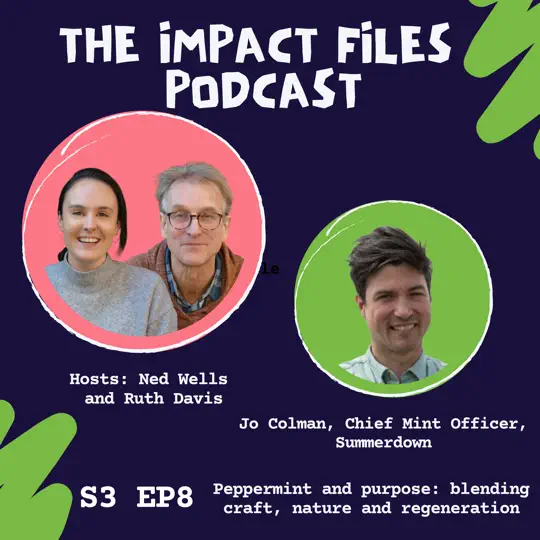
Ned Wells: Welcome to The Impact Files podcast. And this week, Ruth and I are joined by Jo Colman, Chief Mint Officer at Summerdown.
Ruth Davis: Hi Jo, welcome to the podcast. Great to have you here.
Jo Colman: Thanks, Ned. Thanks, Ruth. Really good to be joining you.
Ned Wells: Jo, it’s really nice to have you here. Let’s start with an introduction to yourself and Summerdown, and the work that you’re doing.
Jo Colman: Yeah, of course. So I’m Jo from Summerdown. We’re the Peppermint People. We’re a farm based in north Hampshire, where we are growing, harvesting and distilling our world-famous Black Mitcham peppermint, which we’ve been doing for over 30 years, and turning that into a range of chocolates and teas and treats.
But also, as a farm, we get the great honour of welcoming people, whether it’s to come for a quick walk around, to come for an event, or to come and stay in one of our luxury shepherd’s huts over the weekend.
And my role is to help guide the business in all areas, so I tend to think of myself as a general dogsbody more than anything else.
Ned Wells: Fantastic. So how much land do you have under cultivation for mint?
Jo Colman: We’ve got around 100 acres of our farm growing peppermint at the moment, which constantly changes year on year, as we cultivate more mint, but then we have the constant challenge of weeds taking some of our fields. So it’s a movable feast, but it’s around 100 acres.
Ned Wells: And you were telling me, when we spoke a few weeks ago, that the mint side of your business is part of a larger farm. Was it your father that set up the mint side of things originally?
Jo Colman: It was my grandfather. I’m the fourth generation of my family at this farm, but it was my grandfather who saw the way the wind was blowing for British agriculture, and started diversifying 30-odd years ago. He stumbled across the story of Black Mitcham peppermint, which was once grown widely in this country, particularly in Mitcham, in Surrey, which was where the mint was first developed, by a rose grower who was trying to keep aphids away from his roses.
During the World Wars, pretty much all of the land under cultivation in the UK was put to more productive use, for potatoes and wheat and onions to feed the nation. And that meant that Black Mitcham all but disappeared from this country. My grandfather, with our Master of Mint, Ian, learned this story, and actually then went to America, where some farmers had started growing Black Mitcham, and took some cuttings. He brought them back to our farm here in Hampshire and started with a small plot about the size of half a tennis court. And from that planting we did 30-odd years ago, we’ve taken cuttings and expanded the acreage to the 100 acres we’re now growing, all directly related back to those very first cuttings and plantings.
Ned Wells: And was this almost a retirement project for him, after he’d finished…
Jo Colman: Well, yes. It was more, I think, to save him from the boredom of retirement. My grandfather had extraordinary energy and business vision, and he wanted to create something truly remarkable and distinctive in flavour. My family’s previous business was Colman’s Mustard, and he was the last member of our family to be involved in that business. So after he retired from the mustard business, there was that love of a piercing, strong flavour, and so we settled on peppermint.
Ned Wells: Oh, wow. So, fast forward, and you’re now running the business. What sort of size is the business now? How would you describe it in terms of scale?
Jo Colman: I’d say we’re still very much a small business. But I think there is, for me, a focus on what the right size is, versus a comparative size. So all of our work now is on developing Summerdown to reach its right-sizeness. We’re a small operation, a small team – just under 10.
Ned Wells: Okay.
Jo Colman: But we like to think we’ve got a rather outsized impact. Our products are sold across the world, from San Francisco to Sydney, and pretty much everywhere in between. And we’re hopefully found in every farm shop close to anyone who’s listening to the podcast across the UK. So whilst we might still be quite small, we try to have an outsized impact, both in our sales and in the wider environment and economy.
Ned Wells: And you were telling me, when we spoke previously, that you’re selling to brands like Liberty and Selfridges, and to Cook.
Jo Colman: That’s right. We’ve got some phenomenal customers that we’re really proud to work alongside. Like I said, we’ve got Selfridges and Liberty in London, and we work nationally with Cook, the frozen food team, who are one of my business icons. I think what they do and how they do it is phenomenal. And we get to work with around 1,000 local, independent retailers up and down the UK: farm shops and delis, food halls and garden centres, local convenience stores, community shops. So we’re not in any of the major retailers and multiples. We’ve really tried to focus our growth and our development on working with other independent businesses. For what we do and what we provide, I feel the way to give real value, both in terms of the cost on the shelf and to their customers, is through working with fantastic local businesses.
Ned Wells: And you were saying that you have a range of peppermint chocolates, teas, body and bath products, all focused on this amazing single-estate peppermint.
Jo Colman: That’s right. Our range is powered by our peppermint, and it’s at the heart of everything that we make. Summerdown is not a brand stamped out in a marketing lab. We’re a place – part of the farm is called Summerdown. That’s why we are who we are. And we are trying to transport our customers, through the product, back to our farm. We want them to open a box of chocolate mints, pour a cup of our peppermint tea, enjoy our diffuser and candle, or our hand wash, and feel as if they are stood in the middle of one of our mint fields.
And that comes with real beauty, but also, we hope, a little bit of wild ruggedness. Without wildness running through the fields, we wouldn’t have a diverse farm, and without a diverse farm, we wouldn’t see life coming. That’s what is so exciting about this time of year, in early spring. You really start to see the farm coming alive. I saw my first swallow yesterday.
Ned Wells: Aww.
Jo Colman: Flying in. That is always, for me, the sign that spring has come, because the swallows have arrived. And the birdsong that now fills the air is extraordinary.
Ned Wells: Fantastic. And I should just say for our listeners that we’re recording this on the 15th of April, so, yes, it really is light and lovely outside. You mentioned that you want to grow the business to the right size. What does that mean, then?
Jo Colman: So I see growth like an oak tree. We’ve got some magnificent oaks here, some that are hundreds of years old. The life of an oak tree has years – hundreds of years – of expansive growth. It starts as a small acorn, and we get to see it grow. There’s an acorn planted in our old cricket pitch, which is where our shepherd’s huts are now. It’s an acorn that fell off a tree that we had to fell, because it was coming to the end of its life. That acorn was planted, and it’s now grown into a tiny little sapling. And over the next 100, 200 years, it’s going to get bigger and bigger and bigger. It’s going to mean that we’re eventually going to have to move a gate and a path to accommodate its expansive growth. I will be telling my sons, “We need to protect this oak tree.”
But then there comes a point where the oak has reached its mature size, and it does not expand any longer. But every year it’s still alive, still growing, in a non-expansive but regenerative way. It’s a home for fauna and flora. It is abundant with life. Just because it’s not getting bigger doesn’t mean it’s not alive and growing and full of life.
And I think that’s true for all businesses. We often underestimate that there is a right size for every company. And trying to push past that right size is when you can’t help but fall into extractive processes, where you are taking from someone else to perpetuate your growth. I believe strongly that there is a way of hitting your right size and still growing – just not in an expansive way, but in a regenerative way.
Ned Wells: And do you have a sense of how you will know when you reach that right size?
Jo Colman: I think having clear sustainability goals and targets is one of the ways. It’s being really clear about who you’re serving. One of the core parts of Summerdown is serving with intention: we put, at the heart of everything we do, a real desire to serve the customer, but also to serve our farm and our environment, and to balance those two. If, to serve one, you have to extract from the other, that’s when you know you’re moving into dangerous territory.
There’s no clear definition that can be applied universally, but I think the more connected you are to your customers, and the more connected you are to the place that you’re working from, the clearer and easier it becomes. I think I’m enormously blessed that we’re doing this from a farm. But one of the challenges of the modern economy is that we have extracted ourselves so much from the day-to-day reality of our environment…
Ned Wells: Yeah.
Jo Colman: …that we’ve lost touch with how to right-size, because we’re not connected to the environment that we are directly impacting.
Ned Wells: So interesting. Ruth, over to you. That’s fascinating.
Ruth Davis: Yeah, that feeds really nicely into our next discussion point, actually. Obviously, being a farm, and I suppose within the agricultural sector as well, you have this intrinsic link to nature, and just talking to you, you can see that it clearly runs through everything that you do. So could you talk us a little bit through the business case for sustainability, and how you’re building a business that, as you say, is going to last long into the future, but in a responsible and regenerative way?
Jo Colman: Yeah. I suppose, Ruth, it was slightly by accident and slightly on purpose that we’ve got to this point. I didn’t know exactly how it was going to look, but I knew that as we continued to build out our strategy for the business, if we didn’t put sustainability first, chronologically, it was always going to get knocked to the back of the queue. So we worked with some fantastic people on developing our sustainability strategy a couple of years ago, and I really wanted to start with that before we built out the next cycle of our business.
So we started there. We got really clear on what impact we can actually have as a business, what’s in our control and what’s not in our control, and what it looks like to serve people and serve the land in equal measure. And from that, we then set the guardrails. So we knew that when we built this really exciting growth plan for the next 5 years, it was in conversation with, and bounded by, our desire to have a positive impact: through cutting carbon, through connecting people with place, through connecting people with nature, and through cultivating natural stewardship, which is really our land management.
And I see those guardrails as really useful for growth. They’re not an impingement. We thrive as people when we’ve got a bit of restriction. If it’s just total free play, where do you even start? But knowing that we can’t move into a certain area, because it goes against our core values and against our sustainability strategy, means it’s just off the table, and we can really focus on how we grow.
It leads to scary points. You do the classic growth map of what has maximum impact and what’s easiest, and you’re hoping you’ve got a few ideas in the top right that are big impact but relatively easy. We had nothing in the top right. It was all hard work. Every impact would be hard work. But it’s worth it, because we’re building a business to endure, not to exit. I’m not looking at this as a sale opportunity in 5 years’ time. This is my home, this is my family’s home, and we want to be looking after it for the next 50 years, for the next 100 years.
Ruth Davis: That’s great. And do you think it’s your personal connection to the land? Is that where this comes from? Because you mentioned you wanted to have sustainability there from the start. I know that’s a bit of an off-piste question, so sorry for putting you on the spot.
Jo Colman: No, no, no.
Ruth Davis: But it’s interesting to know about the personal motivation behind these things, because obviously you’re a B Corp as well, and you have a really solid sustainability strategy, all these partnerships, and you talked about nature recovery. So it’d just be really interesting to know if you can think of a moment when, in your head, you were like, “Aha, this is how I want to do this.”
Jo Colman: Yeah, a number. I think it’s the joy of driving people around when they visit the farm. I got to do it on Friday with one of our long-term American customers, taking him around and showing him the farm for the first time. People come here expecting… I don’t know what. Something. But they never come expecting what they then receive.
You walk around and you see that we’ve got 75 kilometres of hedgerow. It means that, apart from those dreary winter months, the farm is buzzing with life. In the autumn, there are birds in the hedgerow. In the summer, you’ve got the bugs starting to come alive. You’ve got the ground-nesting birds starting to return. You’ve got this life, singing. It’s viscerally loud. You walk through the fields, and the scent of the wildflowers, the grasses, some weeds, and the peppermint as it’s starting to come through is uplifting. You get that sweet spring smell that you find here in this country.
And then come the summer, the heat is literally evaporating the menthol in the peppermint plant, so it smells like you’re walking through a boiled sweet. And all of this is happening in the context of wildness everywhere else: bird life, wildflowers, colours popping off. It’s this assault on the senses, in the most wonderful way, that you can’t help but stop and be impressed by. People come here thinking they might see a chocolate factory, or some industrial estate. And we’re not. We are first and foremost a farm.
I think the reason it’s personal to me is partly, yes, that this is my family’s home. It’s where I’ve grown up and felt so at home. But I think, fundamentally, it’s more than that. I know that we come alive as people when we’re connected to a place. And we get to host people here, because this is our home. We get to invite them in, and show them what placeness looks like, so that they might go and take that with them.
And that’s how we’ve tried to develop our products: so that each one is an experience that reminds you of what this place is. The ultimate Summerdown experience is coming to stay and experiencing it. But you can have that experience in a little way by trying our products, whether you’re at home or abroad. We want to imbue every product with that experience, so that people sense that placeness. Peppermint is the vehicle, but it’s about the place, and being able to transform people’s imagination by experiencing it.
Ruth Davis: That’s amazing. I definitely need to come and visit, for sure.
Jo Colman: Absolutely, yeah.
Ruth Davis: Over to you, Ned.
Ned Wells: I was thinking exactly the same. You’ve painted a really lovely picture of where you are, the place, and your connection to the place, which is fascinating. I’m definitely going to have to come down. I’m trying to join some of the dots in my head. So you’ve got this farm, you’ve got this fantastic natural environment in which you’re working. You’ve got this amazing product. You’re passionately serious about the longer-term sustainability and value of what you’re doing. And you’ve got these amazing clients, like farm shops all over the country, and Selfridges, Cook and Liberty. And you’ve got 10 of you sitting in between. So how does that work, Jo? Who’s doing what? Talk to me about the business, and how you’ve organised it to achieve what you’re doing.
Jo Colman: Fundamentally, it’s an absolutely phenomenal team of extraordinary and passionate people, who I just love to work with. And we have pretty decent staff retention. I won’t name names, but a number of the team are well over 60 and are still working here. People often come and stay until retirement, because it is such a special place to work.
And I think, at its heart, it’s why I love business: the dignity of work is an extraordinary thing. You line somebody up in a role that draws the very best out of them, in a context that encourages a view that you should be achieving something great – that high-performance culture – without it becoming a toxic expectation on them. It’s sometimes a tough road to travel, but we do okay here at Summerdown, because at its heart we can only travel as fast as the team can go. So it’s beholden on me to try and create a culture that enables that.
We’ve got some amazing talent that we’re able to work with, because we have a flexible approach to work. We’ve had a number of people join us when they’re just coming back from maternity leave, or having to juggle family and work priorities. As a company, we’ve always taken a very proactively flexible approach, which means we actually get phenomenal results from the team, because it works for them, and so it’s sustainable. And I think we can sometimes miss the internal team element when we’re talking about sustainability. Sustainability is only as powerful as how long you can keep it going.
Ned Wells: So talk to me about the job roles. I know you’ve got two or three folks working in marketing…
Jo Colman: We’ve got two people working in marketing, both part-time. We’ve got three of us working in sales. I say I work in sales, but I’m all over the place. We’ve recently been joined by our head of operations. Then we’ve got a wonderful lady called Angie, who is our powerhouse for all of our online and shop orders. Then we’ve got our Master of Mint, Ian, who’s working part-time for us now. He worked with my grandfather for 40 years, and is still working with us. And then we’ve got our welcome manager, Laura, who is responsible for all of the activity that happens on site.
Ned Wells: So what time of year are you harvesting?
Jo Colman: And that’s the Summerdown brand team. The farm team is separate. So we harvest our peppermint in mid to late July, early August. We’re also growing chamomile, which is harvested in late May, and our lavender, which is in late June, early July. That’s along with our cereal rotation of wheat and barley and oats, and all of our oats go through a fantastic farm partnership agreement with Jordans, the cereal company. So we grow oats for Jordans, which means that – and this makes me very happy – we have to put at least 10% of our land aside for nature recovery. We have to have wildflower meadows around the majority of our fields. And, as it so happens, we go further than most, with all the hedgerows and our extensive woodlands, to create a balanced ecosystem.
Ruth Davis: This is so interesting, and it’s actually the perfect time to ask a question I was thinking about. Some of your clients and customers – you’ve got Jude’s Ice Cream and Cook – are obviously the big B Corps out there. You mentioned Jordans, and this amazing initiative where they’re encouraging their supply chain to do things for nature. I was wondering about your role in this, and whether all your clients align with your values. Do you do any work with your suppliers on educating them about the role of biodiversity when it comes to agriculture, or any wider values work with your partners?
Jo Colman: Great question. I’m sure we could do more. I suppose I take the view that it’s much better to live out and practise what we believe to be true. As humans, we’re storied creatures. We thrive when we have a story to tell, and a story to live into.
I’ve got lots of facts. I can tell you exactly how many trees we have, how many kilometres of hedgerows, the number of wildflowers we’ve got, how much carbon we’ve sequestered and how much we’ve cut. We’ve got numbers that we can share. Fundamentally, they are only indicators of a deeper reality. And the reality that we know to be true, because we’re living it, is that having a diverse, wild ecosystem, where you get to invite people to come in and participate in cultivating something that is beautiful, creates not only a thriving environment, but also a great place to work, a great place to visit, and great products. We’ve got awards coming out of our ears for everything that we make. But at its heart, it’s because we know that if we can connect people with place, both will thrive.
And that then drives all of our decision-making. It might be something we can go into in a bit more detail later on, but we recently had a pretty big decision to make that was forced on us by, very sadly, one of our longest-term partners. We believe in long-term partnerships at Summerdown. We’d been working with them for 20 years. Very sadly, they went into administration, and so we’ve had to move the majority of our production from that manufacturer to another manufacturer we’d been working with for a number of years. They’re wonderful, but it forced a change.
Now, in that change, we got to a point where we could actually make a little bit more money, because we could save on some margin by purchasing, effectively, a commodity chocolate. It was good. It was Fairtrade, it worked well with our manufacturing partner, and our customers wouldn’t have noticed a difference. But at the same time, because of the growth we’ve seen at Summerdown, we had the opportunity to go out and find a single-origin chocolate supplier. And we found one, and it tastes amazing. We’ve always worked at a high quality, and this is even higher quality – which is always hard to say when you talk about being really high quality and then you find something even better – but we have, and it’s wonderful.
But it meant that we were going to make a lot less money next year on our margin. If we didn’t have a strong story driving our belief in what we’re trying to build, the decision would have been pretty one-dimensional: we make more money with this option, so we must go this way. But it’s not about the money, or about something short-term. It’s about long-term change: serving our customers by giving them the very best we possibly can, and working with fantastic suppliers.
And this is where our sustainability strategy and our values come in: our values around working with our suppliers with uncommon transparency and grace, and our sustainability strategy of having 100% sustainably sourced ingredients by 2035. One of the biggest areas for us was chocolate. And in this move, I knew we were able to move two-thirds of our entire chocolate volume over to this single-origin chocolate, from another B Corp, which has a lower carbon footprint than the Fairtrade commodity chocolate.
In the moment, it felt hard. But looking back, I’m kind of ashamed it was hard, because it was a no-brainer. It just works. We’re giving our customers something that’s going to taste amazing. We’re giving our supply chain a massive boost. And we’re creating something that builds into this story of connecting people with place, because we know they will thrive.
Ruth Davis: Yeah, absolutely. I don’t think the power that has to connect people with nature can be underestimated. And we hear it a lot, actually, don’t we, Ned, with our other podcast guests? They usually have a moment when they’ve been somewhere amazing in the world, and it suddenly hits them. So, in a way, that could be your biggest influence.
Jo Colman: Well, I’d love that to be true. So do come to one of our farm tours. We do a pop-up supper club every summer, and we’ve got these magnificent shepherd’s huts. I try very hard not to become dulled to just how extraordinary this farm is. We’re blessed enough to have some of the rarest wildflowers in Europe growing on our farm. We’ve got some ground-nesting stone curlews – a few breeding pairs – which, again, are on the red list as a very rare ground-nesting bird in the UK now, particularly down here in the south. But because of the way that we’re managing the land, we’re seeing these often rare creatures, fauna and flora, thriving. And it’s an extraordinary privilege to do that whilst trying to create a business that’s able to serve our customers with an extraordinary experience and extraordinary products.
Ned Wells: I wanted to rewind a little bit, and just ask you to describe the slightly bigger picture. You said that the Summerdown brand team is around 10 people, and I wanted to join the dots between your harvesting of the mint and your other crops at particular times of year. Is the product then sent off to a partner who’s doing the processing for you? And then there must be some packaging and some storage and all that sort of stuff. So just talk us through that side of things.
Jo Colman: Yeah. We’re oddly vertically integrated. Our farm business, as it were, which sits alongside the brand, harvests the mint, and the mint is brought from the fields into our on-site distillation space. Don’t think vodka or gin distillery – it’s hot steam distillation. We’ve got this old 1980s boiler that we got from Basingstoke Hospital about 30 years ago…
Ned Wells: Oh, cool.
Jo Colman: …that’s called Thomas, and has been lovingly kept going by our Master of Mint, Ian, and our herb farmer, Rosie.
We take the mint from the field using what’s called a forage harvester. Everyone knows a combine harvester, with its big, wide front. A forage harvester has a much smaller harvesting bit at the front of the tractor, which goes through the mint, chops it up, and spits it into a trailer we’re pulling on the back of the tractor. That trailer is a mobile distillation unit. It comes into the distillery and gets sealed up, and then the boiler is connected through a manifold, and it pumps really hot, wet steam through the plant. That does two things. It breaks down the oil capsules in the peppermint and vaporises the oil, and the vapour then rises and is transported into the cooling towers, and then into our storage for the peppermint. So that’s all done on site to get the peppermint oil.
For the tea leaf, we pick it with a very smart machine that we got recently, and it goes to a neighbouring farm that, very conveniently, has a fantastic leaf-drying facility. He’s a good friend of ours, and he dries the mint leaf for us, which then goes into our range of teas.
We know what we’re good at. We’re really good at farming, and we’re pretty good at telling our story and getting people to buy our stuff. What we’re not good at is manufacturing. That’s not our area of expertise. So we work with other UK manufacturers to produce for us. We don’t go abroad, and we buy everything we can from the UK, whether it’s packaging or manufacturing capacity. So we work with fantastic, often family, businesses in the UK to produce the soaps, the chocolates and the home products, and with people to bag up our teas. We send them the materials – the peppermint and the packaging – and they send back to us the finished goods.
Ned Wells: Right.
Jo Colman: But everything that we sell is sold from the farm. We don’t work with any third-party logistics companies. We want to be as in control of our whole process as possible. We know that if we have our hands on it, we can control the quality, and we can work as closely as possible with the customer.
Ned Wells: So you’re then doing the storage and the distribution once the product comes back to you. Cool. And then you’ve got your brand team, who are, as you say, responsible for the marketing and the sales and all that side of things. Yeah, right, I understand. Fantastic. Ruth, over to you.
Ruth Davis: Yeah. So you mentioned the chocolate supplier as a really good illustration of a decision that shows the purpose and profit seesaw, I suppose. Do you have any other examples of things that have gone really well, or maybe other challenges that you’ve worked through when it comes to that question?
Jo Colman: Yeah. The chocolate one we’re really excited about, because the first production lands in a week and a half’s time, so I can’t wait to get the first production run into my hands.
I suppose, a lot of the time, when we’re working with our supply partners, because we value long-term relationships, we’ve been able to find wins for both of us, whether it’s a slight tweak to a recipe or a deeper dive into the packaging. We’ve been able to make some marginal wins.
Then there are times when it’s just not been possible. Like most FMCG brands, plastic is the big challenge, and we’ve worked really hard to try and remove plastic from our range. We tried to say we’d get rid of it entirely. After lots of investigation, and quite a bit of time researching and working with some research partners on what the alternatives are, it just isn’t possible to move away from plastic whilst also putting something on a shelf that’s food-safe, isn’t going to damage anyone’s health, is sellable, and isn’t too expensive. We hope one day to be able to do more. We’ve developed a prototype of a fully card-based holder for a lot of our chocolate range, but it would add £2 to the price of the product, and that’s so hard.
So our fallback is 100% recycled material. With our range of soaps and lotions, we’re able to use 100% recycled material for the bottle. We did some research with our customers – we looked at aluminium, we looked at glass, and we looked at plastic – and the feedback we got was that they wanted something beautiful and durable. And the majority feedback was that if it’s recycled and recyclable, they’d be very happy with that bottle.
The big challenge is the lid. Most pumps come with a little metal spring, and are often two or three different types of plastic, so your local recycling plant just can’t manage those pumps, and they have to go into general waste and landfill. Our pumps are not 100% recycled material, but they are 100% a single type of plastic, and so are fully recyclable. So where we can’t remove plastic, we’ve leant into the circular economy, and tried to get things that, so long as everybody plays their part – and that includes our customers, local authorities and the government – mean we’re contributing to a closed circular system, where we’re not having to extract anything more from the ground to create the products, because there’s plenty in existence already.
And then we’ve had epiphany moments – or at least, epiphany is a polite way of saying, “Oh gosh, what we hoped would be true just isn’t true.” Because of the woodland that we’ve got on the farm, we’re in a really good position. We are net neutral as a business. In fact, we’re net negative, from a whole-ecosystem point of view.
Ned Wells: Hmm.
Jo Colman: And we’re working with a fantastic partner on how we can certify regenerative carbon credits that are rooted in really rigorous testing of soil carbon and tree carbon capture. So, as a business, we could say, “Well, we’re net negative. Our job is done.” But that’s only because of the inheritance I’ve got from a great-grandfather, a grandfather and a father, who have all invested in woodland planting.
So we aimed to cut our overall carbon output as a business. But after benchmarking and testing, and working with a carbon accounting firm, we realised we can’t grow Summerdown and cut our carbon from our benchmark, because that would make our expansive growth impossible, and we’re not yet at our right size. So a much more honest approach is to say: we’re going to continue to be net zero, because of the insetting we’re doing on the farm. But the project I’ve started this year, which is probably a two- or three-year project to do well, is creating a delta.
The chocolate is a great example. We could have chosen a commodity chocolate that has a pretty high carbon score. We’ve chosen a single-origin, more artisan chocolate that, working with our partners, we know has a certified lower carbon impact than the commodity chocolate available. And we map those decisions across the whole piece. I’m looking at the delta between our carbon output and what it would have been if we’d made the most, quote-unquote, sensible business decision. And when we say sensible business decision, we mean maximising profits, maximising extractiveness, and taking as much of the pie for oneself as possible.
We want to have a regenerative approach, which is: I sacrifice, we win. I’m going to sacrifice my margin. I’m going to sacrifice the opportunity for a win today at your expense. I’m going to make that sacrifice, because I know that in years 2, 3, 4, and in year 50, we’re all winning. For me, regenerative business is a step ahead of ethical, because ethical is win-win. Regenerative is actively seeking to take the first step.
So, in this instance, I think the delta from these micro-decisions will be pretty large over 5-10 years. Sometimes it’ll be very small, sometimes it could be quite big. The business’s carbon score will be much, much lower than it would have been if we’d taken the quote-unquote standard business approach instead of the regenerative one. And I think it’s a much more honest, much more real, and much more interesting approach to take to carbon accounting, and more broadly, to a truly sustainable approach to business.
Ned Wells: I wanted to change tack slightly, if I may. This is so fascinating, but we’re slightly short on time. One quick question before we move on to marketing: why does a single-origin chocolate, as a supply, score lower on carbon than a cheaper chocolate?
Jo Colman: Really good question, and I don’t have all the answers. But the main reason is that we’re working with a specific company that also prioritises sustainability in its core operations. Just because it’s from one region doesn’t automatically make it better. It’s working with a business with a similar mindset to us, prioritising good farming practice and environmental decisions. That’s why. It’s all the decisions that sit below it. It’s not that, because it’s from Colombia, it has a better carbon score than chocolate from West Africa. It’s more that, coming from Colombia, there’s no slavery in the supply chain. It’s with farming families and estates that have prioritised sustainable growing practices over generations, rather than quick wins, and invested in their families and their education, so that it produces better results over the long term.
Ned Wells: So you’re thinking really carefully about your supply chain.
Jo Colman: Yeah.
Ned Wells: Cool. Okey-dokey. That was really interesting. I wanted to ask you about media, marketing and communications, and your view on the role of that in helping you to run the business in the way that you want.
Jo Colman: Yeah. As I said earlier, we’re storied creatures. Really good marketing isn’t spin. It’s not trying to create illusions. It’s telling stories with purpose and with clarity. It’s helping people really understand what is driving the business that they’re choosing to invest their money in.
And I take very seriously the responsibility we have in producing fantastic products that we know are often used as gifts. A lot of the time, people come to our website and buy something, and it goes with a note: “With lots of love”, “Happy birthday”, or “Was thinking of you”. That responsibility sits, in a nice way, quite heavily on us. We want to be creating things that bring utter delight to those who are buying for themselves or for other people. And that delight can only come if we’re telling our story really well.
The team we’ve got in our marketing – our two Hannahs – are extraordinarily talented at it, and a joy to work with as well, which helps. They think really clearly about what we’re actually trying to say in this moment. And I’ve set some fairly frustrating, but I think fruitful, barriers around how we operate with social media, and particularly with paid media. We’re doing virtually no paid media at the moment, because I realised we were just renting eyeballs, and it wasn’t genuinely having an impact on our customers. I want to put as much of our marketing time as possible into telling our story with intention. So, for us, the newsletter is a really powerful vehicle that we’ve been investing in over the last few years.
We’re working on a principle at the moment: we want to get really good at telling our story. Only once we feel really confident in the story we’re telling, which I feel like we are now, do we create some really great content. And that’s content in its true meaning, rather than the slightly cheap social media content approach, which is here today, gone tomorrow. It’s not single-use plastic, but it’s the digital equivalent. It doesn’t have any staying power.
And then we can think about distribution. And paid media, I know, has a role. It pains me to say it, and my team will probably be laughing at this, because I personally have some quite strong convictions about these companies and the way they operate. But I know it’s a phenomenally powerful way of reaching new people. And I’m sure that if we can tell our story well, and we’ve got great, lasting content that conveys that message, we can distribute it in a way that connects – that isn’t renting eyeballs, but is grabbing the attention of people who’ve never heard of us before. We’re very small. I’m shocked when people say, “Oh, I’ve heard of Summerdown.” Genuinely, I think that is so exciting, but it’s also slightly shocking, which probably is a bad admission to make on a public podcast.
Ned Wells: But I do agree that if these are the tools you’re logically obliged to use, then at least having a really robust, genuine, honest story to tell with them is important. Are there any interesting developments coming up in the business in the next year or so that you could share?
Jo Colman: Yeah, lots. We’ve got some fun new product development work, now that we’ve got our hands on this new single-origin chocolate – ideas for how to make the most of it over the next couple of years.
We’ve just finished the work on our pavilion. Like I said, our shepherd’s huts are on our old cricket pitch, which, very sadly, wasn’t used for a number of years after the previous cricket team stopped using it. So we had this whole pavilion sitting in the fields, not doing very much. We’ve redeveloped it to add to our luxury offering. So now we’re going to be able to host people not only in our huts but also in the pavilion, and they can come and actually take the whole site for special occasions. Or we can host teams who are looking for an away day, or somewhere to come and have team training. So that’s on the welcome side.
We’ve got an expanded supper club, which we tested last year and which went really well. We’ve now got two nights, working with a phenomenal local chef and her catering team, putting on a supper next to our peppermint field. So you can come and enjoy a delicious meal whilst looking out over the peppermint. I can’t promise it, but last year there was beautiful sunshine, deer roamed through the fields, and owls came to visit. So it’s a really immersive experience. And then, hopefully, lots of exciting tours and events that we’re putting on over the summer as well.
Ned Wells: Fantastic. Where do you hope your sector will be in maybe 10 years’ time?
Jo Colman: For me, it’s a hard question to answer, because we play in so many different spaces: the rural economy, the FMCG space, experiences. So I’ll say where I hope we as a business are in 10 years’ time. I tend to think in 50-year timeframes, but in 10 years, I hope we’re really modelling what it looks like to be a business that can balance the needs of land and people in equal measure. We’ve taken a definition from a charity we’ve partnered with in the past: that high-quality land balances the needs of people and land in equal measure.
Summerdown is never going to be as big as Cadbury’s. I don’t want it to be as big as Cadbury’s. We’re never going to have as many people staying as the Hilton. I don’t want to be the Hilton. For us, success looks like being really confident in offering what we do in a way that brings genuine joy and delight to those who interact with it. And we know that we give that joy and delight by creating a space that is a thriving ecosystem. So I hope that in 10 years’ time, we’re doing that: growing food that feeds people, in a way that brings total joy and delight, and in a way that encourages the whole environment to come alive.
Ned Wells: Fantastic. And finally, one piece of advice for businesses that are pursuing sustainability alongside financial objectives.
Jo Colman: The closer you can put your decisions to the place you are in, the more achievable, the more impactful and the more real those choices will be. The modern economy has made us pretend that we can exist separately from the planet, but there is nothing in existence that does not start off in the land, in the ground.
Whether your business is a service-based company or a product-based company, the ground is where it starts. So it’s figuring out what that ground is. It might be where your team spend their time. It might be the ground where the minerals are extracted to create your service. It might be, as for a farm, where the food comes from. But it’s figuring out where that place is, and making your sustainability strategy coalesce around protecting it and pursuing a thriving of that place. Because that will strengthen your supply chain, it will protect your long-term future, and you will be directly investing in the thing that will ensure your business can continue.
You may not see a payback in a 1, 2 or 3-year time window. But I think within 4 or 5 years, you will start seeing a payback, and that payback will only compound and grow over time. But if you forget about the place, I think you lose sight of what true sustainability and true success look like.
Ned Wells: And I think that gives me an almost penny-dropping moment, Jo, as to why you invite people to the farm, and you’ve got the shepherd’s huts, and you’re doing tours, and you’re trying to get people connected. Obviously you have to sell online, all over the world, but actually you’re really inviting people to come, be welcomed, and value where it’s all happening. Fantastic. Finally, how can people find out more about you and about Summerdown?
Jo Colman: Well, come and visit us. Go to summerdown.com and see the tours we’re running and the events we’re running. Come and stay in our shepherd’s huts and our new pavilion. Or find a local stockist, where you can support a local, independently owned company. We know from research that every pound you spend in an independent company has a £3 impact on the local economy, whereas if you go to a multiple retailer, every pound has about a 30 pence impact on the local economy. So go and find a local independent retailer. They will have Summerdown. And if they don’t, let me know, and very soon they will, because we have a pretty high hit rate. When we get in touch with a shop, they often like to stock us, because what we make is exceptional. And I can’t wait for people to try it for the first time.
Ned Wells: Fantastic. What a lovely note to finish on. Jo, thank you so much. That was brilliant.
Jo Colman: Thanks, Ned. Thanks, Ruth.
Ruth Davis: Thanks, Jo. Bye!